Showing posts with label American Ex-Pat in France. Show all posts
Showing posts with label American Ex-Pat in France. Show all posts
Thursday, May 11, 2017
Q&A: Do the French Ever Work/Do They Hate Work/Are They Lazy? (Given the 35 Hour Week, Holidays, Vacation . . .)
In one moment, you will be redirected to the new blog.:-)

Saturday, May 6, 2017
Biarritz and the Hotel Star System in France
In one moment, you will be redirected to the new blog.:-)
Thursday, April 27, 2017
Making My Own Chocolate, SNCF Weekend Card & Finding Good Eats in Paris
In one moment, you will be redirected to the new blog.:-)
Thursday, April 20, 2017
Les Sables d'Olonne - Bookends on a Winter a of Transition
Welcome to my 100th post!
Les Sables d'Olonne. I was disappointed that I'd made the choice to return to a place I've already been (after all, there's A LOT of France still to see), but on my second day walking along the beach, I realized that my two trips here were the perfect bookends on a challenging winter of adjustment.

When I was here last, I still felt I had something to prove. To whom, I don't know, but I felt that I had to prove this was the right decision, that I didn't just move here on a whim. I had to make friends, especially French ones . . . maybe find a boyfriend too in order to really assimilate. I had to sink down roots, become fluent in the language, figure it all out.
I no longer feel that way. Moving here has mostly been a great adventure. Even if I only stay a year, two years, it wasn't a mistake to come - it was a dream for 10 years that I finally fulfilled.
 And life in France shares some things with life in the US - it's still life and can be just as unexpected. The person I thought I'd be great friends with divorced and moved away. A friendship that I thought would be brief, due to a large age difference, has instead become a solid friendship that is going on 6 months now. I just met his parents and he announced to them that he hopes to do his foreign apprenticeship near my hometown next summer, even though it means switching from the food division to hard cider.
I understand more of the common phrases said around me as well. "C'est bon" - it's good. "Ce pas grave" - it's no big deal, it's not important. "Le même" - the same. "Ce comme ça" - it's like that. I understood enough to survive dinner with four French people, who don't speak much English, without needing constant help. Even if all of the details weren't clear, I could pick up talk about the elections, the migrant camp burning down and them asking him if he had difficulty communicating with me ("no"). It helped to learn he'd done very poorly in English until recently, meaning he became fluent as a adult, so surely I can too!
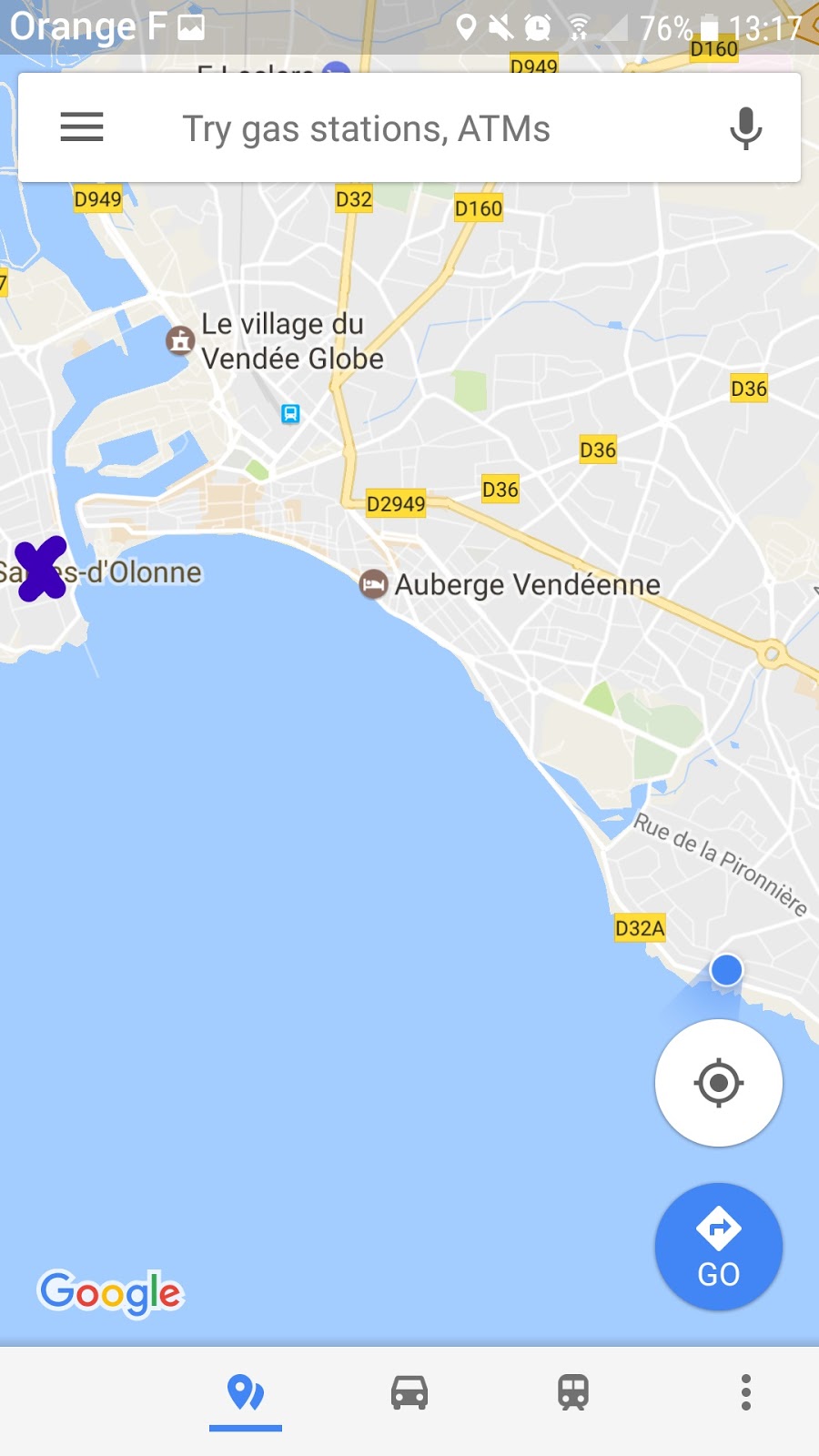
 As for my actual weekend, it started with a bit of a disappointment. Even though the ad stated where the flat was, I didn't know the town and so I looked at the map on the site. The blue "x" represents where the map showed the property . . . the blue dot is where it actually is. In typical fashion, I made the best of it and set out on the lovely path that continued all the way into Les Sables d'Olonne. The below photo gives a visual of the distance - it's the city wrapping around the curve!
 Even though I prefer to walk on a sandy beach, the rocky shorelines are often visually prettier and make for better photos, so I really did enjoy the walk in every day (less the walk back though)!
 Saturday was actually the best day on the beach. There were surprisingly few people for it being a holiday weekend, so I walked for a while, then sat against the sea wall (there are lower sections and many people sit on or against them and read for a little bit. If you're looking for a nice coastal town with a lovely beach to just relax on, this is a great place for it! It also has the best boardwalk area of the towns I've seen - a nice broad pedestrian portion, designated bike lane (a full car lane split in two) and one lane for traffic, although this was closed off on Easter due to the high number of pedestrians.
 I don't find Les Sables d'Olonne to be one of the French towns with particular cultural or historic interest (I'm sure a French person could tell me all about why I'm wrong), so I've decided that my long weekends will be spent elsewhere in the future . . . but for a normal weekend getaway, this is still a place that I can imagine owning a "weekend flat!"

Les Sables d'Olonne. I was disappointed that I'd made the choice to return to a place I've already been (after all, there's A LOT of France still to see), but on my second day walking along the beach, I realized that my two trips here were the perfect bookends on a challenging winter of adjustment.

The neighboring town I stayed in
I no longer feel that way. Moving here has mostly been a great adventure. Even if I only stay a year, two years, it wasn't a mistake to come - it was a dream for 10 years that I finally fulfilled.

I understand more of the common phrases said around me as well. "C'est bon" - it's good. "Ce pas grave" - it's no big deal, it's not important. "Le même" - the same. "Ce comme ça" - it's like that. I understood enough to survive dinner with four French people, who don't speak much English, without needing constant help. Even if all of the details weren't clear, I could pick up talk about the elections, the migrant camp burning down and them asking him if he had difficulty communicating with me ("no"). It helped to learn he'd done very poorly in English until recently, meaning he became fluent as a adult, so surely I can too!


Thursday, April 13, 2017
Dealing with the Expat Blues
When you're living in a gorgeous country and you like most things about it, it can be difficult to admit or acknowledge when things simply aren't going well.
There are cultural differences between the US and France, but the ones that get you in trouble are the ones that aren't as obvious and you don't know about. The issue largely happens to me when the same behavior is assumed to have two completely different motivations in the two countries.

When these things happen, it's easy to miss home. Obviously, there can be misunderstandings that happen in your home country too, but not usually over things that are normal behavior in your country. The problem here is when you do something completely normal and somebody is upset about it because, well, it's not normal here.
My natural tendency is to gloss over these things. Usually, it's small and passing, plus what right do I have to complain? I'm "living the dream after all" and I moved here voluntarily. I have a good job, live in a nice (albeit old) home and have even managed to make some friends.
 There are still times when it seems like EVERYTHING is going wrong though. Such as:

While there is nothing major that went wrong, when it feels like many small things are going wrong due to cultural differences, language barriers, etc. it can be tempting to consider packing up and moving back. Just considering it put me in an even worse mood though.
Since I knew I wasn't ready to return to the US, it was time to deal with the "blues" head-on! Here's what worked for me:
 These are some of the same things that worked for me the last time - get some exercise, focus on the positive things about living in France, socialize with friends in both countries and cut myself (and the French) some slack when it comes to language and culture issues. If you're also an Expat who is having a low moment, I hope these same ideas may work for you!
There are cultural differences between the US and France, but the ones that get you in trouble are the ones that aren't as obvious and you don't know about. The issue largely happens to me when the same behavior is assumed to have two completely different motivations in the two countries.

Safely on the list of things that do NOT make me want to move - French food
My natural tendency is to gloss over these things. Usually, it's small and passing, plus what right do I have to complain? I'm "living the dream after all" and I moved here voluntarily. I have a good job, live in a nice (albeit old) home and have even managed to make some friends.

- My oral French lesson online made no sense, even though the written lessons are fairly easy. Am I *ever* going to understand spoken French well?
- My colleague seemed REALLY angry with me about . . . pastries?!?
- My friend had to cancel a trip with me after I'd already paid for a non-refundable hotel room.
- I couldn't figure out how to pay my first electric bill because my "account balance" online was apparently only the most recent bill and I'd thrown out the original payment slip. I received mail demanding payment, but still with no clear way to actually PAY.
- My very first brand-new car was custom ordered (this is normal here - you don't really find huge lots full of cars) and the former employee who submitted the order put the wrong color. I am now driving my custom BLACK car, not blue. Really a disappointment to have your first brand-new car not ordered correctly!

Ok, so it doesn't look that bad in black . . . black is considered a "distinguished" color here, so I suppose it works for a cadre
Since I knew I wasn't ready to return to the US, it was time to deal with the "blues" head-on! Here's what worked for me:
- I met up with a new French woman and practiced French. Considering that I spoke no French at the end of 2015 and have only had 21 hours of formal lessons, I focused on how much I have learned and can understand now.
- I spent time with French friends, which helped remind me of the many things that I love about living here (and about the future plans I've already made)
- I went for a nice long walk in my town. Over an hour of enjoying the sun and really looking at the various little houses, shops, gardens and other lovely things in the area helped! This is the source of the photos here!
- I spent time catching up with US friends also - strangely, it helps me feel more settled in my life here when I maintain my connections with the people I love back in the US
- Since I love seeing new places and learning about them, I looked at my list of places I'd like to travel to in Europe and neighboring areas. There are at least 3 years worth of countries that will be much easier and cheaper to see if I live here - that's good motivation to stay for me!
- I had a good conversation with my colleague about what was really going on - pesky cultural differences as it turned out. It's really easy to assume that "you did X, so it means Y" when it actually means Z because I'm American or because he's French. The same behavior cannot be assumed to have the same motivations or same meaning when you take it out of the cultural context. It's an interesting learning experience for sure.

Thursday, April 6, 2017
A Random Road Trip in France
I'm quickly learning that a real "plan" is perhaps not necessary in order to see beautiful things in France - you can just pick a random place and go.
In this case, my only plan was "let's do something" and Alexis took charge! He wanted a town that was new for both of us, so slightly south of La Rochelle, he made lunch reservations in Rochefort. While prices are a little steep near the coast, the lunch was excellent. I was jealous when his cake came out, but it turned out that my mascarpone was divine, absolutely divine!
We took a little walk around Rochefort, which I realized was the city where the Hermoine replica boat is. The Hermoine was originally sent by France to help the Americans in the American Revolution (for those who've forgotten, the French originally helped us win a war). A replica was built and it sailed to the US and back in 2015, but the ship remains in Rochefort and can be toured. There was no tour for us, but I have a lovely photo with it!
 After a brief walk around the town (and the purchase of two French books much more suitable for my current reading level), we decided that this wasn't ACTUALLY the beach, looked at the map, and decided that this tiny finger of land looked interesting to see. We didn't see the island out in the water (or paid no attention to it) until we arrived at the end and people were walking out onto a raised "road" across the tidal flats.
 When we first entered the town, I was surprised by the resemblance to other French coastal towns that I've seen - it reminded me a little of the outer portion of Biarritz (clearly, nothing like the main town there though). As you can see from the location of the blue dot on the map, after arriving in the town and going to the very end of the tip, we decided to head out to see the fort. The tide was out when we started, stranding this fisherman's hut far from the water! I had no idea what it even was, so having a Frenchie along was quite useful.
 Even though we were about halfway across when the tide clearly started coming in, we were on a mission to make it to the fort! Despite the fact that all of the people with oyster buckets were clearly headed in the other direction, Alexis was confident that we wouldn't get trapped, so I took his word for it and kept going (to be fair, we had cell service, so it couldn't be THAT difficult to get a boat out there if needed). It turns out, it's about a 30 minute walk out to the fort over a road that has disintegrated badly over the years; however, it's great exercise and lovely views all along the way.
 I haven't really tried just picking a random spot on the map before and going there, but it turned out to be a fun idea. I saw my first oyster farms, a random abandoned fort and the island had lovely views of the bridges from the coast out to the two big islands in the area . . . plus it was kind of cool to WALK out to a spot shown as an island in the middle of the ocean on a map. To get a feel for the distance, in the photo below that white dot is a van - look past it on the horizon and you can see the buildings where the car park is.
 And not a photo from the road trip, but rather just a typical Saturday afternoon in France from the day before. There are certain parts of living in France that are EXACTLY what you expect. The French cafe scene is one of those things! People really do just sit (even on the same side of the table), chat and just watch the world go by. Truly one of my favorite things about French culture!

In this case, my only plan was "let's do something" and Alexis took charge! He wanted a town that was new for both of us, so slightly south of La Rochelle, he made lunch reservations in Rochefort. While prices are a little steep near the coast, the lunch was excellent. I was jealous when his cake came out, but it turned out that my mascarpone was divine, absolutely divine!
We took a little walk around Rochefort, which I realized was the city where the Hermoine replica boat is. The Hermoine was originally sent by France to help the Americans in the American Revolution (for those who've forgotten, the French originally helped us win a war). A replica was built and it sailed to the US and back in 2015, but the ship remains in Rochefort and can be toured. There was no tour for us, but I have a lovely photo with it!


Thursday, March 16, 2017
French Banking vs. American Banking

- Online-Only Banks: They exist; however, they're not accessible for Americans. You can't submit the IRS-required proof of your social security number for FATCA, so this is a no-go.
- (No) Free Banking: There is no such thing as free banking in France, at least that I've been able to find. Sure, you might be able to get a basic account for free . . . with no bank card . . . and potentially no checks? So, if you can live strictly on cash payments and wire transfers, you're good to go. Otherwise, get used to paying a fee.
- Account Withdrawal Limits: There are limits on virtually everything that involves your bank card. If you didn't receive your PIN for TWO MONTHS like me, then have a lot of things to buy due to an International move, your card will simply stop working. There is also a limit on cash withdrawals. I could only guess at the other limits, but I don't seem to have hit them yet . . . you do begin to understand why people still pay for groceries and gas with CHECKS though. If you hit the limits, you then have to contact your personal banker to raise the limit.
- Personal Banker: Which brings me to the next item - you will have a personal banker. Mine seemed very nice and friendly at first, even helping me largely in English (which, considering the bank advertises itself as having English-speaking services, is not that surprising). Since then, he's been a total pain in my butt. Primarily, I suspect that it is not his fault, but all of these ridiculous rules that France seems to have . . . however, when I again couldn't use my card and requested an appointment to resolve the issue, no appointment was ever made. It was finally fixed, without the documentation I was told was MANDATORY, after I threatened to close my account if it wasn't resolved within 24 hours. My card is AGAIN not working consistently (and not at all for online purchases) and his response was completely unhelpful. He also ignores any communication I send in English . . . why advertise your bank as serving the needs of English-speakers if my banker will refuse to communicate in that language?
- Paperwork: You will spend 90 minutes signing your life away just to open a bank account. You will then receive notifications roughly every other day that some other random thing has been sent to your online message system.
- Even More Paperwork: Forget about opening an account without proof of address. I you're lucky, like me, you can provide the insurance attestation (it's good enough for the prefecture to issue a Residence Card, so it should be good enough for the bank) . . BUT, when you move and provide the updated attestation, be prepared for them to tell you that this is not adequate proof of address. Really?!? It's adequate proof for immigration purposes, but not banking? When you then inquire if a water bill is adequate, you'll be told that only an electric bill is sufficient and it needs to be sent within the month . . . for a utility that only sends a bill every two months. I wish that I were joking.
- Interest: You can pretty much forget about any sort of interest-bearing account. The banker opened something for me called a "savings" account, but the only purpose appears to be to stick 30 Euro in there to reduce my monthly maintenance fee.
- Credit Cards: From what I've seen, a French credit card comes with insanely high interest rates and no grace period, so you're charged interest from the day of purchase. While this still seemed like a good deal with the discount it would get me on the purchase, PB warned me that they come with all sorts of fees and generally should be avoided. There does not seem to be credit cards of the US variety, where you have no annual fee and can collect points . . . so that my US card actually pays me for using it.
- Credit Score: This could be because there are no credit scores in France. It seems that you're extended credit solely on the basis of your income. If you fail to pay something, it's also unclear if there is any actual recourse for them to collect the money (probably just the court system)
- (Lack of) English-Speaking Services: Even the bank that advertised itself as having English-speaking services apparently just meant it has a single English-speaking phone line. Once you open the account, your online portal, all documents, etc will be in French. You may, like me, have a personal banker who refuses to respond to English messages. While I am working on learning French, banking is a pretty complex topic and CRITICAL to understand, so the lack of ACTUAL English-speaking services is a serious challenge.

Thursday, March 9, 2017
Friendship and Dating in France
I'm in Germany this week, but I finally feel like I'm adapting to French friendship and dating. Last weekend was the best weekend that I've had since I arrived in France - it was the perfect mix of fun with a new person, plus great food (see below) and great conversations with existing friends.
 There are some serious adjustments that you have to make when you come to France though. For example, French men will convey a level of emotion that is just not common with American men . . . unless you're seriously dating or have been friends for a very, very long time. They will say things like, "You should have known that I will take care of you. I will always take care of you if I can," or "I don't want to have distance between us" or they will tell you that they care about you and they just want to take care of you until you feel better. And it's all completely platonic.
They will, however, accuse other French men of liking you . . . for the exact same behavior that they themselves exhibit.😉
 At first, this will drive you slightly crazy as an American. You'll keep reminding yourself that French men are normally VERY obvious if they like you (from what your female French friend told you) and these odd displays of sentiment don't necessarily mean what they would in the US. You'll occasionally feel slightly put off, like the relationship is bordering on "too much" and wonder if you're going to have to end the friendship. At some point though, they've stayed safely in the "friend zone" long enough that it just becomes one of those endearing traits of your French male friends.
You'll also learn that French men loathe it when a woman in their life appears to be mad at them or upset with them. Rather than high-tailing it away from a woman who shows emotion, it seems to launch them into a full campaign to win you back over. And, for me at least, it's virtually impossible to stay mad at, or upset with, somebody who will not stop acting silly, giving me big puppy dog eyes and calling me "Broooouuuuuk" until they finally get me to smile at them. I think the only possible way to stay mad at a Frenchman is to refuse to speak to him, look at him or even be in the same room with him. Otherwise, he will use literally everything that he knows about you to find SOME way to convince you to forgive him.
 As for female French friends, my first one moved out of the area for a job, although I plan to visit her in her new town now! I have a couple of co-workers who may become friends, but people seem to be very cautious here about friendships with colleagues. Other than that, I've found it more challenging to get women to exchange conversation or to agree to repeated plans. I did recently find a woman looking to learn better English though, so I've been enjoying our conversations.
This week went exceptionally well for work and I'm visiting friends this weekend, so I'll be back with a German edition next week! Or not!

They will, however, accuse other French men of liking you . . . for the exact same behavior that they themselves exhibit.😉

You'll also learn that French men loathe it when a woman in their life appears to be mad at them or upset with them. Rather than high-tailing it away from a woman who shows emotion, it seems to launch them into a full campaign to win you back over. And, for me at least, it's virtually impossible to stay mad at, or upset with, somebody who will not stop acting silly, giving me big puppy dog eyes and calling me "Broooouuuuuk" until they finally get me to smile at them. I think the only possible way to stay mad at a Frenchman is to refuse to speak to him, look at him or even be in the same room with him. Otherwise, he will use literally everything that he knows about you to find SOME way to convince you to forgive him.

This week went exceptionally well for work and I'm visiting friends this weekend, so I'll be back with a German edition next week! Or not!
Thursday, March 2, 2017
Cooking French Food for a French Person
A strange thing happens when you live in another country long enough and start to build a life there - your blog quits being a story about this great adventure you're having and just becomes a story about your life . . . I'm learning that I'm not quite comfortable with that.
I simply don't want to publish details of private moments on a public blog. When the highlight of your week was time spent with a friend or the low moment was having someone you trust really let you down, it doesn't feel like a "shareable" moment for me. I know there are ex-pat bloggers who do it because I've read the blogs, but it doesn't work for me personally.
 Having said that, I think there are plenty of broad cultural differences, weekend adventures and other topics that I can post on . . . but we'll see how it goes. I'll be in Germany for work next week, so that will provide a fresh topic.
 One upside of my knee feeling better is that my house is really coming together! The downstairs is basically finished (living area, dining room and kitchen) and there are only a few non-critical furnishings to build still . . . except my armoire, but that's so large, I will certainly need help. The other upside is that I've met a new friend since I started driving again, so my social circle is broadening even more.
 I also had the bright idea of hosting a dinner again and making a classic French dish for a French person. It sounded like a great idea when I first decided to do it; however, as I started following the recipe, the doubts began . . . "wow, that looks like a lot of onions. Really, that much onion?!? I swear there weren't so many onions at the restaurant." Then, "there are seriously enough potatoes here to feed 10 people, not 2 people. How many servings is this . . . I guess that explains the huge pile of onions . . . I swear there can't be enough cheese in that container for all of this." Followed by, "Ugh, this is what I get for using a tartiflette recipe in English - why would I trust a French recipe that's in ENGLISH! Merde!"
 I did have a small win in managing not to overcook the potatoes, so they were easy to slice and didn't turn into mashed potatoes. It still didn't quite look right to me . . . and go, "He's probably been eating his mother's authentic-absolutely-perfect tartiflette since he was a toddler. What level of American arrogance made me think that cooking a traditional French dish for a French person was a GOOD IDEA . . . why didn't I cook something American, like . . . wait, what is actually American food? Not spaghetti, that's Italian. Umm, nothing Mexican. I can cook Indian, but still not American . . . fried chicken? Do I really have no "go-to" recipes that are originally American? Screw it - I'm making this tartiflette and he's going to eat it and like it!"😈
 In my defense, it must not have been too bad because, even with a starter and dessert to follow, he still ate two servings. The recipe could use a few adjustments, but the leftovers have been even better - the cheese really melted down in and mixed with the cream & wine sauce, so I'm not too disappointed that I've been eating the leftovers all week. BUT, it is heavy enough that I'm also not terribly disappointed that the season for making it is winding down and lighter fare is on the way! Like, a chèvre salad I hope. I miss my chèvre chaud salads!

I simply don't want to publish details of private moments on a public blog. When the highlight of your week was time spent with a friend or the low moment was having someone you trust really let you down, it doesn't feel like a "shareable" moment for me. I know there are ex-pat bloggers who do it because I've read the blogs, but it doesn't work for me personally.


Thursday, February 23, 2017
Q&A: Do the French Drink All of the Time?
There are still random amusing things that happen during day-to-day life here, even when I'm mostly stuck at home with an injury. For example, it took PB four weeks of me not driving before it occurred to him to ask how I was managing to keep food in my pantry. Fortunately, he's not the main person in France who I turn to for help anymore or I *might* have starved.😂
I really have great co-workers in general though. L’américaine provided work transportation most days, took me to pick up groceries and out to a few social activities. PB provided the rest of my work transportation, plus took me for groceries & to the pharmacy; YV drove me to the doctor; SB called the doctor and nurses several times because the secretaries often don't speak English (even if the doctors or nurses do) and CB would have taken me to work every day this week, but my knee was finally healed enough to drive short distances!
And Alexis remains a great (and reliable) friend - I'm lucky to have met him.
Q&A on French Drinking
Since life with a knee injury hasn't been very exciting, I thought I'd post another Q&A. I've been asked by several people if the French drink "all of the time" or a lot more than Americans.
The best I can say about total consumption is that I read something somewhere (really precise, right?) that said the French drink about the same amount as Americans, but spread out through the whole week, whereas Americans tend to drink their full consumption as "binge drinking" on Friday and Saturday night.


I really have great co-workers in general though. L’américaine provided work transportation most days, took me to pick up groceries and out to a few social activities. PB provided the rest of my work transportation, plus took me for groceries & to the pharmacy; YV drove me to the doctor; SB called the doctor and nurses several times because the secretaries often don't speak English (even if the doctors or nurses do) and CB would have taken me to work every day this week, but my knee was finally healed enough to drive short distances!
And Alexis remains a great (and reliable) friend - I'm lucky to have met him.
Q&A on French Drinking
Since life with a knee injury hasn't been very exciting, I thought I'd post another Q&A. I've been asked by several people if the French drink "all of the time" or a lot more than Americans.
The best I can say about total consumption is that I read something somewhere (really precise, right?) that said the French drink about the same amount as Americans, but spread out through the whole week, whereas Americans tend to drink their full consumption as "binge drinking" on Friday and Saturday night.

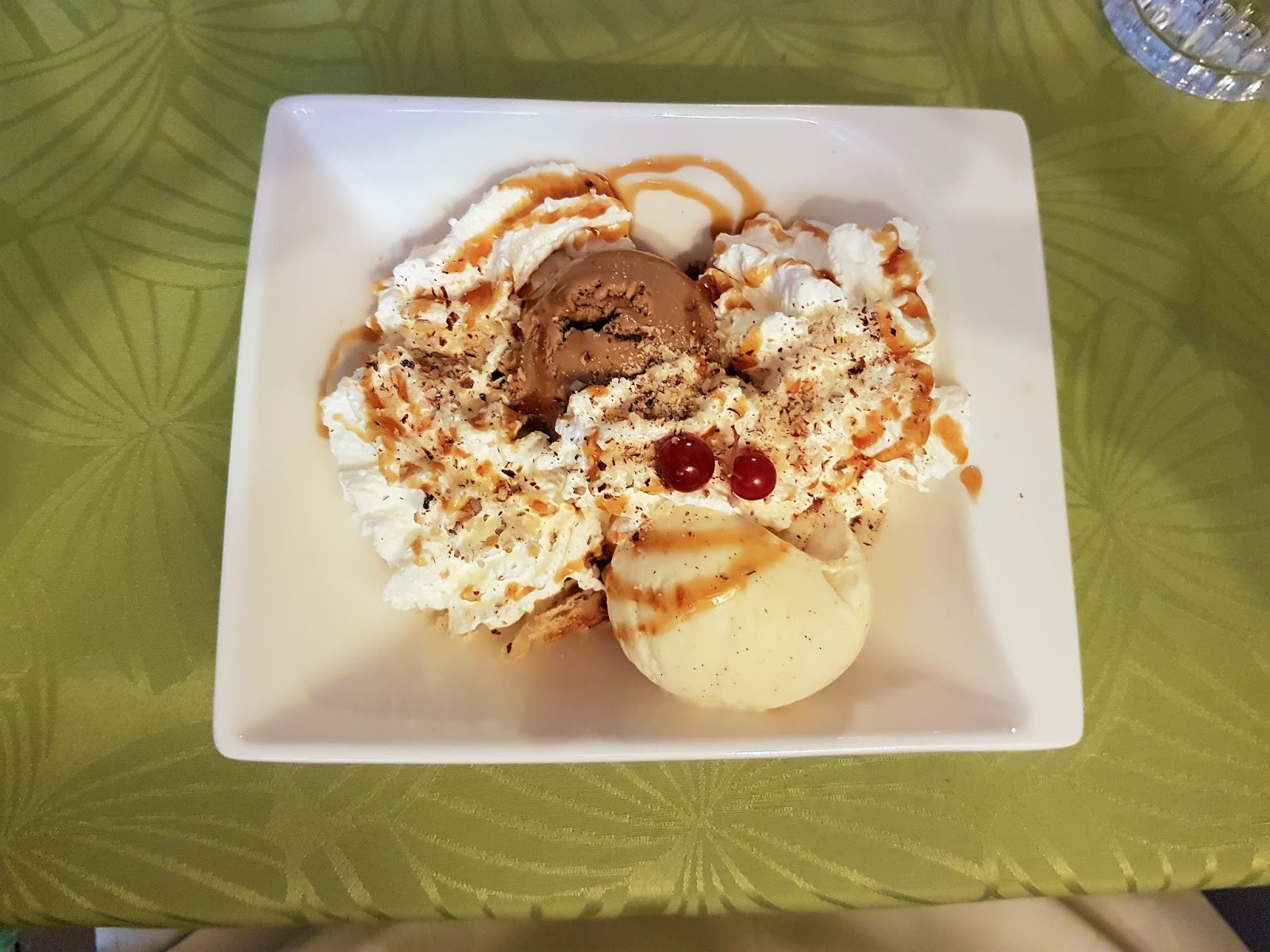
And again, when there aren't particular photos, you get examples of great French food. Note: there technically *is* wine in the upper right corner.
From personal experience, here are the main differences that I've noticed:
- It is not a big deal to drink during lunch on a workday. Most tables seem to have a bottle to share (4+ people) or a glass each. My company seems to be a little more conservative, so the managers who eat out for lunch typically only drink on Fridays. L’américaine and I have adopted this habit and we have a pineau per week on "fancy lunch" Fridays.
- It is nearly impossible to discipline or fire somebody for drinking, unless they are injured on the job or there is some other major incident that can be attributed to their drinking. You can (and possibly will) have at least one co-worker who smells like they bathed in a bottle of booze, but if they're a functional alcoholic, nothing can be done about it.
- Most of the French I know do not drink every day. If they do, it is a glass of wine with lunch or dinner. The only time I've seen them have multiple drinks in one sitting is at a nice dinner out (pre-dinner cocktail, wine with the starter and wine with the meal usually) or a nice dinner at home with friends (same 2-3 drinks).
- Beer seems to be consumed only on rare occasions and not often with a meal, usually it's a pre-dinner drink or completely separate from eating.
- Hard liquor is also consumed much less than in the US. Most of the stronger alcohol is consumed as a pre- or post-dinner drink, one small serving only and not as a mixed drink. It is something like a pineau (local specialty), cognac or a good whiskey. I don't recall seeing a French person have a mixed drink the entire time that I've been here (this is not to say that they don't drink them, just that it is uncommon in my experience).
- The French seem to be very conscientious about drinking and driving. Too many people joke about it in the US and don't seem to take it seriously (unless they get caught). Here, my French friends and colleagues very clearly drink less when they are the driver than if they are at home or not driving.
Thursday, February 16, 2017
French vs. American Healthcare
Advantages of the French Medical System:

Update on my Knee:
For those who are interested, as mentioned above, it appears that I tore the meniscus. I was allowed to try walking without the splint if I could tolerate the pain, but unfortunately it took less than two days of trying to walk around at work without it before my whole lower leg and foot swelled back up and every step was painful again . . . so I'm back in the splint until after the MRI and treatment is determined.
Of course, I had my own comedy routine on Monday and there really should have been video. I had asked the doctor if I could drive with the splint off and she said, "if you can?" I thought this was like the walking and referred to my pain level, so I was determined to tough it out and have my freedom back! So, I tried to sit in the car and realized that I had to move the seat back. I was quite proud of myself when I was in, foot on the gas pedal and ready to go . . . except I was so far back that I couldn't fully clutch. "Ok, so I'll scoot the seat forward a bit. Yep, I can fully clutch now!" Pushed the clutch in and went to press the brake to start the car. And learned the doctor literally meant if I was actually physically CAPABLE of driving when I can only bend my knee unaided to the position shown below.
 It's enough to sit my foot on the gas, but I tried, and failed, to bend my knee enough to actually raise it off the gas and onto the brake. I yanked on my pant leg, moved my leg to the brake by hand and went to start the car before the less-stubborn, more-logical part of my brain suggested that perhaps it was not wise to drive, especially a manual, when I'd just had to use my HAND to transfer my foot from the gas to the brake. This was proven quite true when an attempt to transfer my foot back over unaided resulted in my foot half on both peddles and a bit wedged between them.
So, there will be no driving for me through Feb 28. Hopefully, there will be good news then and I'll only need a few weeks of physical therapy! If not, I'll be facing surgery in a foreign country. The period of time since I injured my knee is the first extended period when I've wanted to return to the US - at home, I know how to take care of myself. Here, the forms are in French, the instructions are in French, many of the people only speak French. Naturally, I'm in France, but it adds a level of complication that is really unpleasant when you're already hurt.
- There doesn't seem to be any cost-benefit analysis done. If there is a risk, even minor, that you could die of a blood clot, they will treat you. Update: they also do not wait for you to have a life-threatening reaction before prescribing an EpiPen equivalent. If you have a food allergy that causes respiratory issues, they prescribe it - as the doctor noted, the reactions are often progressive and you could easily die before medical services reached you.
- Even uninsured medical costs are so low that I mistakenly thought they were my post-insurance rate. Twice. 23 Euro for an uninsured doctor's visit? 88 Euro for DAILY injections at home by a nurse for two weeks? Oh right - attending university is free here, so they don't need to pay college-educated people crazy high salaries just to afford their student loans . . . that's one way to keep the gap between "rich" and "poor" narrower for sure. There is a premium paid for college-educated people (you still invest your time after all), but it isn't nearly as large as in the US. This is also NOT a for-profit system, so every level of the medical industry doesn't need to carve out their profit at levels that satisfy shareholders.
- While I pay A LOT of taxes, the overall percentage for somebody like me is not actually that much different from what I paid in the US, plus my health care premiums, plus the FSA to be certain I could always foot the 20% that my insurance didn't cover, plus the higher amount I needed to save for retirement because health care costs are one of the big spend categories for US retirees . . . basically, the difference in France is that many people pay a little more in taxes, but then everyone is also covered if the worst happens. You aren't likely to lose your house here because you get sick or injured.
- They prioritize your health. I could have easily chosen to spend the last 3 weeks off work with nearly full pay. Except, I didn't really feel it was necessary with my job and it would have hurt my plant to go through close and year-end adjustments without their only local finance person.
- The doctors actually explain stuff to you. They tell you not only that they've determined you injured a ligament, then later, probably tore the meniscus, but also that it was this particular test where they moved your leg in this or that way which told them what the problem was. It inspires a certain level of confidence in the diagnosis when the doctor openly tells you how they drew that conclusion.
- If you tell a French person that you're calling on Wednesday for an appointment the following Monday, they will be shocked because you're calling so EARLY. Apparently, there must be a much better per-capita number of doctors here than the US if a few days notice gives you your choice of appointment times.
- Doctors will make house calls, if necessary.
- If you can't drive, there is an "ambulance" service that is made up of normal cars to provide medical transportation. I will be using one of these for my trip to Poitiers for the IRM (MRI). Or not - I decided to take the train and save a few Euro.

There are really no pictures that go with this post, so you get random French food. This is a super tasty tartiflette
Disadvantages of the French Medical System:- Daily injections? Really? This isn't really a "con" of the system, but I loathe needles and this was a special kind of torture for me.
- While I understand that there can be issues with people abusing painkillers, pain management is kind of important. When somebody has torn a ligament, a week's worth of narcotics is not that big of an issue. Especially when it eventually turns out to be a torn ligament and meniscus.
- Even though most French people aren't paying for them, I'm not sure what the point is in prescribing a full box of medication instead of just the number prescribed. I guess the upside is that I can tally up my prior leftovers before filling a prescription, just to be sure I actually need it! It also saves time at the pharmacy - they just grab the boxes and send you on your way.
- Again, probably because there is virtually no cost to the individual (and the gov pays either way), you are required to see a doctor if you miss even a single day of work. Otherwise, you're taking vacation pay for it. It comes across like your employer doesn't trust you, but actually the government won't reimburse their share without proof you were ill/injured.
- Due to the house call issue, your doctor really needs to be in your town. You can't just pick the person in a town 20 minutes away who your friend recommended.
- There can be a little wait for certain non-emergency procedures. Like, my MRI can't be done until February 28. But, I've had to wait in the US for non-emergency MRIs also . . . and there is certainly a long wait for many specialists in the US. It was over a month both for a dermatologist and a hand surgeon.
Update on my Knee:
For those who are interested, as mentioned above, it appears that I tore the meniscus. I was allowed to try walking without the splint if I could tolerate the pain, but unfortunately it took less than two days of trying to walk around at work without it before my whole lower leg and foot swelled back up and every step was painful again . . . so I'm back in the splint until after the MRI and treatment is determined.
Of course, I had my own comedy routine on Monday and there really should have been video. I had asked the doctor if I could drive with the splint off and she said, "if you can?" I thought this was like the walking and referred to my pain level, so I was determined to tough it out and have my freedom back! So, I tried to sit in the car and realized that I had to move the seat back. I was quite proud of myself when I was in, foot on the gas pedal and ready to go . . . except I was so far back that I couldn't fully clutch. "Ok, so I'll scoot the seat forward a bit. Yep, I can fully clutch now!" Pushed the clutch in and went to press the brake to start the car. And learned the doctor literally meant if I was actually physically CAPABLE of driving when I can only bend my knee unaided to the position shown below.

So, there will be no driving for me through Feb 28. Hopefully, there will be good news then and I'll only need a few weeks of physical therapy! If not, I'll be facing surgery in a foreign country. The period of time since I injured my knee is the first extended period when I've wanted to return to the US - at home, I know how to take care of myself. Here, the forms are in French, the instructions are in French, many of the people only speak French. Naturally, I'm in France, but it adds a level of complication that is really unpleasant when you're already hurt.
Thursday, February 9, 2017
The Hunt for an Open Restaurant on a Monday Night in Rural France
Upon moving to rural France, you quickly become accustomed to the fact that you cannot count on things being open at all hours like in the US. Most stores close by 7:30 PM each night and are closed all day on Sunday (or only open until 12:30 PM). Same with the pharmacies, except there will be a sign indicating the rotating schedule for which pharmacy in the area has extended hours.
This also extends to restaurants. While virtually every restaurant is open for weekday lunches, most of them are closed all day on Sunday. Several restaurants will also close all day for one week day and, as I learned this week, very often that day is Monday. Since Alexis has been helping me a lot, I offered to treat him to dinner (since I'm not really up to cooking). This is sort of the American way, at least in my region - if somebody helps you move, assemble furniture, etc., you offer food and/or drink in return. The last time he was over, he both assembled furniture AND provided the food, so it was certainly my turn to do something nice. Of course, I offered to treat him to dinner on Monday . . . without a full realization of precisely what I had done.
 Thus began the great search for an open restaurant. As it turns out, the place that is reliably open for dinner is NOT open for dinner on Mondays (O'Napoli - picture above is a burger from there). The other restaurant that I had in mind is only open for dinner Friday and Saturday (O City'ven - see picture below). A quick search of the internet and a few phone calls established that virtually all restaurants in the area are closed for dinner on Mondays. It also established that, during the winter, many of them are closed all day Sunday-Tuesday, many are open only for lunch during the week and many have random days they are closed. One restaurant advertised a new take-out menu of 6 dishes "tout les jours" (all the days), but when I called, I was told that "all the days" apparently does not include Monday. 😒
This is not accounting for the fact that you either have to follow local places on Facebook, check their website (if they have one) or eat there weekly to learn when they will be closed for a week or two for their vacations, to completely revise the menu or to remodel. In short, you become accustomed to the idea that you may want to make a reservation for lunch or dinner every time, just to be sure that the place will be open when you show up!
 Finally, I checked one of my other favorite restaurants, Relais Pays de Civrasian. I was in luck because their closing days are Wednesday night and all day Thursday! I do think that I'm introducing Alexis to bad habits because the big social meal in France is normally lunch, but here I am dragging him out for dinners . . . and twice in one week at that! You do realize why the restaurants aren't really open for dinner outside of the weekends though because they will be packed at lunch, but only two or three groups will come in for dinner - and both nights it was virtually all British people.
Once you're here for awhile, you also start to realize why they all have days they are closed and limited hours though - the people cooking and serving are usually the owners; several restaurants in the area are actually owned and operated by a married couple. Due to some of France's laws, it can be cost-prohibitive or a regulatory nightmare to hire additional staff, so the owners have to limit the hours they are open, and have some days they are closed, simply to have a break! Having said that, I think it is smart to be the only place in town open on a particular night . . . however, in my search for a restaurant open on Monday nights, I saw several Brits in my area with the same question, so it seems that the restaurant could have a lot more Monday night business if they got the word out that they are open!
Actually, you've heard it here folks - if you are looking for a restaurant in the Civray/Ruffec area that is open on Monday for dinner, Relais Pays de Civrasian is your place! They have a menu of the day that is available for dinner, not just lunch, plus other fixed price menus. And the owners (and staff) have always been very nice to us, even with our awful French!
This also extends to restaurants. While virtually every restaurant is open for weekday lunches, most of them are closed all day on Sunday. Several restaurants will also close all day for one week day and, as I learned this week, very often that day is Monday. Since Alexis has been helping me a lot, I offered to treat him to dinner (since I'm not really up to cooking). This is sort of the American way, at least in my region - if somebody helps you move, assemble furniture, etc., you offer food and/or drink in return. The last time he was over, he both assembled furniture AND provided the food, so it was certainly my turn to do something nice. Of course, I offered to treat him to dinner on Monday . . . without a full realization of precisely what I had done.

This is not accounting for the fact that you either have to follow local places on Facebook, check their website (if they have one) or eat there weekly to learn when they will be closed for a week or two for their vacations, to completely revise the menu or to remodel. In short, you become accustomed to the idea that you may want to make a reservation for lunch or dinner every time, just to be sure that the place will be open when you show up!

Once you're here for awhile, you also start to realize why they all have days they are closed and limited hours though - the people cooking and serving are usually the owners; several restaurants in the area are actually owned and operated by a married couple. Due to some of France's laws, it can be cost-prohibitive or a regulatory nightmare to hire additional staff, so the owners have to limit the hours they are open, and have some days they are closed, simply to have a break! Having said that, I think it is smart to be the only place in town open on a particular night . . . however, in my search for a restaurant open on Monday nights, I saw several Brits in my area with the same question, so it seems that the restaurant could have a lot more Monday night business if they got the word out that they are open!
Actually, you've heard it here folks - if you are looking for a restaurant in the Civray/Ruffec area that is open on Monday for dinner, Relais Pays de Civrasian is your place! They have a menu of the day that is available for dinner, not just lunch, plus other fixed price menus. And the owners (and staff) have always been very nice to us, even with our awful French!
Thursday, February 2, 2017
A Serious Injury in France - Part 2 and Great Friends
The differences in France and the US when it comes to healthcare are a little surprising. I don't think that I've ever heard of somebody with an immobilized limb getting daily injections to prevent blood clots in the US, but PB has asked me multiple times about this and was acting like I was in grave danger of imminent "death by blood clot" because I went the whole first week without the injection (largely due to difficulty finding a nurse). It's also weird that they just hand you these boxes of injections, so PB had a valid threat when he said if I didn't find a nurse, I would force him to inject them himself.
By the way, if I do die tragically from a blood clot - PB, you were right. As always. Postulate #1. 😁
 Frankly, I would probably have went ahead and gotten the injections (why take an unnecessary risk, no matter how small?), except for two small problems. The first is that I tried to register my social number and it wasn't valid - apparently, a "temporary number" is basically useless. It wasn't until January 30th that I finally received a valid social number . . . which I registered and my information was promptly sent out. To my old address. Apparently, my HR folks forgot to update the address with CPAM (although the prefecture has my correct address). Of course, governmental departments don't really share information in the US either, so this is no different. Everything seems to be working smoothly now with my certificate of rights, even without the Carte Vitale.
The second problem is that, despite a large British ex-pat community in the area, I have had serious issues finding English-speaking medical care. The doctor that I saw in the neighboring town won't drive to my town. Unlike the US, you may not be able to call your doctor when they've, say, given you a prescription that you're allergic to - the doctor is too busy to return calls. But they'll make a freaking house call . . . as long as you live in the same town basically. So, no more doctor in the neighboring town (the nurse that was recommended in the same town also won't drive here for my injections).
So, I started the great quest to find more English-speaking medical people. The next nurse I called also told me that their group is too far away and gave me the number of two groups that are closer. I postponed calling the new places because I was a little concerned about daily nurse visits without confirmed insurance. Once it was confirmed, the nurse's group in my area had inconsistent English ability, so PB gave them his number as my contact person. He was thus able to arrange for my daily torture, which is probably good because I would have quit after the first two! Check out the bruise from the first one - can you blame me for wanting to skip them! The second one left a smaller bruise, about the size of a penny . . . and the third looks like it might be the best of all. Which is good, because I was beginning to wonder how they'd possibly find room for 14 (let alone 21) of these.😱
 I have to say that I'm happy I live in an area with a large British ex-pat community at the moment because they really came through on medical suggestions! I now have the name of an English-speaking doctor and dentist, plus the nurses. I'm only missing an eye doctor. My new doctor is great, but sadly leaving the area in July. She'll at least be able to get me through the rest of my knee treatment - at the one week mark, she determined I'd actually injured TWO ligaments and that the swelling was not down as much as it should have been. I was lectured on being less active, but persuaded her that I could still work AND be less active. PB persists in refusing to fetch my coffee though, which really undermines his assertion that he's become my highly-paid assistant.😂
In addition to PB looking after my medical care (and occasional transportation), l'américaine has been super helpful with driving me back and forth to work most days, taking me to get lunch and buying some of my groceries. I'm super lucky that I picked a place that is close to work, so it's not SUPER inconvenient for people. It is still a hassle though because they have to consider my schedule, such as me needing to eat in order to take my medication . . . so I have to be home by a certain time. Another woman, YV, volunteered to drive me to my doctor's appointment, which was also really nice and a third co-worker has offered various forms of help too. My team takes good care of me during the week, but I was a little concerned about the weekend. It was pure luck that Alexis' knee had healed up and he'd arrived back in town the weekend before (I was actually getting him from Poitiers when I hurt myself), so he offered to come by on Saturday. He ended up looking after me nearly the whole day and assembled my shelves, table and chairs for me (and cleaned up the packaging). Plus, he took me to get groceries, helped unpack some of my stuff, hung my curtains, washed my dishes and cooked us dinner. Yep, I've been very, very fortunate to meet some really great people in France!!!

By the way, if I do die tragically from a blood clot - PB, you were right. As always. Postulate #1. 😁

The second problem is that, despite a large British ex-pat community in the area, I have had serious issues finding English-speaking medical care. The doctor that I saw in the neighboring town won't drive to my town. Unlike the US, you may not be able to call your doctor when they've, say, given you a prescription that you're allergic to - the doctor is too busy to return calls. But they'll make a freaking house call . . . as long as you live in the same town basically. So, no more doctor in the neighboring town (the nurse that was recommended in the same town also won't drive here for my injections).
So, I started the great quest to find more English-speaking medical people. The next nurse I called also told me that their group is too far away and gave me the number of two groups that are closer. I postponed calling the new places because I was a little concerned about daily nurse visits without confirmed insurance. Once it was confirmed, the nurse's group in my area had inconsistent English ability, so PB gave them his number as my contact person. He was thus able to arrange for my daily torture, which is probably good because I would have quit after the first two! Check out the bruise from the first one - can you blame me for wanting to skip them! The second one left a smaller bruise, about the size of a penny . . . and the third looks like it might be the best of all. Which is good, because I was beginning to wonder how they'd possibly find room for 14 (let alone 21) of these.😱

In addition to PB looking after my medical care (and occasional transportation), l'américaine has been super helpful with driving me back and forth to work most days, taking me to get lunch and buying some of my groceries. I'm super lucky that I picked a place that is close to work, so it's not SUPER inconvenient for people. It is still a hassle though because they have to consider my schedule, such as me needing to eat in order to take my medication . . . so I have to be home by a certain time. Another woman, YV, volunteered to drive me to my doctor's appointment, which was also really nice and a third co-worker has offered various forms of help too. My team takes good care of me during the week, but I was a little concerned about the weekend. It was pure luck that Alexis' knee had healed up and he'd arrived back in town the weekend before (I was actually getting him from Poitiers when I hurt myself), so he offered to come by on Saturday. He ended up looking after me nearly the whole day and assembled my shelves, table and chairs for me (and cleaned up the packaging). Plus, he took me to get groceries, helped unpack some of my stuff, hung my curtains, washed my dishes and cooked us dinner. Yep, I've been very, very fortunate to meet some really great people in France!!!

Thursday, January 26, 2017
A Serious Injury, CPAM and the French Medical System
One of those things that I worried about, but hoped would never happen, came to pass this week. I have a partial tear of a ligament in my knee, which means I'm in a thigh-to-calf splint for the next 3 weeks (potentially a month and a half . . . or an additional month and a half? There was a small language difficulty). The worst part - I live in small rural town and I cannot drive.
Well, the pain may actually be the worst part because it doesn't appear to be customary to prescribe strong painkillers the first visit, even for a serious injury (not even Tramadol, which is what I prefer because it isn't as strong and is an opioid, but non-narcotic). This would potentially be ok, since I was given a prescription dose of a painkiller similar to Tylenol, a prescription dose of Naproxen Sodium and a pain relieving cream . . . except I'm allergic to soy, which I told the doctor (in French), yet I was prescribed a soy-containing pain cream. Unlike in the US, you apparently cannot just call your doctor and tell them that there's a problem with your prescription or that your pain is not even remotely well-controlled. You can try, but you'll be told by the receptionist that the doctor is too busy to return a call and you'll have to make an appointment. Are. You. Freaking. Kidding. Me?!?! The doctors here will make a house visit to ensure you have your required note for missing a day of work, even for a cold, but not return a phone call. Not even to correct their own mistake. Incredible.
 Now that I know that, I've changed my mind about continuing to see a doctor in the town 20 minutes away who speaks the best English because, as I also learned, they won't make a 20 minute drive for the house calls. I learned this when I tried to contact the recommended nurse for my DAILY injection. This is another interesting difference from the US. I've had limbs splinted or immobilized before and never had an injection required. After having it prescribed in France, I looked up why this might be. It's because they've studied the risk of a clot and it's near zero if you don't have at least 3 risk factors (I don't), so it's been determined that prophylactic treatment is not recommended. The French all took it as gospel that I would need this treatment (but of course you need the injection!) and joked that Americans are simply content to let natural selection take its course for the poor tiny percentage of the population that could be impacted by this.
I'm guessing it also has something to do with the fact that a daily house visit from the nurse isn't so objectionable when the combination of your socialized health care and extra mutuelle coverage is footing the bill. Can you imagine the cost of a nurse coming to your home for three weeks to administer a daily injection in the US? 😨 Not only would people not agree to pay for it, the for-profit insurance in the US would surely refuse.
So, outside of the apparent reluctance to prescribe anything remotely suitable for the pain caused by a torn ligament, French doctors have no qualms about prescribing you the entire remainder of the pharmacy stock. This is what I left the pharmacy with:
 There's also no need for silly bottles. If you were prescribed 14 pills, they just sell you the full box of 16. Presumably nobody cares since they're not paying out-of-pocket. Of course, if you're not French, then you've probably also encountered the most incompetent branch of the French government well before you've needed any medical care.
In direct contrast to my experience of getting my work permit issued in a week and my visa arriving promptly, plus the prefecture finding me an appointment before my visa expiration, CPAM seems to delight in it's ability to be completely dysfunctional. First, they incorrectly told my human resources department that I was not eligible for a social number (or Carte Vitale) until I'd been in the country for 3 months. My immigration attorneys assured me that this was not true with the visa type that I have, plus they sent the link to the French government website that proved this.
It's unclear whether the next problem was CPAM or my co-worker, but somehow this issue never progressed further until I complained to PB that I'd been in the country for nearly 3 months, paying high social taxes and for a mutuelle policy that I couldn't use, with no Carte Vitale to show for it. He followed up with my co-worker, who possibly never tried to clarify with CPAM about my visa type. My dossier was finally sent over and, several weeks later, PB followed up again. CPAM informed us that they'd received no such dossier. My co-worker forwarded the proof that we'd filed. CPAM then miraculously found my file, which had been assigned to somebody who was out on leave of some sort. It seems that CPAM was content to leave my file waiting on a desk until whenever the person returned, but they were finally persuaded to do something with it.
PB laughed a bit while telling me that I was having my first experience with TRUE French bureaucracy. Apparently, the French just accept this as the way things are here, which could be why so many of them are in favor of politicians who want to fire a significant number of civil servants! Finally, in early January, I was issued my "temporary" social number and told that a bill of rights would be mailed to me. The mutuelle insisted that my temporary number could not be used for registering with them. Fine, I'll continue to wait.
Well, this became a problem when I injured my knee. Even though I should have been covered from the day I arrived, because my human resources folks didn't persist and file until December, I'm told I have coverage as of December 22. But, without a Carte Vitale, I have to pay upfront and hope that the French government will actually reimburse me.
 The cost in France for an uninsured "urgent care" visit to a doctor? Twenty-three Euro. Yes, that's the entire cost. The pharmacy, on the other hand, set me back over two hundred Euro, but that was for the entire stack of medication and the knee splint.
So, financially, the lack of proof of insurance has not been so terrible. Of course, I have no idea where to send my "factures" or invoices, in order to be reimbursed. The CPAM has quit responding to my employer when an update is requested as well (I should have pushed for my US HQ to include this in the services that the immigration attorneys were hired for - they seem able to persuade the government to actually do its job). I will say that PB has made it his personal mission this week to resolve the issue and has our HR staff working on it studiously. My understanding is that they will help me get reimbursed and to register with the mutuelle, regardless of my lack of Carte Vitale.
My fears before this experience centered more around what I would do if I were seriously injured in a country where I don't have any long-term friendships yet and no family to call on. As it turns out, I was worried about something that hasn't really happened yet. Le Américaine has helped a lot with buying my groceries for the week, driving me to the doctor and taking me back and forth to work. Alexis, who is back in the area, brought me an ice pack and is going to help with my furniture assembly. Another co-worker has also offered to pick up groceries for me or help with any other errands. A new friend offered to accompany me if I needed surgery, so I'd have an interpreter. On the other hand, PB had a brief moment of acting like I'd injured myself during the WORST POSSIBLE TIME (our CEO visited this week) just to inconvenience him, but then he recalled that I just received a large set of knives as my 5 year service gift 😈 . . . er, I mean he recalled that he generally likes me and should be more concerned that I'm injured than about the poor timing of the injury.
I have learned that there are a lot of things that are a bit of a challenge when you can't bend one knee. Like getting up from any sitting position without something to grab on to. On the other hand, my left leg is going to have quads of steel and I'll be able to swing my lower body around using my arms like a gymnast! My poor right quad is having a time of it though as I pulled it trying to swing my sock around and catch my foot in it like a net. You know, socks are overrated anyway. As are shoes. I posed this question on my FB, but fuzzy blue slippers are proper work attire, right?
 To my relief (and surely that of PB), I managed to wrangle a sock and (untied) shoe onto my foot prior to our CEO's arrival and have not yet had to wear fuzzy slippers in public. Which I'm pretty sure a French person would view as sufficient public humiliation to justify a home visit and a doctor's note to skip work.😊
Well, the pain may actually be the worst part because it doesn't appear to be customary to prescribe strong painkillers the first visit, even for a serious injury (not even Tramadol, which is what I prefer because it isn't as strong and is an opioid, but non-narcotic). This would potentially be ok, since I was given a prescription dose of a painkiller similar to Tylenol, a prescription dose of Naproxen Sodium and a pain relieving cream . . . except I'm allergic to soy, which I told the doctor (in French), yet I was prescribed a soy-containing pain cream. Unlike in the US, you apparently cannot just call your doctor and tell them that there's a problem with your prescription or that your pain is not even remotely well-controlled. You can try, but you'll be told by the receptionist that the doctor is too busy to return a call and you'll have to make an appointment. Are. You. Freaking. Kidding. Me?!?! The doctors here will make a house visit to ensure you have your required note for missing a day of work, even for a cold, but not return a phone call. Not even to correct their own mistake. Incredible.

I'm guessing it also has something to do with the fact that a daily house visit from the nurse isn't so objectionable when the combination of your socialized health care and extra mutuelle coverage is footing the bill. Can you imagine the cost of a nurse coming to your home for three weeks to administer a daily injection in the US? 😨 Not only would people not agree to pay for it, the for-profit insurance in the US would surely refuse.
So, outside of the apparent reluctance to prescribe anything remotely suitable for the pain caused by a torn ligament, French doctors have no qualms about prescribing you the entire remainder of the pharmacy stock. This is what I left the pharmacy with:

In direct contrast to my experience of getting my work permit issued in a week and my visa arriving promptly, plus the prefecture finding me an appointment before my visa expiration, CPAM seems to delight in it's ability to be completely dysfunctional. First, they incorrectly told my human resources department that I was not eligible for a social number (or Carte Vitale) until I'd been in the country for 3 months. My immigration attorneys assured me that this was not true with the visa type that I have, plus they sent the link to the French government website that proved this.
It's unclear whether the next problem was CPAM or my co-worker, but somehow this issue never progressed further until I complained to PB that I'd been in the country for nearly 3 months, paying high social taxes and for a mutuelle policy that I couldn't use, with no Carte Vitale to show for it. He followed up with my co-worker, who possibly never tried to clarify with CPAM about my visa type. My dossier was finally sent over and, several weeks later, PB followed up again. CPAM informed us that they'd received no such dossier. My co-worker forwarded the proof that we'd filed. CPAM then miraculously found my file, which had been assigned to somebody who was out on leave of some sort. It seems that CPAM was content to leave my file waiting on a desk until whenever the person returned, but they were finally persuaded to do something with it.
PB laughed a bit while telling me that I was having my first experience with TRUE French bureaucracy. Apparently, the French just accept this as the way things are here, which could be why so many of them are in favor of politicians who want to fire a significant number of civil servants! Finally, in early January, I was issued my "temporary" social number and told that a bill of rights would be mailed to me. The mutuelle insisted that my temporary number could not be used for registering with them. Fine, I'll continue to wait.
Well, this became a problem when I injured my knee. Even though I should have been covered from the day I arrived, because my human resources folks didn't persist and file until December, I'm told I have coverage as of December 22. But, without a Carte Vitale, I have to pay upfront and hope that the French government will actually reimburse me.

So, financially, the lack of proof of insurance has not been so terrible. Of course, I have no idea where to send my "factures" or invoices, in order to be reimbursed. The CPAM has quit responding to my employer when an update is requested as well (I should have pushed for my US HQ to include this in the services that the immigration attorneys were hired for - they seem able to persuade the government to actually do its job). I will say that PB has made it his personal mission this week to resolve the issue and has our HR staff working on it studiously. My understanding is that they will help me get reimbursed and to register with the mutuelle, regardless of my lack of Carte Vitale.
My fears before this experience centered more around what I would do if I were seriously injured in a country where I don't have any long-term friendships yet and no family to call on. As it turns out, I was worried about something that hasn't really happened yet. Le Américaine has helped a lot with buying my groceries for the week, driving me to the doctor and taking me back and forth to work. Alexis, who is back in the area, brought me an ice pack and is going to help with my furniture assembly. Another co-worker has also offered to pick up groceries for me or help with any other errands. A new friend offered to accompany me if I needed surgery, so I'd have an interpreter. On the other hand, PB had a brief moment of acting like I'd injured myself during the WORST POSSIBLE TIME (our CEO visited this week) just to inconvenience him, but then he recalled that I just received a large set of knives as my 5 year service gift 😈 . . . er, I mean he recalled that he generally likes me and should be more concerned that I'm injured than about the poor timing of the injury.
I have learned that there are a lot of things that are a bit of a challenge when you can't bend one knee. Like getting up from any sitting position without something to grab on to. On the other hand, my left leg is going to have quads of steel and I'll be able to swing my lower body around using my arms like a gymnast! My poor right quad is having a time of it though as I pulled it trying to swing my sock around and catch my foot in it like a net. You know, socks are overrated anyway. As are shoes. I posed this question on my FB, but fuzzy blue slippers are proper work attire, right?

Subscribe to:
Posts (Atom)