Showing posts with label UNESCO World Heritage Sites. Show all posts
Showing posts with label UNESCO World Heritage Sites. Show all posts
Saturday, May 6, 2017
Biarritz and the Hotel Star System in France
In one moment, you will be redirected to the new blog.:-)

Thursday, March 23, 2017
Abroad Edition: An American in Manila
I elected to fly Emirates this trip because I've heard from frequent travelers that their service is fantastic . . . and it's true. The food was good, they had an amazing entertainment system and the legroom in standard coach was more than adequate. The chairs recline partially into your own space, but enough that it's the first decent sleep I've had on a plane since my 2006 trip to Europe. Of course, my connection was in Dubai, which was using an impressive amount of water for this display.
 I've also realized how privileged I am to be an English-speaker. Everywhere I've gone in the world, airport signs were in the local language and English. Egypt and Dubai? Arabic and English. Japan? Japanese and English. France? French and English. I can't imagine how much more difficult traveling would be if I couldn't read the signs or the departure boards. Not to mention the large number of people globally who speak English as their primary second language.
 Upon arriving in the Philippines, I quickly learned that the internet is not up to Western standards - the WiFi at my hotel didn't work two of the three nights I was there. Even the WiFi card that I rented barely worked. I also hadn't planned for a wait while they checked my room for additional charges.


Having said that, I enjoyed my time in Manila. My first day was a visit with my sponsored teen. The majority of the details on that day are on my blog for sponsor travels here:
Manila Visit. Here is a photo of us together though.
I will say that sponsoring kids is one of my great joys! It's such a small amount ($32) to make such a difference for them! In a country, Guatemala, where less than 10% finish high school and youth unemployment is unimaginably high, my first two teens are both employed high school grads. My Filipina is the first in her family to be in college also. I like to spoil the whole family when I visit though!

My second day in Manila was spent on a tour with Philippines Tours and Holidays. The guide is originally from Europe, but married a Filipina and moved here several years ago. We went to the American Cemetery first, which is for soldiers who died in WWII. When you see the massive walls of names, you can begin to understand why, at the time, the US thought dropping a couple of bombs and ending the war was a good idea. More, you wonder why the world keeps fighting endless pointless wars.

It's sad to know 50% of the globe lives in poverty, sadder still that it means each of us who aren't only need to help one person to end it. Think how peaceful the world could be if we treated everyone as equal human beings and traded fairly for the things they had that we wanted? You can't help but notice the disparity in income levels present here.

The weather was not cooperative, so the views of the bay were ok, but a little hazy, so we headed to the park earlier. I was unaware of José Rizal before, but he's a national hero in the Philippines - he's even on the one peso coin, "because everyone can have one peso" as my guide told me. Rizal was an advocate for better rights for Filipinos during Spanish colonization and supported women fighting for their rights. He was falsely accused of been part of a violent rebellion and executed.
 The rest of the park is a little more peaceful, with the Japanese and Chinese Gardens and other areas we didn't make it to because my knee decided it was time for a break!
 We were off to Intramurus then! This is the old Spanish walled city. We went to the Fort first, where they're constructing a new lovely plaza, but you still have access to the old ruins, which were heavily damaged in WWII.
 This section is still original, but some areas were rebuilt with red brick after the war - not the best idea, but it's interesting to get a feel for the design of the fort. There's also a museum about Rizal. We then saw two famous churches in the area - I somehow missed a photo of the first, but did get a quick photo of the San Agustin church. I later learned this is also a UNESCO World Heritage Site.
 It appears that the same five guys who built many of the churches in France also had relatives building them here! There are clearly shared features and they hold their own in comparison, although they're not as ornate as Austrian churches.
The nice thing about a private tour is that you can customize, so the early departure from the park resulted in a tour of an old Spanish colonial house instead.
 It was a lovely tour and more like spending a day with local friends than a formal tour. The company will customize tours and even multi -day trips, which sounds like a great plan for a return trip!


The nice thing about a private tour is that you can customize, so the early departure from the park resulted in a tour of an old Spanish colonial house instead.

Friday, December 30, 2016
Festung Hohensalzburg and Mozart - Salzburg Part 2
Today, it occurred to me that I've grown accustomed to small glasses in France and that large volumes of liquid aren't necessary because the bread is fresh and the meat isn't overcooked, so you aren't washing it down. I ordered a 0.5L sparkling apple juice (they add sparkling water to juice here and in Germany) and I couldn't finish it!
Since Festung Hohensalzburg was the top-rated attraction in the city, I headed up first thing in the morning. Of course, this is where Google Maps failed me again! I put in the address for the funicular to the top . . . and it took me to the TOP of it, meaning I climbed up that hill on the left to reach the fortress!
 Of course, I had some gorgeous views on the 15-20 minute hike up, so I didn't mind so much.

 Once you reach the top, there's a lot of outdoor space that you can wander around to see the views and just a few random things to see, like the remnants of an old fireplace. Note: You need a ticket to access this space also.
 Most of the tour shows little about how the fortress would have once looked and it's virtually empty - it's more about having you walk all over while it tells you about the history of the city and stages of building the fortress. From what I understood, Salzburg was an independent area until 1263, when Bavaria conferred protection. Upon the King's death, Austria was controlled by the Habsburgs, but Salzburg didn't break away from Bavaria until 1328. In 1481, Salzburg was officially granted free city status. The city was able to maintain this status in part due to the wealth from salt. Salt? Yes, salt, which was the primary way to preserve food before refrigeration. The fortress was able to withstand attack and the salt provided ample dried food, so the fortress never fell by force.
 You can even see the remnants of the old city walls still on the adjacent hill across the river.
 There were many things to see in the museums that are in another building on the grounds, but I personally found the tiny discussion of Roman ruins most interesting. The fortress was built on top of an original Roman settlement and there is brief mention of this history and the ongoing work to discover what was left behind.
 It was then time for a little Mozart! I had picked his birthplace as my one "Mozart" option, so after taking the funicular down, I walked to his birthplace nearby. This is when I learned that the Salzburg Pass works as a ticket in some places, so I was allowed to skip the ticket line and enter right away. The house takes about an hour and includes a lot of information on his parents, sister, wife and children. It's pretty comprehensive and I enjoyed it - it's well worth a visit if you want to learn more about Mozart. I took this photo of him as a young prodigy before I realized photos weren't allowed. They even have things, like a lock of his hair!
 Contrary to popular belief, Mozart's family wasn't poor and would have been more middle class. The house had several rooms, including a living room, kitchen, bedroom, etc. This is representative of what there living room would have been like. It's a screen shot from their app, which is quite useful because you can use it when the wall is too crowded to read (and for languages other than German and English, which are the only two languages used).
 To wrap up my Mozart time, I went into the Salzburger Dom to see the organ from around 1700 that Mozart used to play.
 It was a really lovely Cathedral though and had everything - ornate carving, paintings, pipes and the twilight sky blue was perfect.
 Between Mozart's house and the Cathedral, I stopped in at the Salzburg Museum since I had time. It proved that what people like is based on personal preference because this was my favorite of the historical museums (out of it, DomQuartier and Festung). The history felt disjointed for me before, but this really laid it out from early-on to before it joined Austria. 1800-1803 France; 1803-1805 Habsbergs; 1805-1809 Austria (not sure how this differs from Habsburgs?); 1809-1810 France; 1810-1816 Bavaria and then permanently part of Austria since 1816.
 I left my phone in the pocket of my coat by accident, so no photos of the museum, but it was really well done and interactive! There was a theme to each floor, from the history of the city to old folktales and myths about Salzburg vs. reality. Another area explored the historical appeal of the city throughout the ages with paintings and various other depictions, then discussed the pros and cons of the changing tourism scene in Salzburg (basically, they'd like to increase tourism outside of the Salzburg Festival, but limit negative side effects). There was also an area with old musical instruments and recordings you could listen to of how they'd sound. I think it's one that kids would actually enjoy even. It was attached to the panorama museum, which is really just an old panorama painting of the city (really cool to see) and a few small paintings from the same era, when people would paint a city and travel with it so others could see parts of the world they'd never be able to visit!
I ended my day by walking the shopping area, which Austrians also appear to visit in the evenings (although they could have all been tourists honestly). I mistakenly crossed the bridge to where the bus had dropped me off on a one-way street and had to turn around, but what a view from that mistake!

Since Festung Hohensalzburg was the top-rated attraction in the city, I headed up first thing in the morning. Of course, this is where Google Maps failed me again! I put in the address for the funicular to the top . . . and it took me to the TOP of it, meaning I climbed up that hill on the left to reach the fortress!


I ended my day by walking the shopping area, which Austrians also appear to visit in the evenings (although they could have all been tourists honestly). I mistakenly crossed the bridge to where the bus had dropped me off on a one-way street and had to turn around, but what a view from that mistake!

Thursday, December 29, 2016
Snow and Ice in the Austrian Alps! Salzburg Part 1
I tried to visit Salzburg on my first 2006 trip to Europe, but I was incredibly ill when I arrived, so I just caught the first train out to Munich, where I could sleep.
It was a pleasure to finally make it back! I must say that I'm not surprised that the French came up as worst at English in the EU recently - despite speaking more French than German now, it has been more relaxing to be in Austria so far because I can get by with limited German since people are generally fluent in English. While I don't expect this, it certainly is nice! It was also nice to discover that my "single" room here was quite an upgrade from Vienna!
 When I arrived in Salzburg, I bought a 24-hour transit ticket, which is the price of two single tickets. Even if you're buying the Salzburg Pass, this was a good plan because I needed to get to my hotel and to the first attraction to activate it. Beyond that though, this is certainly a city where the Salzburg Pass is a great idea if you're staying at least 2 days! The initial price is a little high for a 24 hour pass, but bumping it to 48 or 72 is quite cheap (only 5 Euro to add the 3rd day). It offers free entry to a huge number of tourist sights, plus free public transportation. Get the Pass!
Once I decided to buy the pass (available at your hotel, but activated at the first attraction), I knew that I didn't want to burn out on any single type of activity. I avoided museums in Vienna because I feel like I've seen SO MANY of them, so I thought selecting a little of everything here would be best - not too many palaces, museums or Mozart sites! So, for Day 1, I decided to really get my money's worth by taking the Untersberg cable car! I'd expected a white Christmas in the Austrian Alps and was disappointed to discover that Austria is not completely buried in snow in December, so it was time to get that "Alps" experience!

Before I arrived here though, it occurred to me that my comfy black sneakers and lack of hat or gloves might be a problem. At first, I figured, "how bad can it be?" and thought I'd just tough it out. Don't do it folks!!! You aren't even seeing the VERY top that we went to in this photo and, in December, the conditions are exactly what you'd expect on TOP OF A GIANT MOUNTAIN. Fortunately, on the way there, I noticed a bus stop in front of a shoe store and shop selling winter gear next door - convenient! If you find yourself in the same boat, the Quick Schuh store in Anif had a nice selection of winter boots on sale, so I found a pair that looked nice, were good quality and were comfortable . . . yet were on sale for 40 Euro! I have no winter boots, so they weren't a wasted purchase either. They kept my feet perfectly dry and warm in appallingly cold conditions.
 After you crest what you think is the top, then see how much further up you're going, you realize that winter gear is mandatory. Even outfitted in better gear, the cold was so intense that my legs hurt with only having jeans on. I've never really traveled in the winter before, so needing full "mountain snow" gear hadn't occurred to me before I left!
 I enjoyed the experience overall though and liked the display that explained how the local mountains and lakes formed. It was a nice place to stop and have lunch as well, but at low prices, I expected the food not to be that great. Surprisingly, the wiener schnitzel had great flavor - the breading was actually the most flavorful that I'd had so far (third version to date). I was shocked, at the end of my meal, to see that the server was smoking at the register though! I didn't notice this in Vienna, but I did notice in Salzburg that people can still smoke in restaurants! It completely grossed me out, although the ventilation at the first place was good enough that I'd never smelled it - I walked out of a couple of other places where I could clearly smell it when I walked in.
 I'd clearly arrived at the right time because I walked outside again and could barely see in front of my face! I decided it was time to move on to the next activity - the Dom Quartier. Having went through the various sites now, I'd recommend seeing the Salzburg Museum first as it gives a more general overview of the city and its history. You can see the nasty storm cloud that came in at the top of the photos below:

 My hotel ended up being in a perfect spot and on both the bus line out to the zoo, Hellbrunn Palace and the cable car, but on that line and another, more frequent, one to the city center (in about 5 minutes). I was surprised when the bus dropped me off on the other side of the river though! Turns out, the roads near the river are one way, so I had to cross it (with an excellent view) to reach the old town, which is a UNESCO site. I started off by crossing Mozartplatz.
 Once you're there, you realize that the old town is a pedestrian area and made up of interlinking squares and small passages. Many of the tourist sites are here with cathedrals, museums and nearby are Mozart's birth house and the funicular to the fortress. While the buildings have a similar green, domed look as the Prussian ones, they are distinctly different. The style is "Baroque," but Salzburg was influenced both by Germany and Italy in the styles and building structures.
 The Dom Quartier includes several different tours. The first takes you through the Residence Palace, which was used by the Prince-Archbishops. This is a key piece of history that is introduced in this part of the tour because Salzburg was ruled by someone who was both prince AND archbishop, meaning he controlled the civic and religious parts of the state. Due to this, Salzburg was an independent city-state for a very long time; technically, Mozart was not Austrian because Salzburg was not part of Austria then! This combined secular-and-spiritual leader model continued until the Napoleonic Wars.
I wanted to share this one photo, which shows the hidden passages that servants used to keep the fires burning without disturbing the nobles. This was a skilled job since a mistake could cause a fire, like one that destroyed part of the palace. The Residenz was interesting to visit, although the majority of the contents are gone now. It was built in 1604 by Wolf Dietrich, who I heard a lot about in other tours later! He was also responsible for the Baroque remodeling of many of the buildings near the Residenz.
 The next part of the museum is an art museum. Here, you learn that Salzburg is really trying to improve the tourism in the city and to attract people outside of the Salzburg Festival (music festival). I have one recommendation that I could make - don't shut so many things down in the winter! Or open them over winter break at least - Hellbrunn Palace, a couple of the smaller museums and the boat cruises are all included in the pass, but are all closed in November-March. The museum was showcasing an exhibit about how this painting of Rembrandt's was drawn and painted. I was drawn in by the detail! Look at how realistic the back of her hands are - incredible.
 I don't have many photos from inside the Dom Quartier because most of the areas had signs indicating that no photography was allowed. I'm not sure why places do this - if somebody isn't going to ever travel to a place, then photographs share a little bit of the world with them. If they *are* going to travel to your place, I've never looked at photos and thought, "well, I don't need to go there and see it myself now." If anything, it's often photos that make me want to see the place myself. If you want to see a brief tour (3 minutes), you can do so here: Dom Quartier Official Video
The tour also takes you through a museum for the church, through the church on the organ balcony (where you will watch little flashes go off repeatedly - used by people who clearly lack the understanding that flash only helps when something is close and in the range of the flash . . . and that it is inappropriate to use in an operational church) and through a recreated "museum of curiosities," where they have gathered items to mimic cabinets of curiosities that would have existed at the time. These used to be a way for rulers to show their knowledge by displaying artifacts from all over the world and natural items, such as large gems or taxidermied animals.
 None of the museums really stand out as SUPER spectacular on their own, but I like the combined ticket that shows you just a small taste of several different things. The total tour takes about 1 1/2 hours and is included in the Salzburg Card.
Now, I will leave you with pictures of the breakfast buffet, which I decided to splurge on for one of my mornings in Salzburg! My hotels after this include breakfast, so we'll see what I'm getting there. This one also included scrambled eggs, eggs you could boil soft or hard, sausages and bacon (along with the usual bread, cereals, juices and coffee). Be aware that German-speaking places have a bad tendency to list "sausages" in English when they actually mean deli meats. I've had this happen in Germany and Austria. In this case, I mean ACTUAL sausages.

 I'll be back tomorrow with my visit to the Fortress, a HUGE Google Maps fail, a little more history about the unique city-state of Salzburg and the Mozart part of my visit! And I'll wrap up my final day in Salzburg with a "Sound of Music" tour. 😀
It was a pleasure to finally make it back! I must say that I'm not surprised that the French came up as worst at English in the EU recently - despite speaking more French than German now, it has been more relaxing to be in Austria so far because I can get by with limited German since people are generally fluent in English. While I don't expect this, it certainly is nice! It was also nice to discover that my "single" room here was quite an upgrade from Vienna!

Once I decided to buy the pass (available at your hotel, but activated at the first attraction), I knew that I didn't want to burn out on any single type of activity. I avoided museums in Vienna because I feel like I've seen SO MANY of them, so I thought selecting a little of everything here would be best - not too many palaces, museums or Mozart sites! So, for Day 1, I decided to really get my money's worth by taking the Untersberg cable car! I'd expected a white Christmas in the Austrian Alps and was disappointed to discover that Austria is not completely buried in snow in December, so it was time to get that "Alps" experience!

That tiny circled spot is the cable car!
Before I arrived here though, it occurred to me that my comfy black sneakers and lack of hat or gloves might be a problem. At first, I figured, "how bad can it be?" and thought I'd just tough it out. Don't do it folks!!! You aren't even seeing the VERY top that we went to in this photo and, in December, the conditions are exactly what you'd expect on TOP OF A GIANT MOUNTAIN. Fortunately, on the way there, I noticed a bus stop in front of a shoe store and shop selling winter gear next door - convenient! If you find yourself in the same boat, the Quick Schuh store in Anif had a nice selection of winter boots on sale, so I found a pair that looked nice, were good quality and were comfortable . . . yet were on sale for 40 Euro! I have no winter boots, so they weren't a wasted purchase either. They kept my feet perfectly dry and warm in appallingly cold conditions.


I wanted to share this one photo, which shows the hidden passages that servants used to keep the fires burning without disturbing the nobles. This was a skilled job since a mistake could cause a fire, like one that destroyed part of the palace. The Residenz was interesting to visit, although the majority of the contents are gone now. It was built in 1604 by Wolf Dietrich, who I heard a lot about in other tours later! He was also responsible for the Baroque remodeling of many of the buildings near the Residenz.


The tour also takes you through a museum for the church, through the church on the organ balcony (where you will watch little flashes go off repeatedly - used by people who clearly lack the understanding that flash only helps when something is close and in the range of the flash . . . and that it is inappropriate to use in an operational church) and through a recreated "museum of curiosities," where they have gathered items to mimic cabinets of curiosities that would have existed at the time. These used to be a way for rulers to show their knowledge by displaying artifacts from all over the world and natural items, such as large gems or taxidermied animals.

Now, I will leave you with pictures of the breakfast buffet, which I decided to splurge on for one of my mornings in Salzburg! My hotels after this include breakfast, so we'll see what I'm getting there. This one also included scrambled eggs, eggs you could boil soft or hard, sausages and bacon (along with the usual bread, cereals, juices and coffee). Be aware that German-speaking places have a bad tendency to list "sausages" in English when they actually mean deli meats. I've had this happen in Germany and Austria. In this case, I mean ACTUAL sausages.


Wednesday, December 28, 2016
There's More to Vienna than the Schloss - Wien Part 3
I've been debating whether to narrow my blog down to just one thing. Right now, it's part cultural commentary on France, part ex-pat tips and experiences, partly a travel journal and, when I visit specific sites, a little bit of history thrown in as well. I started the blog because people back home asked me to, so they could keep up with my life here. So, for now, it will stay a little of everything because that's what life here is actually like!
Despite the fact that my blog has focused largely on Christmas markets and the Schloss, there is actually more to see and do in Vienna than just that! On my last day in the city, I went to Stephansplatz, which is the center of the historic part of Vienna. As opposed to "Rathaus," which is like the Austrian version of "Hötel de Ville" or the town hall. Yes, it sounds like "rat house." It definitely is an adjustment and I snickered a little the first time, "wait, I don't want to go to the main Christmas market at the RAT HOUSE! Who has a market at a RAT HOUSE?" I didn't know at the time that there would be a rathaus in every town.
 You can't miss St. Stephan's Cathedral in the area. Since the square is named after it, I thought I'd take a look. The first thing I noticed was the overwhelming smell of horse dung due to the large number of carriages by the church with all of the horses outfitted with little holders for their poo. In fact, most of the central old town smells vaguely of horse poo.
 When you've been in Europe awhile and you've seen a large number of churches and cathedrals, you really start to notice the ones that offer something unique or less common, so the intricate tile work on the roof caught my eye here. As I walked around, I noticed a rather shocking bit of tiling because the black bird below is a Nazi symbol to me. Of course, this raised the question for me of whether Austria had sided with Germany in World War II. This bird is apparently part of the national symbol of Austria, which predates WWII.
 The history on this is interesting and it answers a question that I had early on during my visit of why Austria is a separate country at all. Starting in 1273, the Austrians were ruled by Germanic people and the Habsburgs appear to have been Germanic; however, it was a separate empire. When Germany was unified, there were those who wanted "Greater Germany," which would have included the Austrian empire (which also ruled Czech and Hungary then) and the Austrian emperor would have been the king of Germany. Others wanted "Lesser Germany," which excluded Austrian territory. In part this was due to Austria being more Catholic and Northern Germany being more Protestant. It was also a bid to unify people of Germanic background and language, so they wanted Austria's non-German lands excluded. The lands being considered were largely part of the former "Holy Roman Empire," which fell apart during the Napoleonic Wars.

To make a long story short, Prussia beat Austria in a war and ousted them from a unified Germany. The Prussian king became the king of Germany and we basically have the country of Germany as we know it today. Austria was essentially annexed into Germany by the Nazis before World War II had really started, something that many Austrians approved of because they felt it unified "Greater Germany." Austria is a separate country today because the Allies decided to view Austria as a victim of Nazi aggression and to restore independence at the end of WWII.

I was curious about the Austrian royalty now, so I hunted down a few more of their buildings. The Hofburg Palace houses the Austrian National Library, which is pretty cool for a book nerd like me! Plus, the building is just stunning! I also found it remarkable that the library actively seeks out the rightful owners of books that were taken by the Nazis during WWII and tries to return them (over 30,000 have been returned).
 Another part of the Hofburg Palace (the total palace is huge and quite spread out) houses the Sisi Museum. I debated whether to go here or not, but ultimately skipped it. While she was a popular princess, I'd read online about her already after the Schloss. Seeing a bunch of her personal items and learning more didn't appeal to me personally, but it looks like an interesting museum for those who want to go more in-depth on Austria's last Princess. The weather had also improved and it was actually warm, so I think I was reluctant to go inside and preferred just walking around and seeing more of Vienna!
 For those who don't know, I will be back in Vienna for New Year's Eve, so I was super excited to see the preparations starting already! I'm not sure if I'll attend the official concert or just head to the main square to see what's going on, but it looks like it will be lovely no matter what!

Despite the fact that my blog has focused largely on Christmas markets and the Schloss, there is actually more to see and do in Vienna than just that! On my last day in the city, I went to Stephansplatz, which is the center of the historic part of Vienna. As opposed to "Rathaus," which is like the Austrian version of "Hötel de Ville" or the town hall. Yes, it sounds like "rat house." It definitely is an adjustment and I snickered a little the first time, "wait, I don't want to go to the main Christmas market at the RAT HOUSE! Who has a market at a RAT HOUSE?" I didn't know at the time that there would be a rathaus in every town.


Wait, why are tourists allowed to enter here during St. Stephen's Day mass? I exited promptly when I realized mass was taking place!
To make a long story short, Prussia beat Austria in a war and ousted them from a unified Germany. The Prussian king became the king of Germany and we basically have the country of Germany as we know it today. Austria was essentially annexed into Germany by the Nazis before World War II had really started, something that many Austrians approved of because they felt it unified "Greater Germany." Austria is a separate country today because the Allies decided to view Austria as a victim of Nazi aggression and to restore independence at the end of WWII.
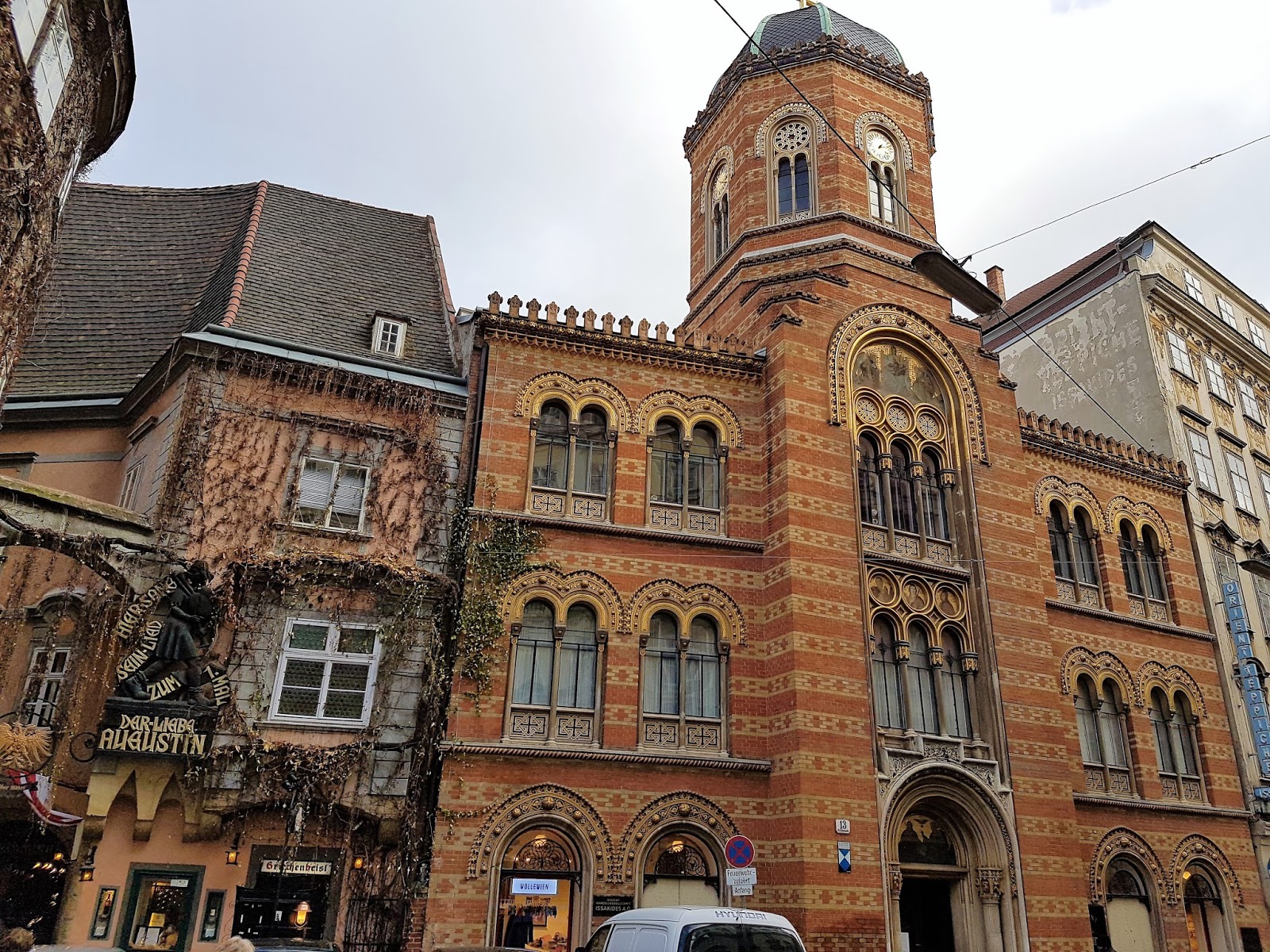
Another church that really stood out as unique, especially in this area, with the red brick and gold! I had no idea what it was, but it's the Grieichische Kirche (Greek Church).
I was curious about the Austrian royalty now, so I hunted down a few more of their buildings. The Hofburg Palace houses the Austrian National Library, which is pretty cool for a book nerd like me! Plus, the building is just stunning! I also found it remarkable that the library actively seeks out the rightful owners of books that were taken by the Nazis during WWII and tries to return them (over 30,000 have been returned).


Tuesday, December 27, 2016
The Family Who Started World War I - Wien Part 2 (Schloss Schönbrunn)
I will start the second post on Vienna with a few tips about Austria that I've learned so far. The first is that Google Maps is useless for public transit. For some reason, it isn't properly linked in with Austrian transit and gave no info for Vienna (and incorrect info for Salzburg). You're better off using the local sites directly (which have an English option); for Vienna it's Wiener Lienen (click link to go directly to the site).
My second tip is to ALWAYS check transit passes or city passes. For Vienna, I arrived late, so bought a 48 hour pass and thought one or two additional tickets my last day would be cheaper. As it turns out, I should have just bought the 72 hour pass still - a day pass was cheaper than 2 tickets and the 72 hour pass would have still saved me a couple Euro! I find that the transit passes are nearly always worth the money, but the city passes vary - some provide discounts only and some offer free entry to virtually everything, so check to see if you'll get your money's worth (I didn't buy one for Vienna). The Schloss was the only paid site I ended up visiting and you receive a timed ticket.
 Schloss Schönbrunn is a former summer palace of the Habsburg monarchy. It started in 1548 as Katterburg and was purchased by the "Holy Roman Emperor" Maximillian II, which is when it joined the royal family. It didn't take on its current appearance until Maria Theresa, who is mentioned frequently in the tour, received it as a wedding gift and changed it in the 1740-50s. She was also the only female Empress of Austria. It doesn't look much like a French palace, but does resemble the Prussian and Swabian palaces that I saw, probably because all three areas belonged to the "Holy Roman Empire" in the past.
 When I went through, I knew nothing of the history and the tour wasn't very helpful with that. I think this is true of many tourist sites though - they assume you have a base level knowledge of the history, which I clearly don't. My American education didn't include a lot of detail on European history, outside of those pesky wars they got into (and we saved them from) and the evil English monarchy, who we overthrew.
The tour talked a lot about Maria Theresa and "Sisi," but it wasn't clear to me who they were or who was alive first. Now, I've learned that Maria Theresa was alive first because I looked up more myself online. She was also the mother of Marie Antoinette! Since you cannot take photos inside, here is a stock photo from wikipedia:
 It was interesting to visit and the hour-long tour (there's a short option too) gives a lot of details about the rooms and, interestingly, paints a rather unflattering picture of royal marriage. Of Maria Theresa's 11 children who survived to adulthood, only her favorite daughter was allowed to marry for love. Maria Theresa herself had been very in love with her husband, but I also learned online that he was perhaps not as enthusiastic and had many affairs. In addition to updating the palace to it's look today, Maria Theresa also had the Gloriana built, which can be seen on the hill below:
 The other famous ruler mentioned often was Franz Joseph I, who married Elisabeth "Sisi" when she was 16. He loved her very much, but she was quoted as saying some rather unflattering things about marriage. Apparently, she was shy and introverted by nature, so court life didn't suit her and her mother-in-law was unpleasant to deal with. Her husband was also king of Hungary and Sisi found she liked Hungary better, so after the suicide of her only son, she spent a great deal of time alone there. Sisi had a rather tragic life since her 3 oldest children were removed from her care by her mother-in-law, her oldest daughter died as a toddler and, about 10 years after her son's death, she was assassinated herself.
 One of the advantages of spending time with friends is the possibility of a full picture (no selfie)! While hard to tell in a winter coat, all of the healthy food options in France have resulted in losing 12 lbs in less than 3 months. It's crazy to really try and struggle in the US, but eat whatever sounds good in France and lose easily.
As for the family who started World War I, it turns out that the Austrian assassination that triggered the war was the nephew of Franz Joseph I, who became his heir when his son died. Franz Joseph I was actually relieved that his nephew, who he disliked, was no longer his heir; however, Austria now had an excuse to declare war on Serbia and try to get part of the Balkans back. Nobody expected all of the various allies to jump into the fray, but they did! Hard to believe that something so tragic started that way.
 While the palace tour was good, it was really the grounds that I liked the best. In fact, I returned with my camera to see if I could get a few good photos. The weather really cooperated with me and there was a lovely golden glow when I was there, which faded just as I was leaving. Photography really is about being in the right place at the right time . . . of course, that's tough at tourist sites that are crawling with people!
 It was great to spend some time with Jen and her family, although Michael joked that he didn't understand why I did it during one chaotic moment. I come from a big family though, so I'm used to kid chaos! It's a small trade-off to share moments with people, which can be a nice break from solo travel.
And there will actually be a part 3 for Vienna! When traveling, it's a challenge to share the differences in culture, food and the historical "people context," which is what I find really fascinating in history, and still keep things short. A few of my regular readers have told me they really enjoy the historical background, so I'll keep providing it! For me, I enjoy when I learn enough to make me curious, then I start putting all of the pieces together - "oh, that's the assassination that triggered the war . . . wait, but nobody liked him? How on earth did WWI start over a guy that nobody liked?!?!?"
My second tip is to ALWAYS check transit passes or city passes. For Vienna, I arrived late, so bought a 48 hour pass and thought one or two additional tickets my last day would be cheaper. As it turns out, I should have just bought the 72 hour pass still - a day pass was cheaper than 2 tickets and the 72 hour pass would have still saved me a couple Euro! I find that the transit passes are nearly always worth the money, but the city passes vary - some provide discounts only and some offer free entry to virtually everything, so check to see if you'll get your money's worth (I didn't buy one for Vienna). The Schloss was the only paid site I ended up visiting and you receive a timed ticket.

The tour talked a lot about Maria Theresa and "Sisi," but it wasn't clear to me who they were or who was alive first. Now, I've learned that Maria Theresa was alive first because I looked up more myself online. She was also the mother of Marie Antoinette! Since you cannot take photos inside, here is a stock photo from wikipedia:


And there will actually be a part 3 for Vienna! When traveling, it's a challenge to share the differences in culture, food and the historical "people context," which is what I find really fascinating in history, and still keep things short. A few of my regular readers have told me they really enjoy the historical background, so I'll keep providing it! For me, I enjoy when I learn enough to make me curious, then I start putting all of the pieces together - "oh, that's the assassination that triggered the war . . . wait, but nobody liked him? How on earth did WWI start over a guy that nobody liked?!?!?"
Subscribe to:
Posts (Atom)