Showing posts with label Working in France. Show all posts
Showing posts with label Working in France. Show all posts
Thursday, May 11, 2017
Q&A: Do the French Ever Work/Do They Hate Work/Are They Lazy? (Given the 35 Hour Week, Holidays, Vacation . . .)
In one moment, you will be redirected to the new blog.:-)

Thursday, February 16, 2017
French vs. American Healthcare
Advantages of the French Medical System:

Update on my Knee:
For those who are interested, as mentioned above, it appears that I tore the meniscus. I was allowed to try walking without the splint if I could tolerate the pain, but unfortunately it took less than two days of trying to walk around at work without it before my whole lower leg and foot swelled back up and every step was painful again . . . so I'm back in the splint until after the MRI and treatment is determined.
Of course, I had my own comedy routine on Monday and there really should have been video. I had asked the doctor if I could drive with the splint off and she said, "if you can?" I thought this was like the walking and referred to my pain level, so I was determined to tough it out and have my freedom back! So, I tried to sit in the car and realized that I had to move the seat back. I was quite proud of myself when I was in, foot on the gas pedal and ready to go . . . except I was so far back that I couldn't fully clutch. "Ok, so I'll scoot the seat forward a bit. Yep, I can fully clutch now!" Pushed the clutch in and went to press the brake to start the car. And learned the doctor literally meant if I was actually physically CAPABLE of driving when I can only bend my knee unaided to the position shown below.
 It's enough to sit my foot on the gas, but I tried, and failed, to bend my knee enough to actually raise it off the gas and onto the brake. I yanked on my pant leg, moved my leg to the brake by hand and went to start the car before the less-stubborn, more-logical part of my brain suggested that perhaps it was not wise to drive, especially a manual, when I'd just had to use my HAND to transfer my foot from the gas to the brake. This was proven quite true when an attempt to transfer my foot back over unaided resulted in my foot half on both peddles and a bit wedged between them.
So, there will be no driving for me through Feb 28. Hopefully, there will be good news then and I'll only need a few weeks of physical therapy! If not, I'll be facing surgery in a foreign country. The period of time since I injured my knee is the first extended period when I've wanted to return to the US - at home, I know how to take care of myself. Here, the forms are in French, the instructions are in French, many of the people only speak French. Naturally, I'm in France, but it adds a level of complication that is really unpleasant when you're already hurt.
- There doesn't seem to be any cost-benefit analysis done. If there is a risk, even minor, that you could die of a blood clot, they will treat you. Update: they also do not wait for you to have a life-threatening reaction before prescribing an EpiPen equivalent. If you have a food allergy that causes respiratory issues, they prescribe it - as the doctor noted, the reactions are often progressive and you could easily die before medical services reached you.
- Even uninsured medical costs are so low that I mistakenly thought they were my post-insurance rate. Twice. 23 Euro for an uninsured doctor's visit? 88 Euro for DAILY injections at home by a nurse for two weeks? Oh right - attending university is free here, so they don't need to pay college-educated people crazy high salaries just to afford their student loans . . . that's one way to keep the gap between "rich" and "poor" narrower for sure. There is a premium paid for college-educated people (you still invest your time after all), but it isn't nearly as large as in the US. This is also NOT a for-profit system, so every level of the medical industry doesn't need to carve out their profit at levels that satisfy shareholders.
- While I pay A LOT of taxes, the overall percentage for somebody like me is not actually that much different from what I paid in the US, plus my health care premiums, plus the FSA to be certain I could always foot the 20% that my insurance didn't cover, plus the higher amount I needed to save for retirement because health care costs are one of the big spend categories for US retirees . . . basically, the difference in France is that many people pay a little more in taxes, but then everyone is also covered if the worst happens. You aren't likely to lose your house here because you get sick or injured.
- They prioritize your health. I could have easily chosen to spend the last 3 weeks off work with nearly full pay. Except, I didn't really feel it was necessary with my job and it would have hurt my plant to go through close and year-end adjustments without their only local finance person.
- The doctors actually explain stuff to you. They tell you not only that they've determined you injured a ligament, then later, probably tore the meniscus, but also that it was this particular test where they moved your leg in this or that way which told them what the problem was. It inspires a certain level of confidence in the diagnosis when the doctor openly tells you how they drew that conclusion.
- If you tell a French person that you're calling on Wednesday for an appointment the following Monday, they will be shocked because you're calling so EARLY. Apparently, there must be a much better per-capita number of doctors here than the US if a few days notice gives you your choice of appointment times.
- Doctors will make house calls, if necessary.
- If you can't drive, there is an "ambulance" service that is made up of normal cars to provide medical transportation. I will be using one of these for my trip to Poitiers for the IRM (MRI). Or not - I decided to take the train and save a few Euro.

There are really no pictures that go with this post, so you get random French food. This is a super tasty tartiflette
Disadvantages of the French Medical System:- Daily injections? Really? This isn't really a "con" of the system, but I loathe needles and this was a special kind of torture for me.
- While I understand that there can be issues with people abusing painkillers, pain management is kind of important. When somebody has torn a ligament, a week's worth of narcotics is not that big of an issue. Especially when it eventually turns out to be a torn ligament and meniscus.
- Even though most French people aren't paying for them, I'm not sure what the point is in prescribing a full box of medication instead of just the number prescribed. I guess the upside is that I can tally up my prior leftovers before filling a prescription, just to be sure I actually need it! It also saves time at the pharmacy - they just grab the boxes and send you on your way.
- Again, probably because there is virtually no cost to the individual (and the gov pays either way), you are required to see a doctor if you miss even a single day of work. Otherwise, you're taking vacation pay for it. It comes across like your employer doesn't trust you, but actually the government won't reimburse their share without proof you were ill/injured.
- Due to the house call issue, your doctor really needs to be in your town. You can't just pick the person in a town 20 minutes away who your friend recommended.
- There can be a little wait for certain non-emergency procedures. Like, my MRI can't be done until February 28. But, I've had to wait in the US for non-emergency MRIs also . . . and there is certainly a long wait for many specialists in the US. It was over a month both for a dermatologist and a hand surgeon.
Update on my Knee:
For those who are interested, as mentioned above, it appears that I tore the meniscus. I was allowed to try walking without the splint if I could tolerate the pain, but unfortunately it took less than two days of trying to walk around at work without it before my whole lower leg and foot swelled back up and every step was painful again . . . so I'm back in the splint until after the MRI and treatment is determined.
Of course, I had my own comedy routine on Monday and there really should have been video. I had asked the doctor if I could drive with the splint off and she said, "if you can?" I thought this was like the walking and referred to my pain level, so I was determined to tough it out and have my freedom back! So, I tried to sit in the car and realized that I had to move the seat back. I was quite proud of myself when I was in, foot on the gas pedal and ready to go . . . except I was so far back that I couldn't fully clutch. "Ok, so I'll scoot the seat forward a bit. Yep, I can fully clutch now!" Pushed the clutch in and went to press the brake to start the car. And learned the doctor literally meant if I was actually physically CAPABLE of driving when I can only bend my knee unaided to the position shown below.

So, there will be no driving for me through Feb 28. Hopefully, there will be good news then and I'll only need a few weeks of physical therapy! If not, I'll be facing surgery in a foreign country. The period of time since I injured my knee is the first extended period when I've wanted to return to the US - at home, I know how to take care of myself. Here, the forms are in French, the instructions are in French, many of the people only speak French. Naturally, I'm in France, but it adds a level of complication that is really unpleasant when you're already hurt.
Thursday, February 2, 2017
A Serious Injury in France - Part 2 and Great Friends
The differences in France and the US when it comes to healthcare are a little surprising. I don't think that I've ever heard of somebody with an immobilized limb getting daily injections to prevent blood clots in the US, but PB has asked me multiple times about this and was acting like I was in grave danger of imminent "death by blood clot" because I went the whole first week without the injection (largely due to difficulty finding a nurse). It's also weird that they just hand you these boxes of injections, so PB had a valid threat when he said if I didn't find a nurse, I would force him to inject them himself.
By the way, if I do die tragically from a blood clot - PB, you were right. As always. Postulate #1. 😁
 Frankly, I would probably have went ahead and gotten the injections (why take an unnecessary risk, no matter how small?), except for two small problems. The first is that I tried to register my social number and it wasn't valid - apparently, a "temporary number" is basically useless. It wasn't until January 30th that I finally received a valid social number . . . which I registered and my information was promptly sent out. To my old address. Apparently, my HR folks forgot to update the address with CPAM (although the prefecture has my correct address). Of course, governmental departments don't really share information in the US either, so this is no different. Everything seems to be working smoothly now with my certificate of rights, even without the Carte Vitale.
The second problem is that, despite a large British ex-pat community in the area, I have had serious issues finding English-speaking medical care. The doctor that I saw in the neighboring town won't drive to my town. Unlike the US, you may not be able to call your doctor when they've, say, given you a prescription that you're allergic to - the doctor is too busy to return calls. But they'll make a freaking house call . . . as long as you live in the same town basically. So, no more doctor in the neighboring town (the nurse that was recommended in the same town also won't drive here for my injections).
So, I started the great quest to find more English-speaking medical people. The next nurse I called also told me that their group is too far away and gave me the number of two groups that are closer. I postponed calling the new places because I was a little concerned about daily nurse visits without confirmed insurance. Once it was confirmed, the nurse's group in my area had inconsistent English ability, so PB gave them his number as my contact person. He was thus able to arrange for my daily torture, which is probably good because I would have quit after the first two! Check out the bruise from the first one - can you blame me for wanting to skip them! The second one left a smaller bruise, about the size of a penny . . . and the third looks like it might be the best of all. Which is good, because I was beginning to wonder how they'd possibly find room for 14 (let alone 21) of these.😱
 I have to say that I'm happy I live in an area with a large British ex-pat community at the moment because they really came through on medical suggestions! I now have the name of an English-speaking doctor and dentist, plus the nurses. I'm only missing an eye doctor. My new doctor is great, but sadly leaving the area in July. She'll at least be able to get me through the rest of my knee treatment - at the one week mark, she determined I'd actually injured TWO ligaments and that the swelling was not down as much as it should have been. I was lectured on being less active, but persuaded her that I could still work AND be less active. PB persists in refusing to fetch my coffee though, which really undermines his assertion that he's become my highly-paid assistant.😂
In addition to PB looking after my medical care (and occasional transportation), l'américaine has been super helpful with driving me back and forth to work most days, taking me to get lunch and buying some of my groceries. I'm super lucky that I picked a place that is close to work, so it's not SUPER inconvenient for people. It is still a hassle though because they have to consider my schedule, such as me needing to eat in order to take my medication . . . so I have to be home by a certain time. Another woman, YV, volunteered to drive me to my doctor's appointment, which was also really nice and a third co-worker has offered various forms of help too. My team takes good care of me during the week, but I was a little concerned about the weekend. It was pure luck that Alexis' knee had healed up and he'd arrived back in town the weekend before (I was actually getting him from Poitiers when I hurt myself), so he offered to come by on Saturday. He ended up looking after me nearly the whole day and assembled my shelves, table and chairs for me (and cleaned up the packaging). Plus, he took me to get groceries, helped unpack some of my stuff, hung my curtains, washed my dishes and cooked us dinner. Yep, I've been very, very fortunate to meet some really great people in France!!!

By the way, if I do die tragically from a blood clot - PB, you were right. As always. Postulate #1. 😁

The second problem is that, despite a large British ex-pat community in the area, I have had serious issues finding English-speaking medical care. The doctor that I saw in the neighboring town won't drive to my town. Unlike the US, you may not be able to call your doctor when they've, say, given you a prescription that you're allergic to - the doctor is too busy to return calls. But they'll make a freaking house call . . . as long as you live in the same town basically. So, no more doctor in the neighboring town (the nurse that was recommended in the same town also won't drive here for my injections).
So, I started the great quest to find more English-speaking medical people. The next nurse I called also told me that their group is too far away and gave me the number of two groups that are closer. I postponed calling the new places because I was a little concerned about daily nurse visits without confirmed insurance. Once it was confirmed, the nurse's group in my area had inconsistent English ability, so PB gave them his number as my contact person. He was thus able to arrange for my daily torture, which is probably good because I would have quit after the first two! Check out the bruise from the first one - can you blame me for wanting to skip them! The second one left a smaller bruise, about the size of a penny . . . and the third looks like it might be the best of all. Which is good, because I was beginning to wonder how they'd possibly find room for 14 (let alone 21) of these.😱

In addition to PB looking after my medical care (and occasional transportation), l'américaine has been super helpful with driving me back and forth to work most days, taking me to get lunch and buying some of my groceries. I'm super lucky that I picked a place that is close to work, so it's not SUPER inconvenient for people. It is still a hassle though because they have to consider my schedule, such as me needing to eat in order to take my medication . . . so I have to be home by a certain time. Another woman, YV, volunteered to drive me to my doctor's appointment, which was also really nice and a third co-worker has offered various forms of help too. My team takes good care of me during the week, but I was a little concerned about the weekend. It was pure luck that Alexis' knee had healed up and he'd arrived back in town the weekend before (I was actually getting him from Poitiers when I hurt myself), so he offered to come by on Saturday. He ended up looking after me nearly the whole day and assembled my shelves, table and chairs for me (and cleaned up the packaging). Plus, he took me to get groceries, helped unpack some of my stuff, hung my curtains, washed my dishes and cooked us dinner. Yep, I've been very, very fortunate to meet some really great people in France!!!

Thursday, January 26, 2017
A Serious Injury, CPAM and the French Medical System
One of those things that I worried about, but hoped would never happen, came to pass this week. I have a partial tear of a ligament in my knee, which means I'm in a thigh-to-calf splint for the next 3 weeks (potentially a month and a half . . . or an additional month and a half? There was a small language difficulty). The worst part - I live in small rural town and I cannot drive.
Well, the pain may actually be the worst part because it doesn't appear to be customary to prescribe strong painkillers the first visit, even for a serious injury (not even Tramadol, which is what I prefer because it isn't as strong and is an opioid, but non-narcotic). This would potentially be ok, since I was given a prescription dose of a painkiller similar to Tylenol, a prescription dose of Naproxen Sodium and a pain relieving cream . . . except I'm allergic to soy, which I told the doctor (in French), yet I was prescribed a soy-containing pain cream. Unlike in the US, you apparently cannot just call your doctor and tell them that there's a problem with your prescription or that your pain is not even remotely well-controlled. You can try, but you'll be told by the receptionist that the doctor is too busy to return a call and you'll have to make an appointment. Are. You. Freaking. Kidding. Me?!?! The doctors here will make a house visit to ensure you have your required note for missing a day of work, even for a cold, but not return a phone call. Not even to correct their own mistake. Incredible.
 Now that I know that, I've changed my mind about continuing to see a doctor in the town 20 minutes away who speaks the best English because, as I also learned, they won't make a 20 minute drive for the house calls. I learned this when I tried to contact the recommended nurse for my DAILY injection. This is another interesting difference from the US. I've had limbs splinted or immobilized before and never had an injection required. After having it prescribed in France, I looked up why this might be. It's because they've studied the risk of a clot and it's near zero if you don't have at least 3 risk factors (I don't), so it's been determined that prophylactic treatment is not recommended. The French all took it as gospel that I would need this treatment (but of course you need the injection!) and joked that Americans are simply content to let natural selection take its course for the poor tiny percentage of the population that could be impacted by this.
I'm guessing it also has something to do with the fact that a daily house visit from the nurse isn't so objectionable when the combination of your socialized health care and extra mutuelle coverage is footing the bill. Can you imagine the cost of a nurse coming to your home for three weeks to administer a daily injection in the US? 😨 Not only would people not agree to pay for it, the for-profit insurance in the US would surely refuse.
So, outside of the apparent reluctance to prescribe anything remotely suitable for the pain caused by a torn ligament, French doctors have no qualms about prescribing you the entire remainder of the pharmacy stock. This is what I left the pharmacy with:
 There's also no need for silly bottles. If you were prescribed 14 pills, they just sell you the full box of 16. Presumably nobody cares since they're not paying out-of-pocket. Of course, if you're not French, then you've probably also encountered the most incompetent branch of the French government well before you've needed any medical care.
In direct contrast to my experience of getting my work permit issued in a week and my visa arriving promptly, plus the prefecture finding me an appointment before my visa expiration, CPAM seems to delight in it's ability to be completely dysfunctional. First, they incorrectly told my human resources department that I was not eligible for a social number (or Carte Vitale) until I'd been in the country for 3 months. My immigration attorneys assured me that this was not true with the visa type that I have, plus they sent the link to the French government website that proved this.
It's unclear whether the next problem was CPAM or my co-worker, but somehow this issue never progressed further until I complained to PB that I'd been in the country for nearly 3 months, paying high social taxes and for a mutuelle policy that I couldn't use, with no Carte Vitale to show for it. He followed up with my co-worker, who possibly never tried to clarify with CPAM about my visa type. My dossier was finally sent over and, several weeks later, PB followed up again. CPAM informed us that they'd received no such dossier. My co-worker forwarded the proof that we'd filed. CPAM then miraculously found my file, which had been assigned to somebody who was out on leave of some sort. It seems that CPAM was content to leave my file waiting on a desk until whenever the person returned, but they were finally persuaded to do something with it.
PB laughed a bit while telling me that I was having my first experience with TRUE French bureaucracy. Apparently, the French just accept this as the way things are here, which could be why so many of them are in favor of politicians who want to fire a significant number of civil servants! Finally, in early January, I was issued my "temporary" social number and told that a bill of rights would be mailed to me. The mutuelle insisted that my temporary number could not be used for registering with them. Fine, I'll continue to wait.
Well, this became a problem when I injured my knee. Even though I should have been covered from the day I arrived, because my human resources folks didn't persist and file until December, I'm told I have coverage as of December 22. But, without a Carte Vitale, I have to pay upfront and hope that the French government will actually reimburse me.
 The cost in France for an uninsured "urgent care" visit to a doctor? Twenty-three Euro. Yes, that's the entire cost. The pharmacy, on the other hand, set me back over two hundred Euro, but that was for the entire stack of medication and the knee splint.
So, financially, the lack of proof of insurance has not been so terrible. Of course, I have no idea where to send my "factures" or invoices, in order to be reimbursed. The CPAM has quit responding to my employer when an update is requested as well (I should have pushed for my US HQ to include this in the services that the immigration attorneys were hired for - they seem able to persuade the government to actually do its job). I will say that PB has made it his personal mission this week to resolve the issue and has our HR staff working on it studiously. My understanding is that they will help me get reimbursed and to register with the mutuelle, regardless of my lack of Carte Vitale.
My fears before this experience centered more around what I would do if I were seriously injured in a country where I don't have any long-term friendships yet and no family to call on. As it turns out, I was worried about something that hasn't really happened yet. Le Américaine has helped a lot with buying my groceries for the week, driving me to the doctor and taking me back and forth to work. Alexis, who is back in the area, brought me an ice pack and is going to help with my furniture assembly. Another co-worker has also offered to pick up groceries for me or help with any other errands. A new friend offered to accompany me if I needed surgery, so I'd have an interpreter. On the other hand, PB had a brief moment of acting like I'd injured myself during the WORST POSSIBLE TIME (our CEO visited this week) just to inconvenience him, but then he recalled that I just received a large set of knives as my 5 year service gift 😈 . . . er, I mean he recalled that he generally likes me and should be more concerned that I'm injured than about the poor timing of the injury.
I have learned that there are a lot of things that are a bit of a challenge when you can't bend one knee. Like getting up from any sitting position without something to grab on to. On the other hand, my left leg is going to have quads of steel and I'll be able to swing my lower body around using my arms like a gymnast! My poor right quad is having a time of it though as I pulled it trying to swing my sock around and catch my foot in it like a net. You know, socks are overrated anyway. As are shoes. I posed this question on my FB, but fuzzy blue slippers are proper work attire, right?
 To my relief (and surely that of PB), I managed to wrangle a sock and (untied) shoe onto my foot prior to our CEO's arrival and have not yet had to wear fuzzy slippers in public. Which I'm pretty sure a French person would view as sufficient public humiliation to justify a home visit and a doctor's note to skip work.😊
Well, the pain may actually be the worst part because it doesn't appear to be customary to prescribe strong painkillers the first visit, even for a serious injury (not even Tramadol, which is what I prefer because it isn't as strong and is an opioid, but non-narcotic). This would potentially be ok, since I was given a prescription dose of a painkiller similar to Tylenol, a prescription dose of Naproxen Sodium and a pain relieving cream . . . except I'm allergic to soy, which I told the doctor (in French), yet I was prescribed a soy-containing pain cream. Unlike in the US, you apparently cannot just call your doctor and tell them that there's a problem with your prescription or that your pain is not even remotely well-controlled. You can try, but you'll be told by the receptionist that the doctor is too busy to return a call and you'll have to make an appointment. Are. You. Freaking. Kidding. Me?!?! The doctors here will make a house visit to ensure you have your required note for missing a day of work, even for a cold, but not return a phone call. Not even to correct their own mistake. Incredible.

I'm guessing it also has something to do with the fact that a daily house visit from the nurse isn't so objectionable when the combination of your socialized health care and extra mutuelle coverage is footing the bill. Can you imagine the cost of a nurse coming to your home for three weeks to administer a daily injection in the US? 😨 Not only would people not agree to pay for it, the for-profit insurance in the US would surely refuse.
So, outside of the apparent reluctance to prescribe anything remotely suitable for the pain caused by a torn ligament, French doctors have no qualms about prescribing you the entire remainder of the pharmacy stock. This is what I left the pharmacy with:

In direct contrast to my experience of getting my work permit issued in a week and my visa arriving promptly, plus the prefecture finding me an appointment before my visa expiration, CPAM seems to delight in it's ability to be completely dysfunctional. First, they incorrectly told my human resources department that I was not eligible for a social number (or Carte Vitale) until I'd been in the country for 3 months. My immigration attorneys assured me that this was not true with the visa type that I have, plus they sent the link to the French government website that proved this.
It's unclear whether the next problem was CPAM or my co-worker, but somehow this issue never progressed further until I complained to PB that I'd been in the country for nearly 3 months, paying high social taxes and for a mutuelle policy that I couldn't use, with no Carte Vitale to show for it. He followed up with my co-worker, who possibly never tried to clarify with CPAM about my visa type. My dossier was finally sent over and, several weeks later, PB followed up again. CPAM informed us that they'd received no such dossier. My co-worker forwarded the proof that we'd filed. CPAM then miraculously found my file, which had been assigned to somebody who was out on leave of some sort. It seems that CPAM was content to leave my file waiting on a desk until whenever the person returned, but they were finally persuaded to do something with it.
PB laughed a bit while telling me that I was having my first experience with TRUE French bureaucracy. Apparently, the French just accept this as the way things are here, which could be why so many of them are in favor of politicians who want to fire a significant number of civil servants! Finally, in early January, I was issued my "temporary" social number and told that a bill of rights would be mailed to me. The mutuelle insisted that my temporary number could not be used for registering with them. Fine, I'll continue to wait.
Well, this became a problem when I injured my knee. Even though I should have been covered from the day I arrived, because my human resources folks didn't persist and file until December, I'm told I have coverage as of December 22. But, without a Carte Vitale, I have to pay upfront and hope that the French government will actually reimburse me.

So, financially, the lack of proof of insurance has not been so terrible. Of course, I have no idea where to send my "factures" or invoices, in order to be reimbursed. The CPAM has quit responding to my employer when an update is requested as well (I should have pushed for my US HQ to include this in the services that the immigration attorneys were hired for - they seem able to persuade the government to actually do its job). I will say that PB has made it his personal mission this week to resolve the issue and has our HR staff working on it studiously. My understanding is that they will help me get reimbursed and to register with the mutuelle, regardless of my lack of Carte Vitale.
My fears before this experience centered more around what I would do if I were seriously injured in a country where I don't have any long-term friendships yet and no family to call on. As it turns out, I was worried about something that hasn't really happened yet. Le Américaine has helped a lot with buying my groceries for the week, driving me to the doctor and taking me back and forth to work. Alexis, who is back in the area, brought me an ice pack and is going to help with my furniture assembly. Another co-worker has also offered to pick up groceries for me or help with any other errands. A new friend offered to accompany me if I needed surgery, so I'd have an interpreter. On the other hand, PB had a brief moment of acting like I'd injured myself during the WORST POSSIBLE TIME (our CEO visited this week) just to inconvenience him, but then he recalled that I just received a large set of knives as my 5 year service gift 😈 . . . er, I mean he recalled that he generally likes me and should be more concerned that I'm injured than about the poor timing of the injury.
I have learned that there are a lot of things that are a bit of a challenge when you can't bend one knee. Like getting up from any sitting position without something to grab on to. On the other hand, my left leg is going to have quads of steel and I'll be able to swing my lower body around using my arms like a gymnast! My poor right quad is having a time of it though as I pulled it trying to swing my sock around and catch my foot in it like a net. You know, socks are overrated anyway. As are shoes. I posed this question on my FB, but fuzzy blue slippers are proper work attire, right?

Monday, January 16, 2017
Learning French, McDo's and How the French Diet Turns US Advice on Its Head
My last two weeks of work have been busy with year-end and my weekends have been mostly spent doing highly exciting things, like assembling furniture and unpacking boxes. The upside is that I have a complete living room, guest bath and kitchen now (pictures to come soon)! The guest room is also usable, although the furniture isn't refinished yet.
Only a dining room set, coat closet, bedroom armoire, utility room stand, upstairs bathroom cabinet and office furniture to go! 😐 I finally caved and hired people with power tools to help with the kitchen because EVERY thing had to be assembled, including the drawers, and it both required power tools AND more than two hands.
Since there isn't a lot to report, I thought I'd share a few cultural gems with you!
Learning French
French culture comes through even in a textbook to learn French. First, the list of annoyances, where a husband who is always absent AND an American boyfriend both make the list. Why only have one man to annoy you when you can have two! 😂


Only a dining room set, coat closet, bedroom armoire, utility room stand, upstairs bathroom cabinet and office furniture to go! 😐 I finally caved and hired people with power tools to help with the kitchen because EVERY thing had to be assembled, including the drawers, and it both required power tools AND more than two hands.
Since there isn't a lot to report, I thought I'd share a few cultural gems with you!
French culture comes through even in a textbook to learn French. First, the list of annoyances, where a husband who is always absent AND an American boyfriend both make the list. Why only have one man to annoy you when you can have two! 😂

Also, all nouns are either male or female in French, which I've been exposed to with Spanish, so it wasn't a big surprise for me. I did find this example of "male" and "female" nouns funny though - remember folks, "the problem" is male and "the solution" is female! I will say that I doubt I'll forget that "eme" is a male ending and "tion" is female now, so this was a clever choice!

While I really enjoy the text that I'm learning from, I'm glad that PB is supportive of me taking more actual French lessons because I find that I can read quite a bit of French, but I'm uncomfortable speaking French because I'm not quite sure on the pronunciation. Of course, Alexis is back this weekend, so reading with him again will help, and I have a few new people I met through a conversation exchange site who are helping me with my French in exchange for help with English.
There are varying degrees of help that you get through the conversational partners though. Some of them seem content to only correct me if what I've said cannot be understood. Most of them start off correcting everything, but as the conversation starts to flow, they switch to only asking or correcting when they don't understand. I only have one person who has continued to correct everything, which is what I need! There are seven total people that I started talking with, but the first woman only replies about once a week, which isn't enough for me to really build on my French. One other woman and one of the men have sent a sentence here and there, also not really helpful. I do have consistent daily conversations with four people now, who vary in age from 21 to 43; however, the consistent writers are all men. One of them lets me use my very limited spoken French to practice speaking on calls and another leaves messages in slow French with the translation in English. I then respond in as much French as I can, mixed with English when I don't know the word. And he then replies with the correct French, so that's helping as well! It seems like you could potentially make friends in this way, so it's a little disappointing that the women haven't been more responsive. 😩
McDo's
I discovered shortly after returning to France that it doesn't seem like I'm allergic to cow dairy anymore. My docs had said it is an allergy that people can "grow out of," but I didn't have high hopes (even though I'm no longer allergic to eggs). Since dairy is not a life-threatening allergy for me, I'd occasionally try something to see. I tried something small here and nothing happened. So, I tried something with a higher amount of dairy - nothing. Time for a full-on dairy meal - cheese in salad, butter in potatoes and dessert was ice cream with whipped cream on top (and fruit). Still absolutely nothing. In the past, I would have felt like I had food poisoning. I've cautiously eaten dairy since then with no issues still after several months. Of course, after not eating it for so long, I no longer have a taste for many dairy products. I prefer coconut milk, many types of chèvre and sorbet still (especially dark chocolate); however, I am thoroughly enjoying real French butter, soft mild cheeses (like brie) and cream-based sauces!
Given that I can eat cheese again, the other day I decided to eat something I haven't had in over 5 years - a BigMac. While the McChicken tastes different here (better I think), the BigMac tastes the same as I remember. I don't eat McDo's often - usually only a couple of times per month and primarily only when I get busy and realize I've missed the dedicated French lunch hour (good luck finding a restaurant that will serve you after 1-1:30 PM) or I have no food at home on a Sunday (when stores & normal restaurants are also closed). I have occasionally stopped in there when I was feeling particularly challenged with French as well - even though I order from the French menu now, it's a touch screen and I don't have to speak French, just read it!

On another random McDo's trip, I tried a chèvre burger because I find the local touches interesting (same reason I tried a McDos special in Switzerland, where you can design your own burger - bacon avocado in my case). The chèvre burger wasn't bad, but it wasn't really good either. The beef isn't greasy, like at home, nor is it drowning in sauce, so if the bread isn't "same day" fresh, the McDos burgers can be a little drier than I prefer.

In addition to the normal local offerings, McDos appears to experiment here more than I recall occurring in the US. They temporarily replaced the potato wedges, that I love, with "New York style" chips shortly before I left France. Right after I returned, the wedges were again replaced with thick herb fries, which I also liked. I don't care for the regular fries here though - they aren't like the US. It isn't just the potatoes they experiment with; currently, the special offer is a burger with ketchup and ranch or mustard and ranch or a fish sandwich with ketchup and ranch. To the best of my knowledge, ranch is not popular in France, so this seems like a strange offering!
While I'm a little embarrassed that I eat McDos while living in France, it's clearly not hurting me (nor is my weekly pineau and random glass or two of wine) because I've lost 15 lbs in 3 1/2 months of living in France. And that's with working 10-12 hour days nearly every Monday-Thursday (9ish hours on Fridays) and no real exercise, outside of walking on the weekends.
Update on the French Diet
It's interesting because the French diet throws everything you're taught in the US about "how to lose weight" out the window, yet I lose weight here without really trying and it was a constant struggle to avoid gaining weight during the three months that I was back in the US.
It really makes one question the wisdom of the US diet industry. Whereas the current advice is to eat 5-6 small meals per day (for blood sugar, metabolism, etc), the French do not snack generally. While this is not true of EVERYONE, the majority of the French that I know eat a small breakfast (piece of baguette with jam, croissant, pain au chocolat, etc) and/or fruit with coffee. Lunch is a large meal with 2-3 courses, unless dinner is expected to be large, then the lunch and dinner meal will be switched. If lunch is 3 courses, dinner will often be just soup or fruit or a similar small thing; however, I choose to do a 2 course lunch and have a 1 course "plat" (main dish) dinner at home.
The primary difference between how I was eating in the US and here ALSO goes against common diet advice in the US. I consistently eat more carbs in France. My breakfast is basically just carbs and fat, no protein (pain au chocolat or with raisins or a croissant with jam) and coffee, whereas I used to eat primarily protein (eggs). My lunch is usually a slice or two of baguette with a starter that varies from veggie soup to quiche to a meat pâté or terrine - so, sometimes good protein and sometimes not. The main dish is typically about half carbs (couscous, rice, pasta, potatoes, etc) with a small amount of salad (think 5 leaves of lettuce) in vinaigrette and the other half of the main dish is about half meat and half veggies, often with a sauce of some sort. Again, less protein than my typical US lunch, although a lot more veggies (and carbs). Along with less protein, the protein source is different because red meat is less common here and there are a lot more turkey, duck and rabbit dishes. If you have dessert, it's also basically carbs and fat (usually with fruit), but lunch is always followed by hot coffee. And most of my dinners have also evolved to about half carbs, half veggies & meat. I still eat red meat at home with about the same frequency as in the US though. In total, my lunches are bigger and my dinners smaller, but I was never super hungry between meals when I first moved here, so I've never had the feeling that I'm eating less.
The other change is one that I made in the US, then slacked off on, and have now re-established here. I traded out artificial sweeteners for sugar in the US, yet I lost weight. Again, contrary to the "more calories=more weight" mantra. I continued to do so in France because artificial sweeteners are almost non-existent here, especially in restaurants. More recently, I replaced all added sugar in my coffee and tea with honey at work and at home, so the only sugar cubes I'm using are 2-4 times per week when I have coffee at a restaurant. The honey usage is a personal thing, not French, but again, they use sugar here, not artificial sweeteners.
And while not all French people are thin, they have much lower rates of obesity than the US and the rest of the European Union. It really makes you question the health advice in the US and what we've done to our food to make maintaining a healthy weight so challenging! I just started an regular "30 minutes a day" exercise routine, so the contrast won't be as clear going forward.
Thursday, December 22, 2016
A French Christmas Party
I'm sure it will come as a surprise to nobody that the French know how to throw a good party! What may surprise some people is learning that I almost didn't go. With L’américaine in the US and PB not expected to return from the US in time to attend, I was envisioning an entire night surrounded by people speaking exclusively in French. It didn't sound fun. 😱
I decided to suck it up and go anyway and was pleasantly surprised when PB drove from Paris to attend the party after all (even though he had to turn right back around the next morning and go to Le Mans). I was sure that at least PB would speak English with me; however, it turned out that I didn't need him for that after all!
I'd asked a little about what people wore and heard everything from jeans to "just wear what you normally do" to "a cocktail dress is good." Since he generally doesn't lead me astray (and kept me from naming myself after a cow), I asked PB for the final word, "What do people normally wear to this dinner?" PB looks at me frowning, like he isn't sure what I mean. So, I clarify, "Should I wear something like I'd normally wear to work or a nice red Christmas dress I have from the US?" There was a little back and forth, but the conclusion was that PB would be wearing a nice black suit and, if it wasn't too much trouble for me to find in my boxes, the red Christmas dress would be nice.
 Yeah . . . about that. My normal work attire is West Coast business casual, but most of my co-workers dress just casual because we're in the country. Other than PB and GO, who were in suits, everyone else was basically in jeans with a nice shirt. There were a couple of skirts with a blouse. When I walked in and realized this, I debated just returning home to change, but people had already seen me and I decided I was just going to rock the Christmas dress! Of course, when I told PB I wasn't happy with him, he just gave the typical Gallic shrug and said the dress was nice, so he didn't see the problem? Really?!?
Things got much better from there though. I ended up talking with one of my female co-workers, SB, and we had a very nice conversation. She also realized that my emergency contact people consisted of two men (PB and Alexis) and gave me a look of wide-eyed horror at the thought that I could have a medical issue as a woman that I would NOT want translated by them. She told me that she would be happy to help me with anything like that, so I didn't have to take a man. I pointed out that this could include a 2 AM hospital visit one day and she assured me that she understood and it was no problem. I'm not sure if this is an indication that my coworkers like me more than I realized or French people are just MUCH more generous with their time than Americans.


I decided to suck it up and go anyway and was pleasantly surprised when PB drove from Paris to attend the party after all (even though he had to turn right back around the next morning and go to Le Mans). I was sure that at least PB would speak English with me; however, it turned out that I didn't need him for that after all!
I'd asked a little about what people wore and heard everything from jeans to "just wear what you normally do" to "a cocktail dress is good." Since he generally doesn't lead me astray (and kept me from naming myself after a cow), I asked PB for the final word, "What do people normally wear to this dinner?" PB looks at me frowning, like he isn't sure what I mean. So, I clarify, "Should I wear something like I'd normally wear to work or a nice red Christmas dress I have from the US?" There was a little back and forth, but the conclusion was that PB would be wearing a nice black suit and, if it wasn't too much trouble for me to find in my boxes, the red Christmas dress would be nice.

Things got much better from there though. I ended up talking with one of my female co-workers, SB, and we had a very nice conversation. She also realized that my emergency contact people consisted of two men (PB and Alexis) and gave me a look of wide-eyed horror at the thought that I could have a medical issue as a woman that I would NOT want translated by them. She told me that she would be happy to help me with anything like that, so I didn't have to take a man. I pointed out that this could include a 2 AM hospital visit one day and she assured me that she understood and it was no problem. I'm not sure if this is an indication that my coworkers like me more than I realized or French people are just MUCH more generous with their time than Americans.

I'm really not used to my food still looking like a living animal, let alone looking like they're cuddling! I still ate them though.😋
The party had started with gifts for the kids, then service awards. This was followed by orange juice cocktails and champagne, plus various "finger foods" circulating on trays. I had the opportunity to try my first escargot - it was blended up with spices and was really good! Then, one of the chefs came out and was cooking up fresh seafood and turkey skewers. It was around this time that I noticed that I always seemed to have an English-speaking coworker (or partner) standing with me, but it wasn't until we were getting ready to sit for dinner that I heard a few of them discussing the seating to be sure that people who spoke English well were sitting near me - it appears that it was intentional that I always had somebody nearby speaking English or helping translate! I really do have great coworkers! 😃
Normally the dinner starts around 9 PM, but it was after 10 PM this year before we sat down and had the first course (shown above), which was a salad with foie gras (which I don't like and sat aside). After the first course, the lights were suddenly turned off, music started and people got up and started dancing. "Wait, that's it for dinner?" Nope - they just dance or sing between each course! Next up was the dish including shrimp, then karaoke, then a small sorbet with alcohol (to cleanse the palate) and then more karaoke. Finally, the main dish came out.
Normally the dinner starts around 9 PM, but it was after 10 PM this year before we sat down and had the first course (shown above), which was a salad with foie gras (which I don't like and sat aside). After the first course, the lights were suddenly turned off, music started and people got up and started dancing. "Wait, that's it for dinner?" Nope - they just dance or sing between each course! Next up was the dish including shrimp, then karaoke, then a small sorbet with alcohol (to cleanse the palate) and then more karaoke. Finally, the main dish came out.
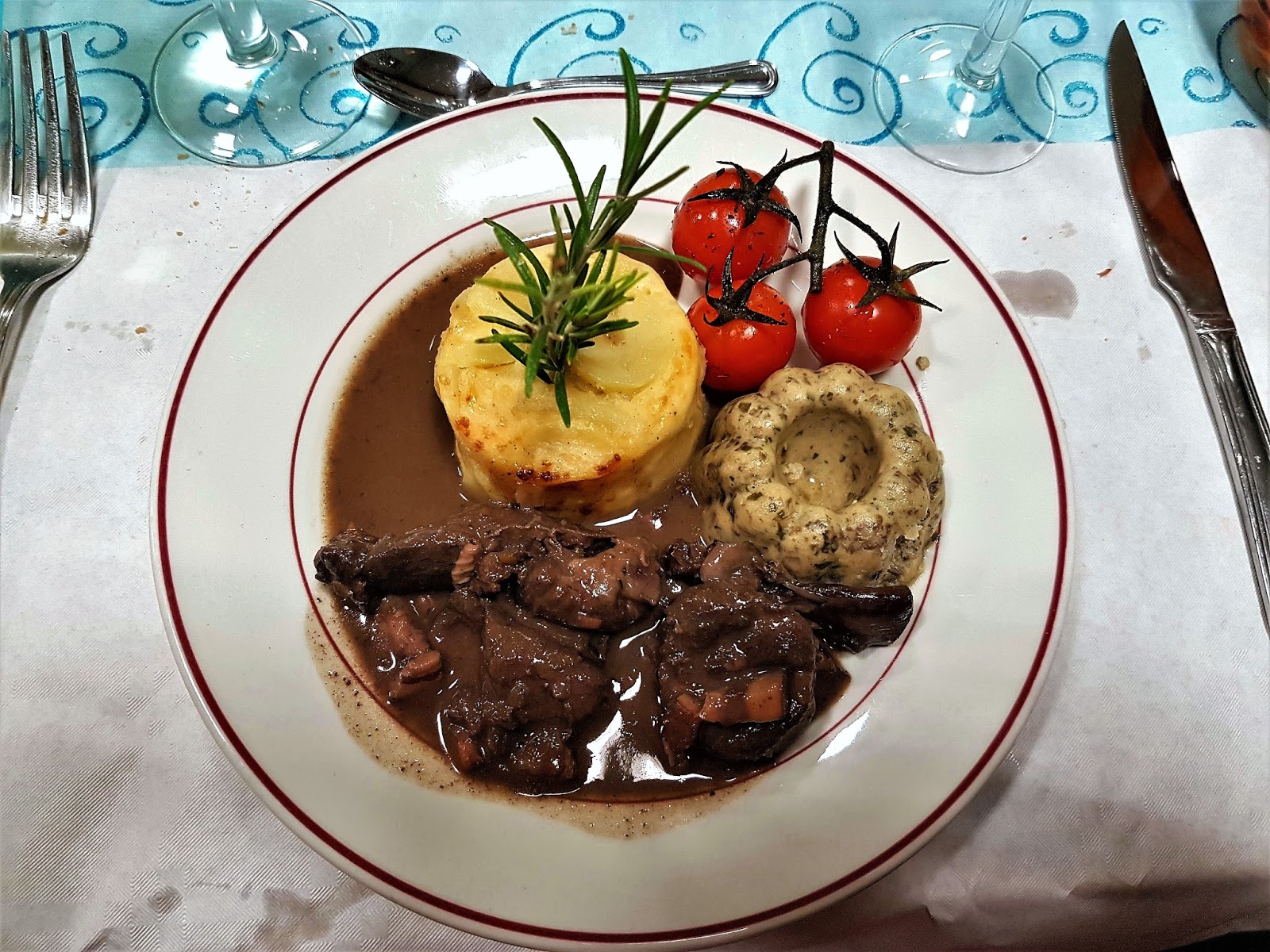
We all thought it was beef, but I was suspicious after the first bite. Sure enough, it turned out to be chevreuil, which is a type of small deer. It was good, but definitely didn't taste like beef! The little mold to the right was a mushroom dish and cheesy potatoes to the left. Even though each course was on a small salad-sized plate, it was still a lot of food! After dinner, it was back to dancing. By now, people had a few more glasses of wine in them, so it was a larger crowd that hit the dance floor and I decided to join them.
The French do not dance like Americans, at least not at a Christmas party. People moved to the music, but nobody looked like they were overtly trying to be "sexy" and when a French guy asked me to dance, we were just standing in front of each other dancing and talking - I didn't see anyone dancing super close, even couples! It was definitely more comfortable for me than the parties you attend in the US where you're certain some people are going to regret their behavior the next morning (for the record, the US portion of my company has a Christmas lunch only, so this would not be in reference to my company).
The French man that I danced with also offered to help me with translation issues or shopping or whatever I might need help with, which was very nice! So, I ended the night with two new people who have offered to help me in France.
In the end, I left just after 2 AM, but before dessert had been served. My appliances were showing up the next morning and I needed to get some sleep! I was told that it is common the party goes until around 3 AM - wow.
The French do not dance like Americans, at least not at a Christmas party. People moved to the music, but nobody looked like they were overtly trying to be "sexy" and when a French guy asked me to dance, we were just standing in front of each other dancing and talking - I didn't see anyone dancing super close, even couples! It was definitely more comfortable for me than the parties you attend in the US where you're certain some people are going to regret their behavior the next morning (for the record, the US portion of my company has a Christmas lunch only, so this would not be in reference to my company).
The French man that I danced with also offered to help me with translation issues or shopping or whatever I might need help with, which was very nice! So, I ended the night with two new people who have offered to help me in France.
In the end, I left just after 2 AM, but before dessert had been served. My appliances were showing up the next morning and I needed to get some sleep! I was told that it is common the party goes until around 3 AM - wow.
Monday, December 12, 2016
Obtaining a French Residency Card and Renting a Home in France
Obtaining a French Residency Card
I've read horror stories about prefecture appointments and the difficulty involved in getting a Carte de Séjour, so I was expecting an unpleasant experience. In my case, I was pleasantly surprised; however, this may have been because my documents were prepared by immigration attorneys and I had a French-speaking assistant who came with me.
The start to the appointment was rather ominous because the man looked at my documentation and muttered about never seeing a "European Blue Card" application before, that he didn't know what was required for my dossier and that he hoped we were prepared to be at the prefecture for a LONG time (all in French, of course). I came across the same lack of knowledge about a European Blue Card at the consulate - it appears that not many people take advantage of this visa, even though it's one of the easiest ways to immigrate to France from a non-EU country. Of course, you have to meet the educational or work experience requirements, plus a salary requirement, but then you're entitled to the same benefits as a resident and have a path to permanent residency.

Moulin Rouge, 2009
Fortunately, the prefecture official came back quickly with the binder for the European Blue Card (aka "passeport talent") and was able to confirm that I had all of the required documents and French translations. Ironically, my original documents were barely glanced at. All they really cared about were the colored copies that were stamped by the official translator and the translations. Since I'll have my new address within 8 days of the appointment, they also issued my card with my new address so I didn't have to return to change it.
The official was actually extremely nice and seemed pleasantly surprised that I understood most of the French and was able to give my address and other information in French. So, I am now in possession of my temporary card (through May 2017) with my permanent one on the way! I officially have the legal right to live and work in France for the next four years! 😊
The official was actually extremely nice and seemed pleasantly surprised that I understood most of the French and was able to give my address and other information in French. So, I am now in possession of my temporary card (through May 2017) with my permanent one on the way! I officially have the legal right to live and work in France for the next four years! 😊


Paris 2009 with a truly awful hair cut!
TIP: If you don't have utilities in your name, an attestation of insurance coverage is adequate proof of address (along with your rental contract) for the prefecture. This also worked when opening my French bank account.
Renting a House in France
I'm very fortunate that I have the general manager that I do! Clearly, it's not part of his job responsibilities to help me with my house (which falls squarely into the "personal" arena in France), but he did it anyway. It would have taken me hours to understand everything that was being said, try to make sure the contract reflected what we agreed on and I probably would have been so distracted trying to translate that I would have missed things (which was my experience when viewing houses initially). PB was able to quickly communicate with the owners, was meticulous about noticing everything and made sure that certain things would be done before I moved in and that they were noted in the contract (like a holder for the shower head).
If you do not speak fluent French and you know ANYONE who does, enlist their help! The tenant is responsible for basically any damage that is not noted on the move-in report (and not normal wear-and-tear). PB also told me to take photos of everything. The couple I'm renting from seem like very nice people, but PB was insistent that I needed to be cautious to protect myself.

I'd read of other ex-pats having trouble getting utilities turned on in their name (or needing the phone number of the prior occupant to switch the phone over); however, I had no difficulties. What is strange is that the owners were able to provide my info to the electric and water company without me ever speaking to the companies myself and the bills will apparently be in my name now; this would not happen in the US! (UPDATE: I received a form to sign and confirm) Most of the sites for internet service asked for the prior phone number, but I was able to select an option to use my address instead. After comparing offers, the offer from Orange was the best for my area. Orange's site was all in French, but I understand enough that I was able to order service (and it was supposed to be on by the 15th, then I received a 2nd message for the 21st - that turned out to be for my TV service though). The owners indicated that I should contact the local mayor's office to determine what to do about trash pickup - usually the website for the commune will have that info, but the one for my town is useless in that regard. It did inform me of the rate for my tax d'habitation next year though!

For those who don't know, tax d'habitation is a tax that renters pay, which I believe is a percentage of the rent. It is based on where you live on January 1, but is not due until later in the year (the bill at my current house arrived in November, due in December). This is on top of the tax that the property owner pays (which is likely passed down to the renter as well through the rent price)!
Monday, December 5, 2016
Homesick and Co-hosting a Birthday Party in France
The last couple of weeks have been a little rough for me. I missed my first major family holiday (Thanksgiving) and it was especially difficult to see the photos and realize that I'm missing out on all of these moments. I'm also missing all of my niece's "firsts" since she was just one month old when I left. I know my nephews and niece won't really remember these years when they're older, but could I really live here beyond 3 to 4 years? Could I be happy as the aunt/sister/daughter/friend who only shows up once or twice a year? I'm not sure I can answer that yet.
What made it worse was having PB tell me that I always have to be here for year-end inventory and I won't ever get to go home for Christmas (before I arrived, I'd been told I always had to take the week of Christmas off for the plant shutdown, so this was an unpleasant surprise).😢 Fortunately, he reversed course a little when he realized that I was upset about this - while I do need to be here for the year-end inventory, in 2017 I could still fly out on Saturday, the 23rd, and be home for Christmas. The same would be true in other years as well, so he told me that he's certain that we can work something out.
 The other thing that suddenly started bothering me was just acknowledging that I'm living in a country where I have no family and no long-term, really close friends. I have friends here now, but I think it would feel like more of an obligation if I needed their help with something serious (say, a 2 AM hospital visit), whereas I have friends in the US who would WANT to be there if I really needed them (and I'd similarly want to be there for them). In other words, I have friends here who'd help me move, but not help me move bodies. 😉
I know my blog probably seems mostly positive because I truly do love France, but I've come across a few ex-pat blogs now and it's pretty consistent that we all have tough times.
I've been lucky to avoid the bureaucratic issues mostly, although nobody seems to be able to figure out HOW to get me a social number. I've also been fortunate to make a few friends quickly, but you just don't replace friendships of years, or decades, so easily. Given that, I view occasional homesickness as normal . . . but I'm glad it passed again for now!
Co-Hosting a French Birthday Party
On another topic, Alexis and I had a tough time trying to decide what to do for L’américaine's birthday. Should we bring flowers, a good cheese and champagne to the festival? But then what would she do with them all day? Maybe we could buy her something at the festival? We wandered off alone a couple of times to look around, but we couldn't decide on anything specific to buy for her since everyone pretty much bought what they really wanted on the spot.
We finally decided that we should host a dinner party for her (and I requested the same main dish he'd made for me). Since L’américaine and Alexis are neighbors, it was more convenient to have it at his house. With the long hours that I often work, we decided that it made more sense for him to do the main dish. He also wanted to do the apéritif, which I thought just meant alcohol, so I offered to manage the entrée, dessert and flowers. It turns out an apéritif can be more than just a few chips or peanuts with your drink, it can be a lot of small bread pieces with different toppings, so we skipped a separate entrée. With just dessert and flowers, I felt like I was getting off pretty easy, especially since the birthday celebration had been my idea, but Alexis insisted that it was "his pleasure."
 I showed up 30 minutes early to help get everything ready and had a minor moment of embarrassment because I was showing Alexis my temporary Carte de Sejour and he immediately noticed and asked about my "divorced" status. I hadn't really thought about it being on my card when I showed it to him nor had I realized that he didn't already know I'm divorced. I wasn't quite sure what to say about it other than to confirm that yes, I am indeed a divorcée. Fortunately, L’américaine showed up then and I was spared having to decide if I was required to provide any further explanation.
Overall, the dinner went well, although with champagne to start and pineau with dinner (which is stronger than wine), the conversation became rather lively as the evening went on! It also went a little late for a work night, but I didn't realize until the following day that I'd left Alexis with all of the cleaning as well! 😔
 It is funny that there are so many things about French culture that seem foreign to us that L’Américaine and I still ask some of the same questions of new French people, like, "Is it really true that if a guy smiles at you and you smile back, he will assume you're interested?" The answer has consistently been "yes," but as Americans, we smile back just to be polite. It's a real learning curve to discover that simple things like this can lead to a misunderstanding! It's so unbelievable for us that we've had to ask four different French people if this is ACTUALLY true.
It's also entertaining to watch a French person's reaction to learning that it is perfectly acceptable in the US to go on a first date on Friday night, kiss the guy, and go out with a different guy on Saturday and kiss him too . . . and neither guy would assume he was your boyfriend! Not that all US guys would like this or all women do it, but if you want to watch a French person's eyebrows raise up nearly into their hairline, explain this little bit of American dating etiquette to them. 😂 Or that you can do whatever you want with other people until you actually discuss your dating status. There's nothing so simple as "we kissed, so we're exclusive" in the US!
Sadly, Alexis is now gone for the next couple of weeks, so I was "forced" to expand my social circle even more by meeting up with EX-PATS! More on this in my next blog.
What made it worse was having PB tell me that I always have to be here for year-end inventory and I won't ever get to go home for Christmas (before I arrived, I'd been told I always had to take the week of Christmas off for the plant shutdown, so this was an unpleasant surprise).😢 Fortunately, he reversed course a little when he realized that I was upset about this - while I do need to be here for the year-end inventory, in 2017 I could still fly out on Saturday, the 23rd, and be home for Christmas. The same would be true in other years as well, so he told me that he's certain that we can work something out.

I know my blog probably seems mostly positive because I truly do love France, but I've come across a few ex-pat blogs now and it's pretty consistent that we all have tough times.
I've been lucky to avoid the bureaucratic issues mostly, although nobody seems to be able to figure out HOW to get me a social number. I've also been fortunate to make a few friends quickly, but you just don't replace friendships of years, or decades, so easily. Given that, I view occasional homesickness as normal . . . but I'm glad it passed again for now!
Co-Hosting a French Birthday Party
On another topic, Alexis and I had a tough time trying to decide what to do for L’américaine's birthday. Should we bring flowers, a good cheese and champagne to the festival? But then what would she do with them all day? Maybe we could buy her something at the festival? We wandered off alone a couple of times to look around, but we couldn't decide on anything specific to buy for her since everyone pretty much bought what they really wanted on the spot.
We finally decided that we should host a dinner party for her (and I requested the same main dish he'd made for me). Since L’américaine and Alexis are neighbors, it was more convenient to have it at his house. With the long hours that I often work, we decided that it made more sense for him to do the main dish. He also wanted to do the apéritif, which I thought just meant alcohol, so I offered to manage the entrée, dessert and flowers. It turns out an apéritif can be more than just a few chips or peanuts with your drink, it can be a lot of small bread pieces with different toppings, so we skipped a separate entrée. With just dessert and flowers, I felt like I was getting off pretty easy, especially since the birthday celebration had been my idea, but Alexis insisted that it was "his pleasure."

Overall, the dinner went well, although with champagne to start and pineau with dinner (which is stronger than wine), the conversation became rather lively as the evening went on! It also went a little late for a work night, but I didn't realize until the following day that I'd left Alexis with all of the cleaning as well! 😔

It's also entertaining to watch a French person's reaction to learning that it is perfectly acceptable in the US to go on a first date on Friday night, kiss the guy, and go out with a different guy on Saturday and kiss him too . . . and neither guy would assume he was your boyfriend! Not that all US guys would like this or all women do it, but if you want to watch a French person's eyebrows raise up nearly into their hairline, explain this little bit of American dating etiquette to them. 😂 Or that you can do whatever you want with other people until you actually discuss your dating status. There's nothing so simple as "we kissed, so we're exclusive" in the US!
Sadly, Alexis is now gone for the next couple of weeks, so I was "forced" to expand my social circle even more by meeting up with EX-PATS! More on this in my next blog.
Subscribe to:
Posts (Atom)