Thursday, March 30, 2017

Abroad Edition: An American on Palawan

While my primary purposes in choosing the Philippines was to visit the girl I sponsor, I was also feeling like I just needed a relaxing vacation.  I tend to plan vacations that are quite busy and full of seeing and doing things, so it's uncommon that I feel the need for a vacation that involves just laying around.

It turned out to be exactly what I needed though!  I arrived with bright ideas of doing morning yoga, swimming, etc.  I did . . . some of it.  First, the flight on AirSwift was great!  It's a little tricky figuring out what to do after you book your flight online because the contact info doesn't appear to be correct, but they give you a nice bag of snacks and water after check-in and you have your own designated seating area at the gates.
When you land at El Nido though, you're nowhere near anything that has the appearance of an airport.  You really get to enjoy a little local experience though with the bus to the airport!
And then you arrive at the airport.  This is the arrivals hut and there is a second one for departures.  I've traveled quite a bit now, so it's uncommon that I see something REALLY shocking, but this was certainly a first for me - clearly, I haven't traveled enough yet!
I was really happy with the place that I chose, even though it was in a secluded location an hour from town.  As you drive through, you really get a sense of the lifestyle of the local people on the island, which introduces an interesting conundrum.  On the one hand, it feels a little uncomfortable (for me) to cruise past a large number of people crammed into a small "bus" for transportation while you're alone in your air conditioned 8 seat van on your way to your "quaint" cottage that is larger than most of their homes.  On the other hand, tourism is the lifeblood of many of these communities.

While I'm not particularly comfortable with Americans buying up islands and prime real estate in impoverished nations so we can turn them into expensive resorts for other Americans, if it provides options for people so they can earn a living without leaving their island, maybe it isn't all bad?
Having said that, the particular American who built this resort did a really nice job with it.  It isn't one of those overdone all-inclusives and has a limited number of cottages.  Above is the beach, which you can see is not crowded with a sea of humans.  You are in the jungle and it feels it - huge plants, more strange looking bugs than I've seen in my life!
Really, this is the place to go if you want sun, tropics and to just relax!  There were water sports (wooden kayaks, stand-up paddle boarding and kite boarding) and island hopping tours, but I was ready for basic relaxation.  I find it difficult because part of me is like, "did I just pay all of this money to lay around, read and swim?  I can do that any number of places!"  Realistically though, it was exactly what I needed!  

One of my favorite things was going on a tour of a local fishing village.  My big plans up until then had been getting a 90 minute massage, but I wanted a real sense of the local life.  On this trip and my trip to Egypt, I've perhaps been a little too brave about trying things because I got sick both trips and, by far, this trip was the worst.  It may or may not have been because I tried coconut wine out of a very dirty bottle!  Of course, it was fermented, so it may not be the most likely suspect!  You can see the tiny bottles in the tree if you look closely.
I will say that my first trips to places with unsafe water, I followed all of the rules.  I relaxed a bit after being told that most major tourist hotels and restaurants use filtered or purified water; however, both trips since then, I've gotten really sick . . . I think it's back to no ice (no matter where from) and only sealed beverages for me.  I know people who take many more risks and never get ill, but I don't seem to have that luck!  Coming down with a serious illness on a flight wasn't as bad as I'd thought though - you have somebody to bring you water and you're forced to rest.  As long as you have an aisle seat, it could be worse!

It was really interesting to see the local houses, then go through one that has been set up as a museum.  There's also a huge traditional boat that you can view as a museum.  It's interesting to see how they manage to make such clever use of everything in their environment with coconut shells, bamboo, etc. employed as spoons, containers to store documents, food storage and even weaving leaves to make the roofs.  The houses are raised off the ground both for storm surges and because of wild pigs.
While it was fascinating to see, I also enjoyed knowing that the local village benefits from part of the fee for the tour.  It was also interesting to see my first mango grove!
At the end, I had the opportunity to participate in a traditional healing, so I figured, "why not?"  The healer burns some herbs in a small pot and you breathe in the smoke.  A small white item is placed in there and will turn a color with a shape on it to indicate what type of evil spirit may be troubling you . . . except I apparently have no evil spirits around and mine stayed pristine white.

The women seemed a little perplexed by this (hopefully not because I'm an American) and decided to try a slightly different second process.  This time, there was some bubbling, but still pristine, which I was told means that I have been around evil spirits before, but passed them by because my own spirit is too strong and fought them off.  They weren't trying to sell me anything else, so I'll take it!

Shortly after, it was back on a plane to Manila, then the next day was my flight home.  Palawan was a lovely place to get some relaxation and to see another corner of the world where people still live in a very traditional way!

Thursday, March 23, 2017

Abroad Edition: An American in Manila

I elected to fly Emirates this trip because I've heard from frequent travelers that their service is fantastic . . . and it's true.  The food was good, they had an amazing entertainment system and the legroom in standard coach was more than adequate.  The chairs recline partially into your own space, but enough that it's the first decent sleep I've had on a plane since my 2006 trip to Europe.  Of course, my connection was in Dubai, which was using an impressive amount of water for this display.
I've also realized how privileged I am to be an English-speaker.  Everywhere I've gone in the world, airport signs were in the local language and English.  Egypt and Dubai?  Arabic and English. Japan? Japanese and English. France? French and English.  I can't imagine how much more difficult traveling would be if I couldn't read the signs or the departure boards.  Not to mention the large number of people globally who speak English as their primary second language.
Upon arriving in the Philippines, I quickly learned that the internet is not up to Western standards - the WiFi at my hotel didn't work two of the three nights I was there.   Even the WiFi card that I rented barely worked.  I also hadn't planned for a wait while they checked my room for additional charges.

Having said that, I enjoyed my time in Manila.  My first day was a visit with my sponsored teen.  The majority of the details on that day are on my blog for sponsor travels here:
Manila Visit. Here is a photo of us together though.
I will say that sponsoring kids is one of my great joys!  It's such a small amount ($32) to make such a difference for them!  In a country, Guatemala, where less than 10% finish high school and youth unemployment is unimaginably high, my first two teens are both employed high school grads. My Filipina is the first in her family to be in college also.  I like to spoil the whole family when I visit though!
My second day in Manila was spent on a tour with Philippines Tours and Holidays.  The guide is originally from Europe, but married a Filipina and moved here several years ago.  We went to the American Cemetery first, which is for soldiers who died in WWII.  When you see the massive walls of names, you can begin to understand why, at the time, the US thought dropping a couple of bombs and ending the war was a good idea.  More, you wonder why the world keeps fighting endless pointless wars.
It's sad to know 50% of the globe lives in poverty, sadder still that it means each of us who aren't only need to help one person to end it.  Think how peaceful the world could be if we treated everyone as equal human beings and traded fairly for the things they had that we wanted?  You can't help but notice the disparity in income levels present here.
The weather was not cooperative, so the views of the bay were ok, but a little hazy, so we headed to the park earlier.  I was unaware of José Rizal before, but he's a national hero in the Philippines - he's even on the one peso coin, "because everyone can have one peso" as my guide told me.  Rizal was an advocate for better rights for Filipinos during Spanish colonization and supported women fighting for their rights.  He was falsely accused of been part of a violent rebellion and executed. 
The rest of the park is a little more peaceful, with the Japanese and Chinese Gardens and other areas we didn't make it to because my knee decided it was time for a break!
We were off to Intramurus then!  This is the old Spanish walled city.  We went to the Fort first, where they're constructing a new lovely plaza, but you still have access to the old ruins, which were heavily damaged in WWII.
This section is still original, but some areas were rebuilt with red brick after the war - not the best idea, but it's interesting to get a feel for the design of the fort.  There's also a museum about Rizal.  We then saw two famous churches in the area - I somehow missed a photo of the first, but did get a quick photo of the San Agustin church.  I later learned this is also a UNESCO World Heritage Site.
It appears that the same five guys who built many of the churches in France also had relatives building them here!  There are clearly shared features and they hold their own in comparison, although they're not as ornate as Austrian churches.

The nice thing about a private tour is that you can customize, so the early departure from the park resulted in a tour of an old Spanish colonial house instead.
It was a lovely tour and more like spending a day with local friends than a formal tour.  The company will customize tours and even multi -day trips, which sounds like a great plan for a return trip!

Thursday, March 16, 2017

French Banking vs. American Banking

Contrary to my love of most things French, I am not a fan of French banking (so I'll share photos of German food with you today).  
Here are the key differences:

  • Online-Only Banks: They exist; however, they're not accessible for Americans.  You can't submit the IRS-required proof of your social security number for FATCA, so this is a no-go.
  • (No) Free Banking: There is no such thing as free banking in France, at least that I've been able to find.  Sure, you might be able to get a basic account for free . . . with no bank card . . . and potentially no checks?  So, if you can live strictly on cash payments and wire transfers, you're good to go.  Otherwise, get used to paying a fee.
  • Account Withdrawal Limits: There are limits on virtually everything that involves your bank card.  If you didn't receive your PIN for TWO MONTHS like me, then have a lot of things to buy due to an International move, your card will simply stop working.    There is also a limit on cash withdrawals.  I could only guess at the other limits, but I don't seem to have hit them yet . . . you do begin to understand why people still pay for groceries and gas with CHECKS though.  If you hit the limits, you then have to contact your personal banker to raise the limit.
  • Personal Banker: Which brings me to the next item - you will have a personal banker.  Mine seemed very nice and friendly at first, even helping me largely in English (which, considering the bank advertises itself as having English-speaking services, is not that surprising).  Since then, he's been a total pain in my butt.  Primarily, I suspect that it is not his fault, but all of these ridiculous rules that France seems to have . . . however, when I again couldn't use my card and requested an appointment to resolve the issue, no appointment was ever made.  It was finally fixed, without the documentation I was told was MANDATORY, after I threatened to close my account if it wasn't resolved within 24 hours.  My card is AGAIN not working consistently (and not at all for online purchases) and his response was completely unhelpful.  He also ignores any communication I send in English . . . why advertise your bank as serving the needs of English-speakers if my banker will refuse to communicate in that language?
  • Paperwork: You will spend 90 minutes signing your life away just to open a bank account.  You will then receive notifications roughly every other day that some other random thing has been sent to your online message system.
  • Even More Paperwork: Forget about opening an account without proof of address.  I you're lucky, like me, you can provide the insurance attestation (it's good enough for the prefecture to issue a Residence Card, so it should be good enough for the bank) . . BUT, when you move and provide the updated attestation, be prepared for them to tell you that this is not adequate proof of address.  Really?!?  It's adequate proof for immigration purposes, but not banking?  When you then inquire if a water bill is adequate, you'll be told that only an electric bill is sufficient and it needs to be sent within the month . . . for a utility that only sends a bill every two months.  I wish that I were joking.
  • Interest: You can pretty much forget about any sort of interest-bearing account.  The banker opened something for me called a "savings" account, but the only purpose appears to be to stick 30 Euro in there to reduce my monthly maintenance fee.
  • Credit Cards: From what I've seen, a French credit card comes with insanely high interest rates and no grace period, so you're charged interest from the day of purchase.  While this still seemed like a good deal with the discount it would get me on the purchase, PB warned me that they come with all sorts of fees and generally should be avoided.  There does not seem to be credit cards of the US variety, where you have no annual fee and can collect points . . . so that my US card actually pays me for using it.
    • Credit Score: This could be because there are no credit scores in France.  It seems that you're extended credit solely on the basis of your income.  If you fail to pay something, it's also unclear if there is any actual recourse for them to collect the money (probably just the court system)
  • (Lack of) English-Speaking Services: Even the bank that advertised itself as having English-speaking services apparently just meant it has a single English-speaking phone line.  Once you open the account, your online portal, all documents, etc will be in French.  You may, like me, have a personal banker who refuses to respond to English messages.  While I am working on learning French, banking is a pretty complex topic and CRITICAL to understand, so the lack of ACTUAL English-speaking services is a serious challenge.

Thursday, March 9, 2017

Friendship and Dating in France

I'm in Germany this week, but I finally feel like I'm adapting to French friendship and dating.  Last weekend was the best weekend that I've had since I arrived in France - it was the perfect mix of fun with a new person, plus great food (see below) and great conversations with existing friends.
There are some serious adjustments that you have to make when you come to France though.  For example, French men will convey a level of emotion that is just not common with American men . . . unless you're seriously dating or have been friends for a very, very long time.  They will say things like, "You should have known that I will take care of you.  I will always take care of you if I can," or "I don't want to have distance between us" or they will tell you that they care about you and they just want to take care of you until you feel better.  And it's all completely platonic.

They will, however, accuse other French men of liking you . . . for the exact same behavior that they themselves exhibit.😉
At first, this will drive you slightly crazy as an American.  You'll keep reminding yourself that French men are normally VERY obvious if they like you (from what your female French friend told you) and these odd displays of sentiment don't necessarily mean what they would in the US.  You'll occasionally feel slightly put off, like the relationship is bordering on "too much" and wonder if you're going to have to end the friendship.  At some point though, they've stayed safely in the "friend zone" long enough that it just becomes one of those endearing traits of your French male friends.

You'll also learn that French men loathe it when a woman in their life appears to be mad at them or upset with them.  Rather than high-tailing it away from a woman who shows emotion, it seems to launch them into a full campaign to win you back over.  And, for me at least, it's virtually impossible to stay mad at, or upset with, somebody who will not stop acting silly, giving me big puppy dog eyes and calling me "Broooouuuuuk" until they finally get me to smile at them.  I think the only possible way to stay mad at a Frenchman is to refuse to speak to him, look at him or even be in the same room with him.  Otherwise, he will use literally everything that he knows about you to find SOME way to convince you to forgive him.
As for female French friends, my first one moved out of the area for a job, although I plan to visit her in her new town now!  I have a couple of co-workers who may become friends, but people seem to be very cautious here about friendships with colleagues.  Other than that, I've found it more challenging to get women to exchange conversation or to agree to repeated plans.  I did recently find a woman looking to learn better English though, so I've been enjoying our conversations.

This week went exceptionally well for work and I'm visiting friends this weekend, so I'll be back with a German edition next week!  Or not!

Thursday, March 2, 2017

Cooking French Food for a French Person

A strange thing happens when you live in another country long enough and start to build a life there - your blog quits being a story about this great adventure you're having and just becomes a story about your life . . . I'm learning that I'm not quite comfortable with that.

I simply don't want to publish details of private moments on a public blog.  When the highlight of your week was time spent with a friend or the low moment was having someone you trust really let you down, it doesn't feel like a "shareable" moment for me.  I know there are ex-pat bloggers who do it because I've read the blogs, but it doesn't work for me personally.
Having said that, I think there are plenty of broad cultural differences, weekend adventures and other topics that I can post on . . . but we'll see how it goes.  I'll be in Germany for work next week, so that will provide a fresh topic.
One upside of my knee feeling better is that my house is really coming together!  The downstairs is basically finished (living area, dining room and kitchen) and there are only a few non-critical furnishings to build still . . . except my armoire, but that's so large, I will certainly need help.  The other upside is that I've met a new friend since I started driving again, so my social circle is broadening even more.
I also had the bright idea of hosting a dinner again and making a classic French dish for a French person.  It sounded like a great idea when I first decided to do it; however, as I started following the recipe, the doubts began . . . "wow, that looks like a lot of onions.  Really, that much onion?!?  I swear there weren't so many onions at the restaurant."  Then, "there are seriously enough potatoes here to feed 10 people, not 2 people.  How many servings is this . . . I guess that explains the huge pile of onions . . . I swear there can't be enough cheese in that container for all of this."  Followed by, "Ugh, this is what I get for using a tartiflette recipe in English - why would I trust a French recipe that's in ENGLISH!  Merde!"
I did have a small win in managing not to overcook the potatoes, so they were easy to slice and didn't turn into mashed potatoes.  It still didn't quite look right to me . . . and go, "He's probably been eating his mother's authentic-absolutely-perfect tartiflette since he was a toddler.  What level of American arrogance made me think that cooking a traditional French dish for a French person was a GOOD IDEA . . . why didn't I cook something American, like . . . wait, what is actually American food?  Not spaghetti, that's Italian.  Umm, nothing Mexican.  I can cook Indian, but still not American . . . fried chicken?  Do I really have no "go-to" recipes that are originally American?  Screw it - I'm making this tartiflette and he's going to eat it and like it!"😈
In my defense, it must not have been too bad because, even with a starter and dessert to follow, he still ate two servings.  The recipe could use a few adjustments, but the leftovers have been even better - the cheese really melted down in and mixed with the cream & wine sauce, so I'm not too disappointed that I've been eating the leftovers all week.  BUT, it is heavy enough that I'm also not terribly disappointed that the season for making it is winding down and lighter fare is on the way!  Like, a chèvre salad I hope.  I miss my chèvre chaud salads!

Thursday, February 23, 2017

Q&A: Do the French Drink All of the Time?

There are still random amusing things that happen during day-to-day life here, even when I'm mostly stuck at home with an injury.  For example, it took PB four weeks of me not driving before it occurred to him to ask how I was managing to keep food in my pantry.  Fortunately, he's not the main person in France who I turn to for help anymore or I *might* have starved.😂

I really have great co-workers in general though.  L’américaine provided work transportation most days, took me to pick up groceries and out to a few social activities.  PB provided the rest of my work transportation, plus took me for groceries & to the pharmacy; YV drove me to the doctor; SB called the doctor and nurses several times because the secretaries often don't speak English (even if the doctors or nurses do) and CB would have taken me to work every day this week, but my knee was finally healed enough to drive short distances!

And Alexis remains a great (and reliable) friend - I'm lucky to have met him.

Q&A on French Drinking
Since life with a knee injury hasn't been very exciting, I thought I'd post another Q&A.  I've been asked by several people if the French drink "all of the time" or a lot more than Americans.

The best I can say about total consumption is that I read something somewhere (really precise, right?) that said the French drink about the same amount as Americans, but spread out through the whole week, whereas Americans tend to drink their full consumption as "binge drinking" on Friday and Saturday night.
And again, when there aren't particular photos, you get examples of great French food.  Note: there technically *is* wine in the upper right corner.

From personal experience, here are the main differences that I've noticed:
  • It is not a big deal to drink during lunch on a workday.  Most tables seem to have a bottle to share (4+ people) or a glass each.  My company seems to be a little more conservative, so the managers who eat out for lunch typically only drink on Fridays.  L’américaine and I have adopted this habit and we have a pineau per week on "fancy lunch" Fridays.
  • It is nearly impossible to discipline or fire somebody for drinking, unless they are injured on the job or there is some other major incident that can be attributed to their drinking.  You can (and possibly will) have at least one co-worker who smells like they bathed in a bottle of booze, but if they're a functional alcoholic, nothing can be done about it.
  • Most of the French I know do not drink every day.  If they do, it is a glass of wine with lunch or dinner.  The only time I've seen them have multiple drinks in one sitting is at a nice dinner out (pre-dinner cocktail, wine with the starter and wine with the meal usually) or a nice dinner at home with friends (same 2-3 drinks).
  • Beer seems to be consumed only on rare occasions and not often with a meal, usually it's a pre-dinner drink or completely separate from eating.
  • Hard liquor is also consumed much less than in the US.  Most of the stronger alcohol is consumed as a pre- or post-dinner drink, one small serving only and not as a mixed drink.  It is something like a pineau (local specialty), cognac or a good whiskey.  I don't recall seeing a French person have a mixed drink the entire time that I've been here (this is not to say that they don't drink them, just that it is uncommon in my experience).
  • The French seem to be very conscientious about drinking and driving.  Too many people joke about it in the US and don't seem to take it seriously (unless they get caught).  Here, my French friends and colleagues very clearly drink less when they are the driver than if they are at home or not driving.

Thursday, February 16, 2017

French vs. American Healthcare

Advantages of the French Medical System:
  • There doesn't seem to be any cost-benefit analysis done.  If there is a risk, even minor, that you could die of a blood clot, they will treat you.  Update: they also do not wait for you to have a life-threatening reaction before prescribing an EpiPen equivalent.  If you have a food allergy that causes respiratory issues, they prescribe it - as the doctor noted, the reactions are often progressive and you could easily die before medical services reached you.
  • Even uninsured medical costs are so low that I mistakenly thought they were my post-insurance rate.  Twice.  23 Euro for an uninsured doctor's visit?  88 Euro for DAILY injections at home by a nurse for two weeks?  Oh right - attending university is free here, so they don't need to pay college-educated people crazy high salaries just to afford their student loans . . . that's one way to keep the gap between "rich" and "poor" narrower for sure.  There is a premium paid for college-educated people (you still invest your time after all), but it isn't nearly as large as in the US.  This is also NOT a for-profit system, so every level of the medical industry doesn't need to carve out their profit at levels that satisfy shareholders.
  • While I pay A LOT of taxes, the overall percentage for somebody like me is not actually that much different from what I paid in the US, plus my health care premiums, plus the FSA to be certain I could always foot the 20% that my insurance didn't cover, plus the higher amount I needed to save for retirement because health care costs are one of the big spend categories for US retirees . . . basically, the difference in France is that many people pay a little more in taxes, but then everyone is also covered if the worst happens.  You aren't likely to lose your house here because you get sick or injured.
  • They prioritize your health.  I could have easily chosen to spend the last 3 weeks off work with nearly full pay.  Except, I didn't really feel it was necessary with my job and it would have hurt my plant to go through close and year-end adjustments without their only local finance person.
  • The doctors actually explain stuff to you.  They tell you not only that they've determined you injured a ligament, then later, probably tore the meniscus, but also that it was this particular test where they moved your leg in this or that way which told them what the problem was.  It inspires a certain level of confidence in the diagnosis when the doctor openly tells you how they drew that conclusion.
  • If you tell a French person that you're calling on Wednesday for an appointment the following Monday, they will be shocked because you're calling so EARLY.  Apparently, there must be a much better per-capita number of doctors here than the US if a few days notice gives you your choice of appointment times.
  • Doctors will make house calls, if necessary.
  • If you can't drive, there is an "ambulance" service that is made up of normal cars to provide medical transportation.  I will be using one of these for my trip to Poitiers for the IRM (MRI).  Or not - I decided to take the train and save a few Euro.

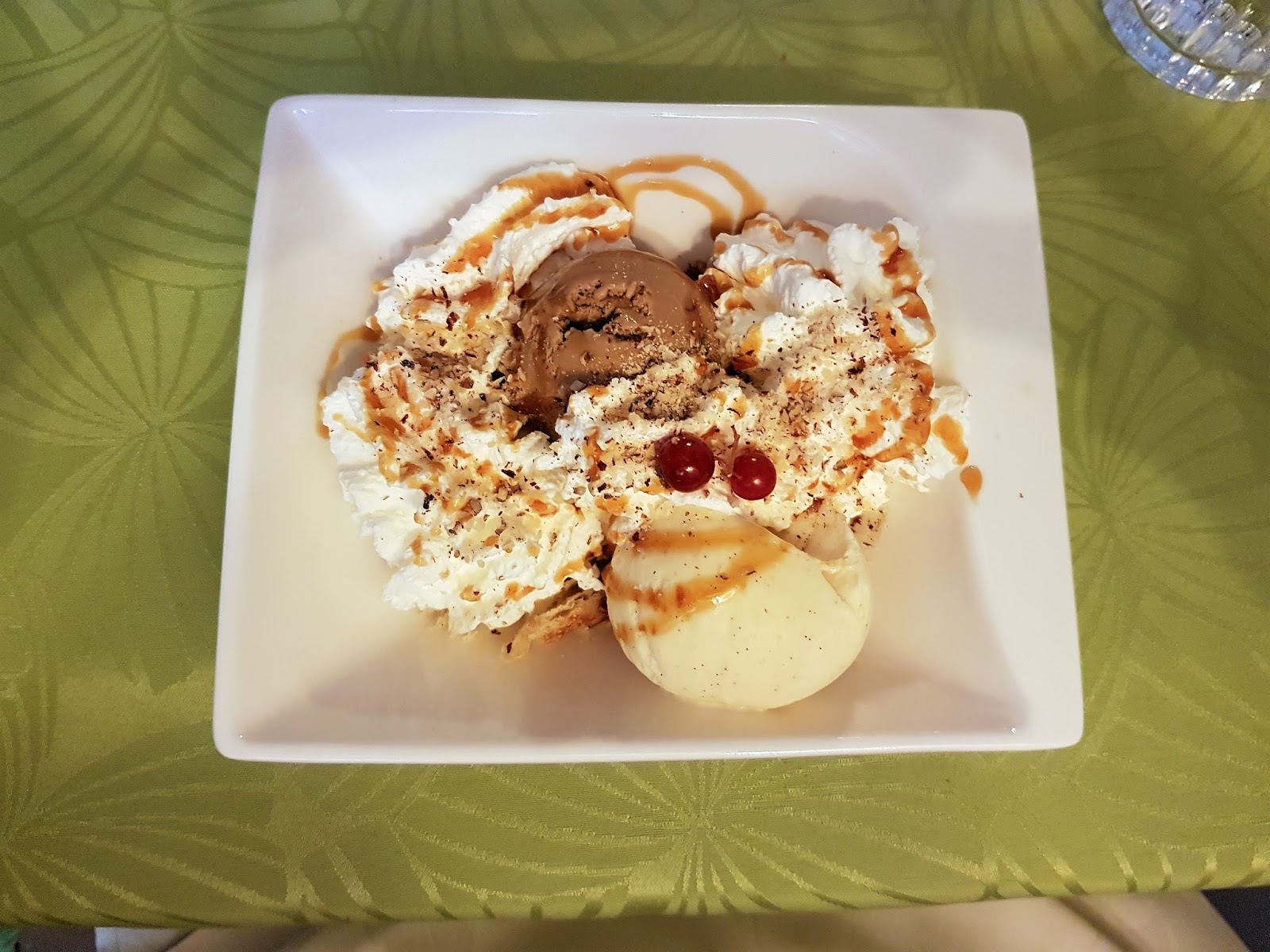
There are really no pictures that go with this post, so you get random French food.  This is a super tasty tartiflette
Disadvantages of the French Medical System:
  • Daily injections?  Really?  This isn't really a "con" of the system, but I loathe needles and this was a special kind of torture for me.
  • While I understand that there can be issues with people abusing painkillers, pain management is kind of important.  When somebody has torn a ligament, a week's worth of narcotics is not that big of an issue.  Especially when it eventually turns out to be a torn ligament and meniscus.
  • Even though most French people aren't paying for them, I'm not sure what the point is in prescribing a full box of medication instead of just the number prescribed.  I guess the upside is that I can tally up my prior leftovers before filling a prescription, just to be sure I actually need it!  It also saves time at the pharmacy - they just grab the boxes and send you on your way.
  • Again, probably because there is virtually no cost to the individual (and the gov pays either way), you are required to see a doctor if you miss even a single day of work.  Otherwise, you're taking vacation pay for it.  It comes across like your employer doesn't trust you, but actually the government won't reimburse their share without proof you were ill/injured.
  • Due to the house call issue, your doctor really needs to be in your town.  You can't just pick the person in a town 20 minutes away who your friend recommended.
  • There can be a little wait for certain non-emergency procedures.  Like, my MRI can't be done until February 28.  But, I've had to wait in the US for non-emergency MRIs also . . . and there is certainly a long wait for many specialists in the US.  It was over a month both for a dermatologist and a hand surgeon.
And . . . well, that's about it (other than dealing with CPAM initially).  Honestly, the disadvantages are more just nitpicky stuff and I can see why it is rated one of the best healthcare systems in the world.  Due to the low medical costs, I've still paid more in taxes than my medical treatment has cost, so it's still a net win for France, but I'm feeling pretty happy about the medical side of the experience.  There are certain specialties here with a wait due to too few doctors, but that's true in the US also (see above).

Update on my Knee:
For those who are interested, as mentioned above, it appears that I tore the meniscus.  I was allowed to try walking without the splint if I could tolerate the pain, but unfortunately it took less than two days of trying to walk around at work without it before my whole lower leg and foot swelled back up and every step was painful again . . . so I'm back in the splint until after the MRI and treatment is determined.

Of course, I had my own comedy routine on Monday and there really should have been video.  I had asked the doctor if I could drive with the splint off and she said, "if you can?"  I thought this was like the walking and referred to my pain level, so I was determined to tough it out and have my freedom back!  So, I tried to sit in the car and realized that I had to move the seat back.  I was quite proud of myself when I was in, foot on the gas pedal and ready to go . . . except I was so far back that I couldn't fully clutch.  "Ok, so I'll scoot the seat forward a bit. Yep, I can fully clutch now!"  Pushed the clutch in and went to press the brake to start the car.  And learned the doctor literally meant if I was actually physically CAPABLE of driving when I can only bend my knee unaided to the position shown below.
It's enough to sit my foot on the gas, but I tried, and failed, to bend my knee enough to actually raise it off the gas and onto the brake.  I yanked on my pant leg, moved my leg to the brake by hand and went to start the car before the less-stubborn, more-logical part of my brain suggested that perhaps it was not wise to drive, especially a manual, when I'd just had to use my HAND to transfer my foot from the gas to the brake.  This was proven quite true when an attempt to transfer my foot back over unaided resulted in my foot half on both peddles and a bit wedged between them.

So, there will be no driving for me through Feb 28.  Hopefully, there will be good news then and I'll only need a few weeks of physical therapy!  If not, I'll be facing surgery in a foreign country.  The period of time since I injured my knee is the first extended period when I've wanted to return to the US - at home, I know how to take care of myself.  Here, the forms are in French, the instructions are in French, many of the people only speak French.  Naturally, I'm in France, but it adds a level of complication that is really unpleasant when you're already hurt.