I find it hilarious that my French friend, Rita, teases me constantly about becoming a traitor to my country and abandoning it for France. The French are under the impression that the US doesn't really support its ex-pats (it doesn't) and, unlike in many countries where living abroad is just an adventure, Americans (at home) are more inclined than many other nationalities to perceive ex-pats as having rejected the country altogether.
Of course, this same friend says that I have a French soul, so perhaps I have rejected my home country in some ways.
I'd like to think that, rather than rejecting the US and US culture in choosing to move, it's more that I can see the pros and cons of both countries and have acknowledged that French culture suits my natural personality better. There are aspects of US culture that feel unnatural to me or fake (and always have), yet the "norm" in French culture is more consistent with how I'd prefer to live my life and interact with others.
Having said that, there are things that are still an adjustment, such as learning that you generally wait in your hotel room until a man, even a co-worker, arrives to pick you up and has the hotel call up to your room to tell you "Monsieur" has arrived. Even if he has to park in a lot and take a ticket. There's no, "I'll be there at this time" with the expectation that you'll be waiting outside or watching to run out and jump in.
I've never minded chivalry, so this suits me just fine, even if it does mean learning a lot of little details about how the cultures differ!
Showing posts with label business travel. Show all posts
Thursday, October 6, 2016
Saturday, June 11, 2016
Returning to the US
I had combed through some ex-pat blogs as my return to the US was coming up and I was curious what the experience of others had been. While my first trip abroad certainly expanded my worldview, subsequent trips to places like Guatemala and Egypt had further changed the way I see the world and people around me.
I can tell you that this is nothing compared to a return home after living abroad for several months. My prior trips had taught me, first, that the US worldview is not shared globally and had challenged me to question the way world events are reported (or not, as the case may be) based on how I saw the same events reported and perceived in other countries. I also saw how differently world history is taught, although, admittedly other countries have the same tendency to focus on their part. For example, WWII is heavy on Pearl Harbor in the US, but Pearl Harbor is a blip on the radar in WWII sites in Europe. Where the US tends to bury its own Antisemitic and Eugenics history, Western Europe tends to openly own theirs and challenges people not to repeat the mistakes of the past.
My trips to Guatemala and Egypt helped me to better understand the level of desperation that would result in people risking their lives to cross deserts or oceans in the hope of a better life - the hope of having adequate shelter, being able to feed their children, to not worry about their house flooding each time it rains. When you're shown where the "rich" people live and it's basically a standard US ranch home on maybe a 1/4 acre, it really drives home that most of us in the US are wealthy by global standards - that the "rich" in many countries live in poorer conditions than the lower-middle class in the US. In fact, the "middle class" in many countries live in areas we'd refer to as "slums" here. Only someone lacking empathy could fail to feel compassion for those who lack our opportunities merely due to the country they were born in.
This adjustment has been even more challenging so far. Right now, everything feels unfamiliar to me. My car has more responsive gas, brakes and steering, which has me peeling out and braking hard on accident. I also keep trying to shift and clutch. My house also feels unfamiliar - I'd forgotten my new neighbors have two dogs that bark constantly; I learned in my one day home that they also fight, slam doors and curse at each other from outside the open front door (fortunately, I can't hear much of what goes on inside the apartment unless they're close to the shared wall). I've acquired a new neighbor in my building who drives the car parked next to mine. I can't remember where all of my things are (primarily those I use infrequently) and I open drawers and am surprised by the contents. I reach out for my phone to the left of my bed, where it was in France, rather than the right. I'm having to adjust to turning lights on by flipping switches up instead of down. I haven't experienced the same sense of not feeling at home that longer term ex-pats describe, but I certainly feel just slightly out-of-place.
After so long away, you don't only notice the big cultural things, but the small ones also. How Americans rush through eating - barely swallowing before shoving the next bite in and surely not taking the time to really savor the taste of their food (for good reason in some cases) and how we're also rushed through eating by servers, with the next course appearing before the last is finished and the check showing up while you're still halfway through dinner. Also, I've noticed how aggressively entitled we are when driving - god forbid you're in somebody's way when they're in a hurry, but if somebody wants to drive slowly in the left lane, well they have the "right" to drive there and you can just wait! I miss the orderly system of driving right and passing left in France! Driving here is much more anxiety-inducing and frustrating.
You also realize how loud Americans are. In France, it's rare to really overhear a full conversation from another table and even more rare that any sort of music is playing above a very low volume. Most rail cars are quiet cars and you step out into the connecting area to take calls, meaning we don't all get to hear the intimate details of people's personal lives. French people also are much less inclined to talk just to hear themselves talk. You realize upon returning to the US that people loudly tell stories about things they're incensed about because it seems they want to be overheard and for others to share in their outrage - not that I think people realize this or do it consciously, but it's clear when you observe it from the outside; the way someone will tell the story about the trashy girl their ex is dating and how his WHOLE family hates her and can't believe he left you, then they subtly look around at others as if gauging whether perfect strangers agree that this is appalling.
And yes, this is a true example of a conversation that loudly took place near me in my one day of being back in the US. I also heard another one about somebody cheating, a mom making underhanded comments about how it must be difficult for her daughter to adjust back to a normal schedule after a week with her dad with "no rules, no bedtime, getting to eat whatever she wanted," about the girl and her boyfriend who keep breaking up and getting back together and people arguing about whether or not the inappropriate story a man was telling was acceptable given the place wasn't "classy" to begin with. All in less than 24 hours. We're loud, folks. And we apparently don't care if strangers around us hear the intimate personal details of our lives whether they want to our not (and trust me, I didn't).
This isn't to say everything is better in France. It's much more common here that we'll strike up a conversation with a stranger about our flight delay and commiserate together over it - even watch each other's luggage for restroom breaks after. Or discover you're both continuing on to Portland and the more experienced International traveler (me) will assist the other in clearing all the re-entry hurdles, forming a brief friendship of sorts. The French are much more stand-offish when it comes to strangers, so these things are not typical there; however, if you're a woman with heavy luggage, you can expect French men will volunteer to carry it up stairs and load/unload it from the train for you, they just won't expect this to turn into a conversation after. They help and are on their way.
The French also don't talk just to be polite beyond "Bonjour." Whereas we're expected to ask, "how are you?" With an expected response of, "Fine" or "Good" and to remember various personal things about co-workers, like how many kids they have, approximate ages, pets, that Fluffy had surgery recently, etc. whether we actually care or even like the person, this is not the French way. If a French person asks how you're doing, they actually care. If they ask what you're doing for the weekend or where you're going on vacation, it isn't polite small talk, but expresses an actual interest in how you spend your time - in other words, something you'd ask a co-worker who's also a friend or you're friendly with, but not every person you work with. In fact, if you ask and aren't personally friendly, it's viewed as invasive and likely won't be answered - hence the perception by both cultures that the others are rude. Which culture is better probably depends on the person, but as a slight introvert, once I understood the "why" behind the French way, I found it rather freeing that there was no expectation that I show an interest in the personal lives of people I barely know. It was also more meaningful when somebody did volunteer info about their family or vacation or weekend because it indicates you've become friendly outside just "co-workers." While it might be rude by US standards not to feign a polite interest in people you really don't care about, at least the French are keeping it real!
The US has one strong positive going for it in my book though - crispy bacon! Bet you can guess what my first American breakfast included! Oh, and my memory foam bed welcomed me home in the best way possible - if I ever relocate, the one piece of furniture that is for sure going with me is that bed! Most comfortable bed I've ever slept on!
I can tell you that this is nothing compared to a return home after living abroad for several months. My prior trips had taught me, first, that the US worldview is not shared globally and had challenged me to question the way world events are reported (or not, as the case may be) based on how I saw the same events reported and perceived in other countries. I also saw how differently world history is taught, although, admittedly other countries have the same tendency to focus on their part. For example, WWII is heavy on Pearl Harbor in the US, but Pearl Harbor is a blip on the radar in WWII sites in Europe. Where the US tends to bury its own Antisemitic and Eugenics history, Western Europe tends to openly own theirs and challenges people not to repeat the mistakes of the past.
My trips to Guatemala and Egypt helped me to better understand the level of desperation that would result in people risking their lives to cross deserts or oceans in the hope of a better life - the hope of having adequate shelter, being able to feed their children, to not worry about their house flooding each time it rains. When you're shown where the "rich" people live and it's basically a standard US ranch home on maybe a 1/4 acre, it really drives home that most of us in the US are wealthy by global standards - that the "rich" in many countries live in poorer conditions than the lower-middle class in the US. In fact, the "middle class" in many countries live in areas we'd refer to as "slums" here. Only someone lacking empathy could fail to feel compassion for those who lack our opportunities merely due to the country they were born in.
Common housing in an area that I sponsor children in
After so long away, you don't only notice the big cultural things, but the small ones also. How Americans rush through eating - barely swallowing before shoving the next bite in and surely not taking the time to really savor the taste of their food (for good reason in some cases) and how we're also rushed through eating by servers, with the next course appearing before the last is finished and the check showing up while you're still halfway through dinner. Also, I've noticed how aggressively entitled we are when driving - god forbid you're in somebody's way when they're in a hurry, but if somebody wants to drive slowly in the left lane, well they have the "right" to drive there and you can just wait! I miss the orderly system of driving right and passing left in France! Driving here is much more anxiety-inducing and frustrating.
You also realize how loud Americans are. In France, it's rare to really overhear a full conversation from another table and even more rare that any sort of music is playing above a very low volume. Most rail cars are quiet cars and you step out into the connecting area to take calls, meaning we don't all get to hear the intimate details of people's personal lives. French people also are much less inclined to talk just to hear themselves talk. You realize upon returning to the US that people loudly tell stories about things they're incensed about because it seems they want to be overheard and for others to share in their outrage - not that I think people realize this or do it consciously, but it's clear when you observe it from the outside; the way someone will tell the story about the trashy girl their ex is dating and how his WHOLE family hates her and can't believe he left you, then they subtly look around at others as if gauging whether perfect strangers agree that this is appalling.
And yes, this is a true example of a conversation that loudly took place near me in my one day of being back in the US. I also heard another one about somebody cheating, a mom making underhanded comments about how it must be difficult for her daughter to adjust back to a normal schedule after a week with her dad with "no rules, no bedtime, getting to eat whatever she wanted," about the girl and her boyfriend who keep breaking up and getting back together and people arguing about whether or not the inappropriate story a man was telling was acceptable given the place wasn't "classy" to begin with. All in less than 24 hours. We're loud, folks. And we apparently don't care if strangers around us hear the intimate personal details of our lives whether they want to our not (and trust me, I didn't).
This isn't to say everything is better in France. It's much more common here that we'll strike up a conversation with a stranger about our flight delay and commiserate together over it - even watch each other's luggage for restroom breaks after. Or discover you're both continuing on to Portland and the more experienced International traveler (me) will assist the other in clearing all the re-entry hurdles, forming a brief friendship of sorts. The French are much more stand-offish when it comes to strangers, so these things are not typical there; however, if you're a woman with heavy luggage, you can expect French men will volunteer to carry it up stairs and load/unload it from the train for you, they just won't expect this to turn into a conversation after. They help and are on their way.
The French also don't talk just to be polite beyond "Bonjour." Whereas we're expected to ask, "how are you?" With an expected response of, "Fine" or "Good" and to remember various personal things about co-workers, like how many kids they have, approximate ages, pets, that Fluffy had surgery recently, etc. whether we actually care or even like the person, this is not the French way. If a French person asks how you're doing, they actually care. If they ask what you're doing for the weekend or where you're going on vacation, it isn't polite small talk, but expresses an actual interest in how you spend your time - in other words, something you'd ask a co-worker who's also a friend or you're friendly with, but not every person you work with. In fact, if you ask and aren't personally friendly, it's viewed as invasive and likely won't be answered - hence the perception by both cultures that the others are rude. Which culture is better probably depends on the person, but as a slight introvert, once I understood the "why" behind the French way, I found it rather freeing that there was no expectation that I show an interest in the personal lives of people I barely know. It was also more meaningful when somebody did volunteer info about their family or vacation or weekend because it indicates you've become friendly outside just "co-workers." While it might be rude by US standards not to feign a polite interest in people you really don't care about, at least the French are keeping it real!
The US has one strong positive going for it in my book though - crispy bacon! Bet you can guess what my first American breakfast included! Oh, and my memory foam bed welcomed me home in the best way possible - if I ever relocate, the one piece of furniture that is for sure going with me is that bed! Most comfortable bed I've ever slept on!
Saturday, May 28, 2016
France - Where Protesting is a National Pastime (aka The Honeymoon is Over)
While I have two more days of Strasbourg to get published, and still haven't made my post about Saintes or Biarritz, I'm going to jump ahead to current times.
This week has been nuts in France. While the French like to strike, they seem to keep it limited to weekdays; however, it has been every Wednesday and Thursday for about a month now. What has made things worse is the President pushed an unpopular law through, so now the French are blocking fuel depots and we're having gas shortages. Gas shortages! Like gas stations literally running out of gas! I have serious concerns at this point about whether I can get to Paris by car OR train on June 9 and have basically told the GM here that I'm holding him personally responsible for ensuring I make it to Paris for my flight . . . to which he replied that he's certain they can provide me with a bike! PB (the GM) likes to think he's funny.
As we drove around on Friday, there were big straw bales with signs on them about death to/for farmers - apparently, a few weeks before I came, the farmers protested the poor pay they receive for their produce by piling tires (sometimes burning) and animal poo in the parking lots and entrances to the local grocery stores. I suppose these signs should have given me some warning that I might have issues on my way to Lyon, but my biggest concern at the time was whether I'd be able to find gas to get back!
I made it some distance East of Civray when suddenly traffic came to a complete stop. It was unclear what was going on, but I suspected a car accident at first. I didn't see any reasonable way around it on my GPS, so I thought I'd wait a bit. Cars started to move, then stopped again . . . then moved. Since traffic was clearly getting through, I thought the accident had been cleared and things would gradually pick up. An hour later I knew better - the primary roundabout providing access to a major East-West connection was being blocked by PROTESTERS. Worse, the police were just watching - apparently in France there is no law against impeding traffic!
The thing is, French people seem to support this behavior. The protesters were walking along the line of cars and handing out flyers to explain whatever it is they were protesting. Not being French, I told them to keep their paper as I wasn't interested. Frankly, I might have been less grouchy about this delay if I didn't need to use a restroom and hadn't been waiting for the main highway where rest stops would be available! You can drive through the French countryside for quite some time without seeing anything that appears to be a public toilet!
Once I finally made it through the human blockade, I was able to locate a rest stop. I was still a little worked up about the French protesters and how ridiculous all of it is with the gas and blocking the road - I mean, they do understand that they're punishing other regular French people and not the government, right? However, after seeing the toilets in the rest stop, I couldn't help but laugh. Outside of two less popular tourist sites in Japan, I'd never actually been forced to use a toilet that is essentially a glorified hole in the ground - I mean, even Guatemala has proper toilets! In France, you may find this in a public rest stop though:
After having a good laugh about the toilet, the lack of toilet paper and just the whole "long and proud" French tradition of protesting, I realized that I simply can't expect things to be like they are in the US. So, "vive la révolution!" I suppose ;-)
Sunday, May 1, 2016
Tips for Traveling in Europe - Planes, Trains and Automobiles
Trains
- Make sure you check what station your trains are arriving and leaving from! Many of the large cities in France have more than one station. For example, I arrived at Marseille Blanchard and left from Marseille St Charles. If you are connecting in Paris, it is not uncommon that your inbound and outbound Paris station may be different. There will be a long enough connection time (in my experience), but pay attention to the specific station listed and plan to transfer by Metro or other means.
- Work-specific: If staying near Civray rather than Poitiers, check fares from Ruffec. Parking there is free and the tickets are often priced similarly or cheaper than those from Poitiers (where parking can be quite expensive at the train station).
- Even if you can drive somewhere, check the trains. I've found a number of cities where the train time was less than driving - sometimes a couple of hours less! Plus, you get to sit back and relax while on the train!
- For budget travelers, while Ryan Air is dirt cheap, they often fly to alternative airports. When comparing prices, make sure you factor in the cost of the train ticket (or Ryan Air's bus) to/from these distant airports. In some cases, I've found that the Ryan Air airfare plus the train/bus ticket was more than flying with another carrier directly into the primary airport. Alternatively, I've found that taking the train the whole way was cheaper and just as fast (by the time you factor in the need to arrive at the airport 2 hours early).
- Unlike most of the train stations, which are typically centrally located or connected into metro networks, the airports are often located 30 minutes or so out of the main city. Make sure you factor in the time and cost associated with the airport location.
- When traveling longer distances, price both an overnight train (assuming you can sleep on them) and a flight plus hotel. In some cases, I've found the overnight train to be a better deal (French, Italian and German trains are reasonably priced, although I found both French & German bunks rather uncomfortable; on Scottish trains I've found great bargains and they had the nicest accommodations!) and in other cases, I found it was cheaper to fly and book a hotel (Spanish night trains are rather expensive).
- Realistically, there are some places you just are not getting to without a car. Civray would be one of those places! Even if you don't have a car your whole trip, you may find you need to rent one in order to see everywhere you want to go.
- Cars provide maximum flexibility, but they also come with some added hassles. I've never driven while on an international vacation, so this is my first experience with it. One of the things that I forget to account for is that parking is often limited, especially free parking, in many of the cities I've visited, so you end up having to hunt down a parking space or a garage . . . which can come with a much heftier fee than you'd expect!
- Most of these towns were built a LONG time ago - before cars. This means a lot of really narrow streets, at times having to pull over to let the other direction of traffic pass (these areas are marked with which direction has right-of-way OR if parking is on your side, the other direction has right-of-way). It also means many one-way streets . . . which can end up feeling like a maze you can't escape from, as happened to me in La Rochelle!
- There's no time to just relax and read a book or engage in other entertainment as with planes and trains - you are driving, with all of the stress and potential accidents that can entail! On the whole, French drivers are very polite and the risk of accident seems minimal - until a wild animal leaps out into the road in front of you! (Please note my prior near collision with a deer)
Labels:
American Ex-Pat in France,
business travel,
European Trains,
French Parking,
Life in the French Countryside,
Poitiers area,
travel tips for Europe,
women traveling alone
Location:
France
Wednesday, April 20, 2016
In France an Extra Month and Oradour-sur Glane: The Most Moving Place I've Seen
There were two additional projects identified during my time here that are outside of the scope of what can be done in the original time frame . . . so I'm here until June 10 now. From a professional perspective, I'd like to leave feeling the work was done properly and the plant is positioned well for a hand-off. On a personal level, I miss my friends and family at this point! It's easy to stay busy with work and exploring for a month, but after that, it gets a little harder to be away from everyone . . . there's only so much you can do with phone calls and Facebook!
Last weekend, a co-worker and I decided to check out a recommendation from the owners of my cottage, Oradour-sur-Glane. Normally, I look into things a little more, but they said it was the site of a preserved village that had been destroyed by the Germans in World War II. For some reason, I envisioned this being a few buildings with an area to stop and look at them . . . from a distance. This seemed like an hour long visit? At most. The day started with a visit to our favorite bakery, that sadly will be closed for the next two weeks as they will be on vacation! I will say that there must be something different with French food as I eat a main dish or sandwich on French bread and often a starter or dessert daily and I weigh slightly less than I did when I got here . . . look, it's diet food guys!
Oradour-sur-Glane
When we arrived, we learned there was a town by that name still (which is what my GPS took me to), but fortunately it only took driving around one block to spot the signs directing us to the correct location with a museum adjacent to the site. When we looked around the museum, there was only one small side we couldn't see, so I was still picturing a handful of buildings hidden away over there. Access to the site is free, but we paid for the full museum experience. If you know a lot about WWII, you can probably skip it, but it was interesting to read about the build-up from a French perspective - the parts of France that could be perceived as not having really opposed Hitler, the various people who fought for (and in some cases, died for) the French Resistance. I don't know if the museum was necessarily worth 9 Euro, but I don't mind supporting the site being available and tended to!
While I can't say I "enjoyed" Oradour-sur-Glane, it was the most moving place I've been in all of my trips to Europe. Unlike what I expected, it is literally an entire village that has been preserved as it was after the Nazis killed virtually everyone and tried to burn the place down. The first building I saw grabbed my attention.
They ask that you're quiet here and you can understand why. It's just incredible to think that this entire village was erased, with the exception of about 6 people who escaped and a few who managed to hide.
We finally came upon the church where the women and children had been rounded up. They were taken here after they were all separated and told the town was being searched for weapons, so they had no reason to suspect what was about to happen. In the massacre shortly after, not even babies were spared.
I don't think there is any way to avoid being emotionally overwhelmed by what you see here. It has a particularly strong impact when you see this town that looks like virtually every other town in this area . . . and it has just been wiped out. This is one price of war - a village destroyed because people in the area were resisting the Nazis and "needed to be taught a lesson" (although the exact reasons this was done aren't known, this is essentially the reason that was given at the time).
You're allowed a great deal of freedom to wander the site without damaging anything or being at risk, so you really see the signs of a life interrupted. The house that used to be two stories, with fireplaces to prove it, that is now an empty shell.
A large fireplace, with lovely tiling, that still had a large pot on over the fire.
The town also had a cemetary where many were later buried from that day and are memorialized by family or others who survived them. One memorial for 8 family members was particularly heartbreaking - from a 72 year old man to a 4 year old little girl.
The special exhibit (included in the combined ticket we bought) was photos of the victims that had been collected and were displayed in a video that stated their age when it occured. There were also very nicely done books with additional photos showing their life before this occurred. While I don't normally buy things from souvenir shops, I did purchase a book from here that is an hour-by-hour account from one of the men who escaped the massacre.
I highly recommend a visit to Oradour-sur-Glane, although be prepared for the emotional impact. It really will bring home the horrible brutality of war. While this was a particularly appalling act by the Nazis, I don't doubt that there are other instances in other wars, but this one has been preserved as a reminder to us all.
"Those who cannot remember the past are condemned to repeat it" - George Santayana
Last weekend, a co-worker and I decided to check out a recommendation from the owners of my cottage, Oradour-sur-Glane. Normally, I look into things a little more, but they said it was the site of a preserved village that had been destroyed by the Germans in World War II. For some reason, I envisioned this being a few buildings with an area to stop and look at them . . . from a distance. This seemed like an hour long visit? At most. The day started with a visit to our favorite bakery, that sadly will be closed for the next two weeks as they will be on vacation! I will say that there must be something different with French food as I eat a main dish or sandwich on French bread and often a starter or dessert daily and I weigh slightly less than I did when I got here . . . look, it's diet food guys!
Oradour-sur-Glane
When we arrived, we learned there was a town by that name still (which is what my GPS took me to), but fortunately it only took driving around one block to spot the signs directing us to the correct location with a museum adjacent to the site. When we looked around the museum, there was only one small side we couldn't see, so I was still picturing a handful of buildings hidden away over there. Access to the site is free, but we paid for the full museum experience. If you know a lot about WWII, you can probably skip it, but it was interesting to read about the build-up from a French perspective - the parts of France that could be perceived as not having really opposed Hitler, the various people who fought for (and in some cases, died for) the French Resistance. I don't know if the museum was necessarily worth 9 Euro, but I don't mind supporting the site being available and tended to!
While I can't say I "enjoyed" Oradour-sur-Glane, it was the most moving place I've been in all of my trips to Europe. Unlike what I expected, it is literally an entire village that has been preserved as it was after the Nazis killed virtually everyone and tried to burn the place down. The first building I saw grabbed my attention.
They ask that you're quiet here and you can understand why. It's just incredible to think that this entire village was erased, with the exception of about 6 people who escaped and a few who managed to hide.
We finally came upon the church where the women and children had been rounded up. They were taken here after they were all separated and told the town was being searched for weapons, so they had no reason to suspect what was about to happen. In the massacre shortly after, not even babies were spared.
I don't think there is any way to avoid being emotionally overwhelmed by what you see here. It has a particularly strong impact when you see this town that looks like virtually every other town in this area . . . and it has just been wiped out. This is one price of war - a village destroyed because people in the area were resisting the Nazis and "needed to be taught a lesson" (although the exact reasons this was done aren't known, this is essentially the reason that was given at the time).
A large fireplace, with lovely tiling, that still had a large pot on over the fire.
The town also had a cemetary where many were later buried from that day and are memorialized by family or others who survived them. One memorial for 8 family members was particularly heartbreaking - from a 72 year old man to a 4 year old little girl.
The special exhibit (included in the combined ticket we bought) was photos of the victims that had been collected and were displayed in a video that stated their age when it occured. There were also very nicely done books with additional photos showing their life before this occurred. While I don't normally buy things from souvenir shops, I did purchase a book from here that is an hour-by-hour account from one of the men who escaped the massacre.
I highly recommend a visit to Oradour-sur-Glane, although be prepared for the emotional impact. It really will bring home the horrible brutality of war. While this was a particularly appalling act by the Nazis, I don't doubt that there are other instances in other wars, but this one has been preserved as a reminder to us all.
"Those who cannot remember the past are condemned to repeat it" - George Santayana
Friday, April 8, 2016
Eating Like The French
When I first saw the Easter pastry with hard boiled eggs & sausage, I was super happy because I never thought I could adjust to a super light breakfast of just carbs. At home, I typically eat an egg with a slice of bacon or an egg and a small bit of hash browns or bacon and hash browns . . . so not a huge breakfast, but definitely always some protein. In fact, this was part of why I thought I'd need to pre-pay for access to a breakfast in my hotels, but I'm glad now that I only added it in Belgium and in one hotel in Germany - when you can eat a breakfast pastry for 1 Euro, why pay 7-10 Euro for a breakfast buffet that tends to be croissants, pain au chocolat, fruit and a small selection of ham and soft cheese?
I'm still not convinced that a breakfast lacking in protein is the best way to start your day, but after nearly 4 weeks (and 2 weeks of eating pain au chocolat virtually every morning), I'm rarely hungry before lunch time at noon (aka "midi" in French). My pastry and coffee seem to get me through the morning just fine and I'm not groggy or dragging (other than very first thing in the morning, but that's always true as I'm a night owl by nature).
The French generally eat a croissant, pain au chocolat or simply skip breakfast in favor of espresso. And once you get used to it, I rather enjoy my light breakfast! It also leaves you plenty of room for another French classic - the fixed price lunch! When I've been out, it seems most of the French around are ordering a starter (entrée), main dish (plat) and dessert; however, I usually go with the fixed price option that is 2 of the 3. Keep in mind that these are all generally small - a quiche slice or a small tart is common for the entrée or dessert. The main dish is usually a little bigger, but still on the small side, especially compared to American meals. They certainly aren't geared towards taking leftovers with you! (BTW, taking leftovers is a serious no-no in France) Lunch is almost exclusively available between 12 and 2 pm. Eating outside the set times can be a challenge here!
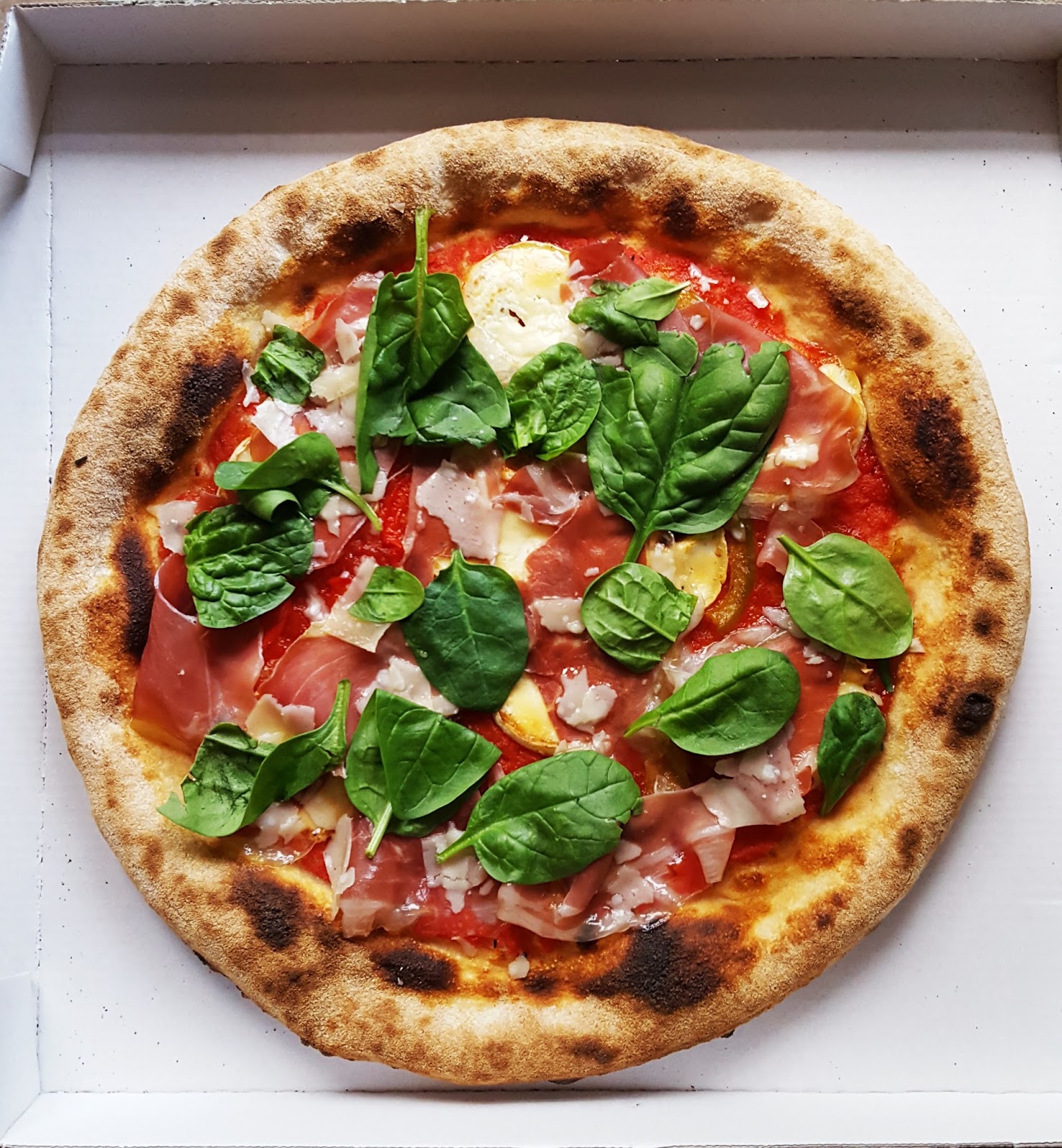
On to dinner - outside of small rural towns, eating dinner out doesn't seem to be an issue. Many restaurants open up again with hours starting roughly around 7-7:30 pm. From what I've heard though, only one meal is large. So, if you have a big fixed price lunch, dinner may be just soup. Since I'm trying to stay on the smaller side at lunch, one current favorite local place for take-out dinner is O'Napoli (when I want a change from French). I love the juice drinks with the feisty names and the unusual pizza combos - the choice below is ham, toasted chèvre, honey, baby spinach and a few other things.
More of Life in Rural France
Since I mentioned them, I went back for a close-up of the head-devouring demons on the church.
I've posted pics of housing in the towns, but this is a typical area home outside of the city center - kind of a small split-level. I think it's interesting to see how the historical styles have morphed into more recent homes.
Last, but not least, I made fire! It kept burning all evening too! Not to say that I wouldn't still need the skills of, say, a former Eagle Scout in a survival scenario, but I'd at least have the fire under control!
I'm still not convinced that a breakfast lacking in protein is the best way to start your day, but after nearly 4 weeks (and 2 weeks of eating pain au chocolat virtually every morning), I'm rarely hungry before lunch time at noon (aka "midi" in French). My pastry and coffee seem to get me through the morning just fine and I'm not groggy or dragging (other than very first thing in the morning, but that's always true as I'm a night owl by nature).
The French generally eat a croissant, pain au chocolat or simply skip breakfast in favor of espresso. And once you get used to it, I rather enjoy my light breakfast! It also leaves you plenty of room for another French classic - the fixed price lunch! When I've been out, it seems most of the French around are ordering a starter (entrée), main dish (plat) and dessert; however, I usually go with the fixed price option that is 2 of the 3. Keep in mind that these are all generally small - a quiche slice or a small tart is common for the entrée or dessert. The main dish is usually a little bigger, but still on the small side, especially compared to American meals. They certainly aren't geared towards taking leftovers with you! (BTW, taking leftovers is a serious no-no in France) Lunch is almost exclusively available between 12 and 2 pm. Eating outside the set times can be a challenge here!
On to dinner - outside of small rural towns, eating dinner out doesn't seem to be an issue. Many restaurants open up again with hours starting roughly around 7-7:30 pm. From what I've heard though, only one meal is large. So, if you have a big fixed price lunch, dinner may be just soup. Since I'm trying to stay on the smaller side at lunch, one current favorite local place for take-out dinner is O'Napoli (when I want a change from French). I love the juice drinks with the feisty names and the unusual pizza combos - the choice below is ham, toasted chèvre, honey, baby spinach and a few other things.
More of Life in Rural France
Since I mentioned them, I went back for a close-up of the head-devouring demons on the church.
I've posted pics of housing in the towns, but this is a typical area home outside of the city center - kind of a small split-level. I think it's interesting to see how the historical styles have morphed into more recent homes.
Last, but not least, I made fire! It kept burning all evening too! Not to say that I wouldn't still need the skills of, say, a former Eagle Scout in a survival scenario, but I'd at least have the fire under control!
Wednesday, April 6, 2016
For Yellow Fields of Rapeseed . . . and Wind Turbines
Doesn't quite have the same ring as amber fields of grain, does it? As I drive around here, there is field upon field of endless yellow flowers here though, which is commonly referred to just as "rape;" however, saying the area is a high producer of rape just doesn't sound right, so rapeseed it is! Wind turbines are also everywhere and not just rural areas in Europe either - I saw a huge tall one towering above industrial buildings that shot up out of a business parking lot! Once you're outside the town center though, this is it! The lovely flatness you see here is the reason it is generally safe to fly along at 90 KPH (56 MPH) on roads that are often basically one-way roads - you can see oncoming traffic for quite some distance.
I had lunch on my own this Monday (I usually eat with the other American here), so I ate quickly and popped over to the small church in town - listed on historical records as early as 1118! I keep thinking that the cathedrals will eventually all look the same (at least within category - Gothic, Romanesque, etc), but if you don't cram too many of them in at a time, they all have their own unique appeal. The local church apparently falls into the category of Poitevin Romanesque and was painted as it currently appears in 1865. From the outside, it kind of just looks, well, old. I should have taken a close-up picture of the doorway though! You can see that it is carved, as well as the carvings remaining on the right upper section. Part of the church collapsed at one point and had to be rebuilt stone by stone.
While the exterior isn't necessarily anything special (in a country full of really, really old buildings), the interior was completely empty, extremely peaceful . . . and so brightly painted! Hard to believe so much of it is still intact from 1865! While there are obviously damaged sections, I'm kind of glad they haven't tried to "fix" them as restoration work on ancient structures can be very hit-or-miss!
And last for photos, I will leave you with this lovely and very LARGE spider than was hanging out in my shower! This is apparently the spider time of year in the area, so I've had many, many spider visitors; however, this one was by FAR the largest. Actually, it is the largest spider I've ever seen inside any home that I've ever been in. It was hard to get a photo that showed it's true size, but that is the CORNER OF THE SHOWER that it is hanging out in.
Life in France
So, on to life in France or, more accurately, "things I miss about the US." One thing that never bothered me on vacations, but is starting to hit the "miss list" is the lack of bathtubs here. Apparently, taking a bath is just not a thing - you shower. And you shower in something roughly the size of a telephone booth, which makes shaving really, REALLY fun. I'm beginning to understand part of why French women appear to stick with waxing. On the upside, the shower heads are detachable - I've decided my future dream home will have a soaking bathtub AND a detachable shower head!
Other than the bathing arrangements, one of the main things that is different about day-to-day life here is the lack of certain appliances we take for granted in the US. Most apartment complexes that are "nicer" have banned the unsightly idea of drying clothes outside, but here, it is not optional. Many of the homes were built before laundry rooms were a "thing" it would seem, so your clothes washer is under the counter in the kitchen (where the US would have a DISHwasher) and there simply is no clothing dryer. I found an inexpensive clothes rack and I dry my clothes over the new electrical heater at the moment, given the weather hasn't exactly cooperated with outdoor drying . . . however, I have begun to wonder if they simply don't wash bedding all winter? I can't even properly dry my clothes and more than one towel at a time, let alone a sheet and duvet cover!
So, getting back to the lack of a dishwasher, my evenings go something along the lines of get home late, cook dinner (if I have no leftovers), then HAND WASH dishes. The upside of this being you don't need to own many dishes since you don't need to fill a dishwasher. Nothing ever has time to really get stuck on either. The downside being the part where washing dishes by hand is a chore I have loathed for all of time and I have refused to live in any apartment/condo/house that lacked a dishwasher since I was 23.
At least once a week, I have to do a small load of laundry (did I mention the washers are smaller?) and then hang it on the rack to dry and on Wednesday nights, it's time to prep the uniform black trash bags to throw out on the side of the street Thursday morning for pick-up. We also have a specified uniform clear bag for recyclables . . . which admittedly makes my little Portland heart happy! I was struggling with the whole "throw everything out" concept before my co-worker showed me the clear bags. Oh, don't forget glass though! No curbside recycling for that - you have to walk it down to the local glass bin. Lucky for me, mine is just at the end of the street and in a lovely park!
Granted, most of life in the French countryside is pretty idyllic. Excellent reasonably-priced food, fantastic cheap wine (if that's your thing), easy walking distance to town, excellent fresh bakeries on virtually every corner, really nice people, amazing driving rules, picturesque historic sites in every tiny village you come across . . . however, if I ever planned to live here for longer than 3 months, I would be on an awfully long (and mandatory) search for a home with a bathtub, clothes dryer (or space for one) and dishwasher. The dishwasher could *maybe* be optional as, weirdly, washing my dishes right away and having them actually be really clean (my current dishwasher at home is a bit dicey on this) has been strangely pleasant. The bathtub and clothes dryer are non-negotiable though!
I admit that I will miss the lovely towel warmer that's on the wall behind my towel rack though! I'm told they're used as a source of heat for bathrooms (metal warmed coils), but mine is directly behind the towel rack and results in lovely warm towels! I've also taken to using it to dry things that don't dry quickly enough on the rack. :-/
I had lunch on my own this Monday (I usually eat with the other American here), so I ate quickly and popped over to the small church in town - listed on historical records as early as 1118! I keep thinking that the cathedrals will eventually all look the same (at least within category - Gothic, Romanesque, etc), but if you don't cram too many of them in at a time, they all have their own unique appeal. The local church apparently falls into the category of Poitevin Romanesque and was painted as it currently appears in 1865. From the outside, it kind of just looks, well, old. I should have taken a close-up picture of the doorway though! You can see that it is carved, as well as the carvings remaining on the right upper section. Part of the church collapsed at one point and had to be rebuilt stone by stone.
While the exterior isn't necessarily anything special (in a country full of really, really old buildings), the interior was completely empty, extremely peaceful . . . and so brightly painted! Hard to believe so much of it is still intact from 1865! While there are obviously damaged sections, I'm kind of glad they haven't tried to "fix" them as restoration work on ancient structures can be very hit-or-miss!
And last for photos, I will leave you with this lovely and very LARGE spider than was hanging out in my shower! This is apparently the spider time of year in the area, so I've had many, many spider visitors; however, this one was by FAR the largest. Actually, it is the largest spider I've ever seen inside any home that I've ever been in. It was hard to get a photo that showed it's true size, but that is the CORNER OF THE SHOWER that it is hanging out in.
Life in France
So, on to life in France or, more accurately, "things I miss about the US." One thing that never bothered me on vacations, but is starting to hit the "miss list" is the lack of bathtubs here. Apparently, taking a bath is just not a thing - you shower. And you shower in something roughly the size of a telephone booth, which makes shaving really, REALLY fun. I'm beginning to understand part of why French women appear to stick with waxing. On the upside, the shower heads are detachable - I've decided my future dream home will have a soaking bathtub AND a detachable shower head!
Other than the bathing arrangements, one of the main things that is different about day-to-day life here is the lack of certain appliances we take for granted in the US. Most apartment complexes that are "nicer" have banned the unsightly idea of drying clothes outside, but here, it is not optional. Many of the homes were built before laundry rooms were a "thing" it would seem, so your clothes washer is under the counter in the kitchen (where the US would have a DISHwasher) and there simply is no clothing dryer. I found an inexpensive clothes rack and I dry my clothes over the new electrical heater at the moment, given the weather hasn't exactly cooperated with outdoor drying . . . however, I have begun to wonder if they simply don't wash bedding all winter? I can't even properly dry my clothes and more than one towel at a time, let alone a sheet and duvet cover!
So, getting back to the lack of a dishwasher, my evenings go something along the lines of get home late, cook dinner (if I have no leftovers), then HAND WASH dishes. The upside of this being you don't need to own many dishes since you don't need to fill a dishwasher. Nothing ever has time to really get stuck on either. The downside being the part where washing dishes by hand is a chore I have loathed for all of time and I have refused to live in any apartment/condo/house that lacked a dishwasher since I was 23.
At least once a week, I have to do a small load of laundry (did I mention the washers are smaller?) and then hang it on the rack to dry and on Wednesday nights, it's time to prep the uniform black trash bags to throw out on the side of the street Thursday morning for pick-up. We also have a specified uniform clear bag for recyclables . . . which admittedly makes my little Portland heart happy! I was struggling with the whole "throw everything out" concept before my co-worker showed me the clear bags. Oh, don't forget glass though! No curbside recycling for that - you have to walk it down to the local glass bin. Lucky for me, mine is just at the end of the street and in a lovely park!
Granted, most of life in the French countryside is pretty idyllic. Excellent reasonably-priced food, fantastic cheap wine (if that's your thing), easy walking distance to town, excellent fresh bakeries on virtually every corner, really nice people, amazing driving rules, picturesque historic sites in every tiny village you come across . . . however, if I ever planned to live here for longer than 3 months, I would be on an awfully long (and mandatory) search for a home with a bathtub, clothes dryer (or space for one) and dishwasher. The dishwasher could *maybe* be optional as, weirdly, washing my dishes right away and having them actually be really clean (my current dishwasher at home is a bit dicey on this) has been strangely pleasant. The bathtub and clothes dryer are non-negotiable though!
I admit that I will miss the lovely towel warmer that's on the wall behind my towel rack though! I'm told they're used as a source of heat for bathrooms (metal warmed coils), but mine is directly behind the towel rack and results in lovely warm towels! I've also taken to using it to dry things that don't dry quickly enough on the rack. :-/
Saturday, April 2, 2016
My Day in Cognac! And a Near Miss with a Deer.
I woke up rather late after a late call back to the States the night before, so I wasn't planning to wander too far from "home." Plus, my adventure into Poitiers involved a very near miss with a deer (like swerved into the other lane and still barely missed it). I did realize that I have no idea what to do if something like a deer collision were to happen in the middle of the night here. It also made me determined to figure out if the main N10 highway runs closer to town! I don't mind doing 90 KPH on crazy country back roads during the day, but I think I'm done with it at night because, well, deer collision.
After looking out at the grey and dreariness going on (and the river getting awfully high on it's banks (overflows are open), I decided that I should check my list of weekend ideas against the weather.
I've discovered that I'm somewhat ideally located. A little over an hour SW is Cognac, 2 hours SW is Bordeaux, 2-3 hours N are the Chateaus of the Loire Valley and less than 2 hours W is La Rochelle on the Atlantic Coast. Winning by virtue of being closest (about an hour), and with nice weather projected, was Cognac. As I was driving along the aptly named "Route de Cognac," my GPS tells me to take a left . . . which I did, somewhat dubiously. For the third time, I found myself routed onto a tiny one lane road (two directions of traffic though) meandering through the countryside. On the upside, I saw some of the actual Cognac vineyards!
I freely admit that I know virtually nothing about Cognac, so I thought I'd head to the little Musée des Arts du Cognac after reading online that it is a great introduction to Cognac. When I first started through the museum, I was afraid that my lack of general interest/knowledge about alcohol was going to make it a miss for me. I did think this Cognac bottle from 1850 was pretty interesting though! There was a whole series of bottles showing the evolution of different styles, brands and labels. The ancient equipment on display was interesting too, but at this point I was pretty happy it only cost 4 Euro!
The exhibit then had videos (with a free English translation on an audio guide) and the one area started talking about how Cognac is made - how the acidity of the type of grapes and alcohol volume make it perfect for distilling, how the Dutch were the ones who really pushed the market for distilled wine, etc. Then, it explained how a Cognac has to be grown in a specific region (with even differences in the region creating more of a lavender flavor in Cognacs from the Borderies, but more white peach in the Champagnes and Fine Bois areas (see map below). This type of information seemed much more interesting - what it is that uniquely makes a "Cognac."
Then, it was time to go down an old flight of stairs (love how they reuse old buildings as museums in Europe!) and see the display of how Cognac is advertised differently by region. Lots of Western symbols and red used in Asia, the knowledge of how Cognac is made sells itself in Europe (with simple designs) and young Cognacs in flashy bottles for America, where we don't properly drink Cognac as a digestif straight, but instead put it in mixed drinks.


After checking out a display about the paper advertising for Cognac through history (with impressive examples) and an area about how making glass bottles has transformed over the history of Cognac, it was time to wander around the city. I hadn't realized that Cognac tastings are not like wine tastings in Oregon and you generally need to book your tour in advance! I found one place that had a final tour that was still being offered, but the remaining tour was only in French. I thought I could make better use of my time by seeing what the city had to offer and sampling some Cognac at dinner. Given the stuff is made near here, it isn't hard to find!
One of the great things about these little European towns is that you can find something to photograph virtually anywhere. A school building, an old church packed so tightly into a narrow city street that you can only photograph a narrow slice of the front (capturing the stunning window), random homes in Cognac that look like they belong in a Bavarian village and old castles that are owned by the Cognac families for tasting rooms & tours.
Further exploration of the city led me to Cognac's Hôtel de Ville, which contrary to what it sounds like is NOT a hotel. The Hôtel de Ville is typically the town administration building. In Cognac, it is surrounded by a lovely public garden area with a fountain. Similar to what I discovered about where the locals go in Marseille, Cognac felt like a ghost town until I reached two areas - the Hôtel de Ville gardens and a pedestrian street closed to cars and lined with shops, where it appears the whole town was shopping and dining in cafes on a late Saturday afternoon.
I wrapped up my time in Cognac by taking a walk through this lovely remnant of an old city wall? Hard to say, but it is common to see portions of ancient structures that are still incorporated into the design of the city (walls, aqueducts, etc). Through the gates was a lovely river walk along the Charente River.
Having not eaten since breakfast, I decided it was time to head back and stop in at a restaurant recommended by the owners of the cottage. It was 30 min away in the direction of Cognac, so a great location to pair with my trip! On my way there, I suddenly saw what appeared to be the turrets of a castle on the horizon. As I drove past it and over the river, I had to stop and take a photo . . . not as castle-like, but this view just perfectly summed up a drive through rural France - tiny roads in the middle of nowhere, when suddenly you come upon a city and something like this is just hanging out there:
The restaurant was worth the recommendation! I decided that, since I'm eating most dinners in and typically a sandwich meal at lunch, that once a weekend I would have a nice meal out. Auberge de l'Argentor served me delicious spicy chips and garlic olives with my aperitif. I haven't really been drinking since I arrived in France - one glass of sparkling wine on Friday at lunch (it's the norm here), so after my tour of Cognac, I felt like I should try the product of the region. The aperitif I had was perfect! It was then dinner hour, so I ordered my entrée of hot chèvre salad and waited to see what EXACTLY would show up.
First, a tiny little starter came out that was some type of veggie drink (very tasty) and a caramelized veggie (aka legume) crostini. Then, the entrée (in French, an appetizer) came. It was incredibly good, although I had no idea what some of it was. The patties under the chèvre seemed almost like a fried chickpea patty? Something along those lines. My plat (main dish) came shortly after the entrée was complete. The photo makes the steak look smaller than it seemed (actually, I couldn't finish the fries because I was so full) and the carrot quiche slice was quite tasty. The sauce is a peppercorn sauce that is quite common in this region as well. Very nice presentation and the food was the best I've had in France. I keep thinking that I've had *really* good food here, then I find somewhere even better. No wonder France is known for their food!
After looking out at the grey and dreariness going on (and the river getting awfully high on it's banks (overflows are open), I decided that I should check my list of weekend ideas against the weather.
I've discovered that I'm somewhat ideally located. A little over an hour SW is Cognac, 2 hours SW is Bordeaux, 2-3 hours N are the Chateaus of the Loire Valley and less than 2 hours W is La Rochelle on the Atlantic Coast. Winning by virtue of being closest (about an hour), and with nice weather projected, was Cognac. As I was driving along the aptly named "Route de Cognac," my GPS tells me to take a left . . . which I did, somewhat dubiously. For the third time, I found myself routed onto a tiny one lane road (two directions of traffic though) meandering through the countryside. On the upside, I saw some of the actual Cognac vineyards!
I freely admit that I know virtually nothing about Cognac, so I thought I'd head to the little Musée des Arts du Cognac after reading online that it is a great introduction to Cognac. When I first started through the museum, I was afraid that my lack of general interest/knowledge about alcohol was going to make it a miss for me. I did think this Cognac bottle from 1850 was pretty interesting though! There was a whole series of bottles showing the evolution of different styles, brands and labels. The ancient equipment on display was interesting too, but at this point I was pretty happy it only cost 4 Euro!
The exhibit then had videos (with a free English translation on an audio guide) and the one area started talking about how Cognac is made - how the acidity of the type of grapes and alcohol volume make it perfect for distilling, how the Dutch were the ones who really pushed the market for distilled wine, etc. Then, it explained how a Cognac has to be grown in a specific region (with even differences in the region creating more of a lavender flavor in Cognacs from the Borderies, but more white peach in the Champagnes and Fine Bois areas (see map below). This type of information seemed much more interesting - what it is that uniquely makes a "Cognac."
Then, it was time to go down an old flight of stairs (love how they reuse old buildings as museums in Europe!) and see the display of how Cognac is advertised differently by region. Lots of Western symbols and red used in Asia, the knowledge of how Cognac is made sells itself in Europe (with simple designs) and young Cognacs in flashy bottles for America, where we don't properly drink Cognac as a digestif straight, but instead put it in mixed drinks.


After checking out a display about the paper advertising for Cognac through history (with impressive examples) and an area about how making glass bottles has transformed over the history of Cognac, it was time to wander around the city. I hadn't realized that Cognac tastings are not like wine tastings in Oregon and you generally need to book your tour in advance! I found one place that had a final tour that was still being offered, but the remaining tour was only in French. I thought I could make better use of my time by seeing what the city had to offer and sampling some Cognac at dinner. Given the stuff is made near here, it isn't hard to find!
One of the great things about these little European towns is that you can find something to photograph virtually anywhere. A school building, an old church packed so tightly into a narrow city street that you can only photograph a narrow slice of the front (capturing the stunning window), random homes in Cognac that look like they belong in a Bavarian village and old castles that are owned by the Cognac families for tasting rooms & tours.
Further exploration of the city led me to Cognac's Hôtel de Ville, which contrary to what it sounds like is NOT a hotel. The Hôtel de Ville is typically the town administration building. In Cognac, it is surrounded by a lovely public garden area with a fountain. Similar to what I discovered about where the locals go in Marseille, Cognac felt like a ghost town until I reached two areas - the Hôtel de Ville gardens and a pedestrian street closed to cars and lined with shops, where it appears the whole town was shopping and dining in cafes on a late Saturday afternoon.
I wrapped up my time in Cognac by taking a walk through this lovely remnant of an old city wall? Hard to say, but it is common to see portions of ancient structures that are still incorporated into the design of the city (walls, aqueducts, etc). Through the gates was a lovely river walk along the Charente River.
Having not eaten since breakfast, I decided it was time to head back and stop in at a restaurant recommended by the owners of the cottage. It was 30 min away in the direction of Cognac, so a great location to pair with my trip! On my way there, I suddenly saw what appeared to be the turrets of a castle on the horizon. As I drove past it and over the river, I had to stop and take a photo . . . not as castle-like, but this view just perfectly summed up a drive through rural France - tiny roads in the middle of nowhere, when suddenly you come upon a city and something like this is just hanging out there:
The restaurant was worth the recommendation! I decided that, since I'm eating most dinners in and typically a sandwich meal at lunch, that once a weekend I would have a nice meal out. Auberge de l'Argentor served me delicious spicy chips and garlic olives with my aperitif. I haven't really been drinking since I arrived in France - one glass of sparkling wine on Friday at lunch (it's the norm here), so after my tour of Cognac, I felt like I should try the product of the region. The aperitif I had was perfect! It was then dinner hour, so I ordered my entrée of hot chèvre salad and waited to see what EXACTLY would show up.
First, a tiny little starter came out that was some type of veggie drink (very tasty) and a caramelized veggie (aka legume) crostini. Then, the entrée (in French, an appetizer) came. It was incredibly good, although I had no idea what some of it was. The patties under the chèvre seemed almost like a fried chickpea patty? Something along those lines. My plat (main dish) came shortly after the entrée was complete. The photo makes the steak look smaller than it seemed (actually, I couldn't finish the fries because I was so full) and the carrot quiche slice was quite tasty. The sauce is a peppercorn sauce that is quite common in this region as well. Very nice presentation and the food was the best I've had in France. I keep thinking that I've had *really* good food here, then I find somewhere even better. No wonder France is known for their food!
Subscribe to:
Posts (Atom)