Local Munich Transportation Tip: if you take the local train, you can buy two XXL tickets for 4.50 or a day pass for 8.60 - I'd recommend the day pass!
Best Hotel of My Trip
On my way from Berlin to Stuttgart, I decided to stop off for a day in Dachau. It was less expensive to stay in Munich (aka München in German) and buy a local day pass for the round trip to Dachau and I'd recommend doing the same to others. While I don't normally get into my hotels much outside reviews, this hotel deserves special mention! The rooms all had unusual names - mine was called "fear" online, but "angst" at the hotel. I arrived late and called for the key code, then let myself into a dark hall. When I found the light button for the stairwell, I was confronted with a black hall festooned with creepy old religious icons stuck to the walls. I had a moment of hesitation wondering if I should leave as quickly as possible, but the second floor switched to black and white photos. I was a little concerned about my room decor at this point!

I was pleasantly surprised when the room was bright and cheerful - I didn't even realize the wall painting was a knife-wielding plant trying to eat me until I turned the lights off and noticed it glowed in the dark.
Best room I've had my whole trip though! It was clean, everything was comfortable and and I liked that the color theme continued through the bathroom even. I completely recommend the Hotel Achterbahn if you're in Munich.
Dachau
You can wander around Dachau with a map for free, pay 3.50 Euro for an hour audio guide or 3.00 Euro for a 2.5 hour guided tour. I'd suggest coming early as it was already crowded at the 11 AM tour and, by 2 PM, it was positively crawling with groups of teenagers.
While at first I found it encouraging that German teens are taught this part of their history, the number of them laughing and goofing off casts serious doubt on whether they really absorbed the gravity of what they were seeing.
I went with the English guided tour and it was quite good. While I'd thought the 2.5 hour tour would cover everything, it really went in depth on a few key parts of the history, but I don't think I allowed enough time for everything because I ran out of time to read more about the conditions there and to view the different displays in more detail. The original main entry is gone, but the inside entry remains. The gate reads, "Arbeit Macht Frei" or "work makes you free," but the prisoners knew it was untrue. It was actually Nazi propaganda used to support their news reports that the camp had been opened for the re-education of terrorists, criminals and troublemakers. In reality, Dachau was the only camp open all 12 years of the war and all the original prisoners were German political opponents.


When you first enter, you can see 2 barracks; however, our guide told us they were reconstructions because the originals were used for refugees after the war, so they had been improved and changed so they could house families. The survivors thought having replicas more accurate to wartime conditions was better.
This is another propaganda photo. The healthiest prisoners were used and they were all fully shaved and shot from above to make them appear more criminal.
Contrary to what I'd thought, Dachau was not an extermination camp. Germany largely built those in Eastern Europe and kept the real "dirty work" out of their own backyard. While you can see many types of camps in Germany, the triangles for death camps are to the East.

Not sure when this was written, but it reads, "smoking forbidden"
In the early years, people were sometimes released from the camps. The man who painted this was one of them and was lucky enough to get a visa to immigrate to China after. The painting shows what the conditions were really like. It's difficult to see at the top, but he painted the eye of God . . . closed.
When you enter the bunker area of cells, the guide pointed out that some had a radiator or a toilet and others didn't, so if you were being punished here, it was up to the SS whether you had a "good" cell or not. This was also done to encourage a lack of unity amongst the prisoners by giving some benefits that others didn't have.
Photos of the grounds:
These gravel beds each show where a barrack stood when the Nazis were running the camp:
Only one man escaped from within Dachau. This photo shows the difficulty - if you even stepped on the grass, you were shot at. If you made it over the grass, you had to get into the ditch and back out, then over the electrified barb wire fence.
A plaque on the wall of the crematorium from 1955 talking about the liberation of the camp:
The gas chambers also did not start with the Jews. Starting in 1939, they were originally used for the "euthanasia" of those who were physically or mentally ill and unable to work. The propaganda suggested this was the humane thing to do for these "poor people." The gas chamber at Dachau is believed to have only been used once (about 70 people killed for an experiment) as the Germans realized they had a free labor force in the imprisoned Germans and many were dying due to the poor conditions anyway. Here, as in other places, the gas chamber was designed to look like showers.
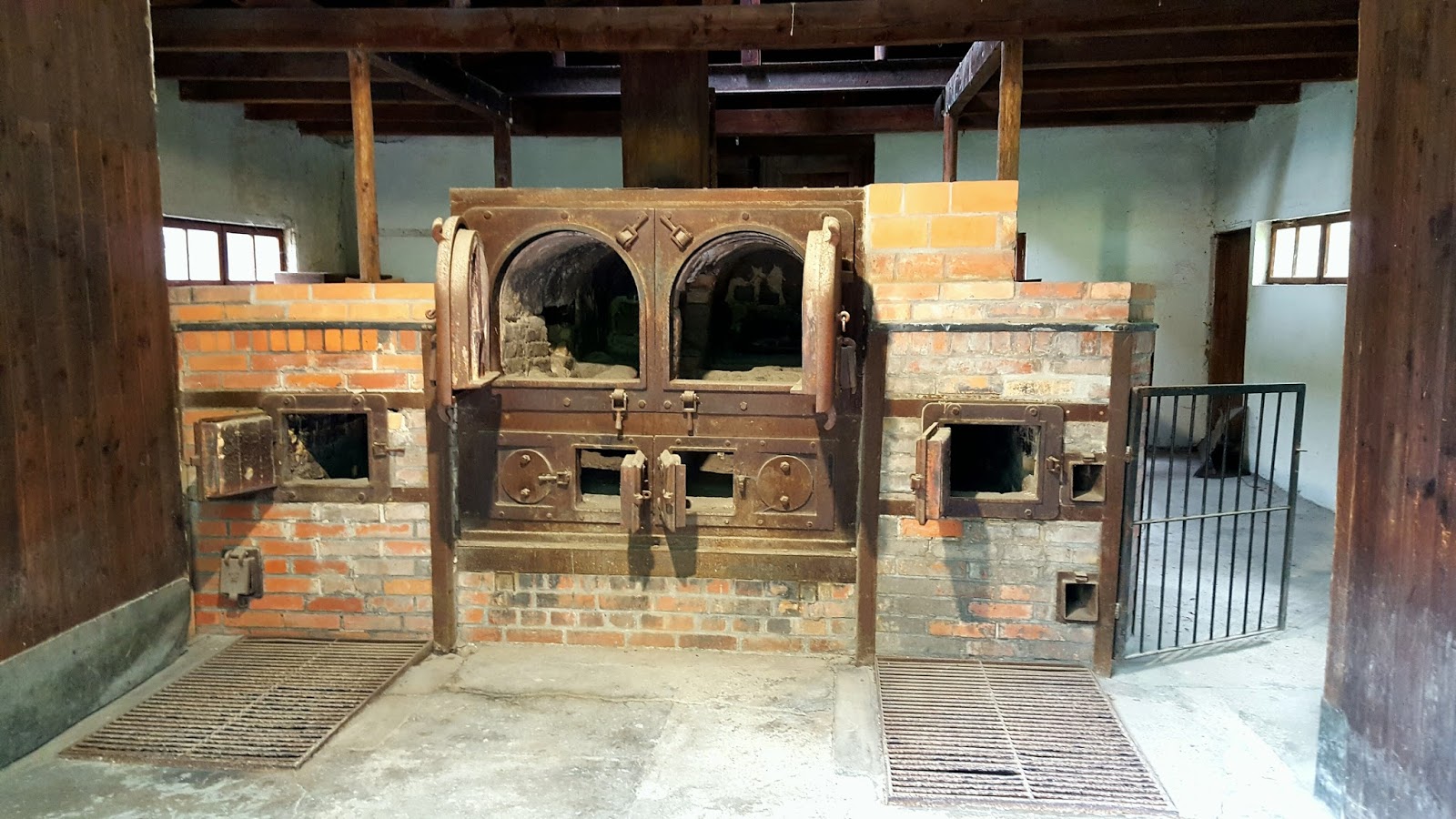
By 1940, the original crematorium was too small and a larger one was built. Cremation was not common then, but the Nazis had been questioned once about the very poor condition of bodies returned to families, so they stopped returning them at all.
There's an International memorial here and the anniversary of the liberation was recent, so the flowers were still present. Dachau was made a memorial as a reminder that humanity is capable of this. Hitler rose to power by promising to return Germany to greatness and his Antisemitism was originally not as popular as he'd hoped. It was only after a Jewish boy walked into an embassy and killed someone that Hitler was able to turn Jews into the common enemy for Germany to rally around. It's also important to note that the other popular parties, due to the economic conditions, were Socialist and Communist, leading some business men to give Hitler funds and support, even though he eventually jailed at least one of them.


An interesting thing to note about the below part of the memorial is that it excludes the pink (homosexual), green (career criminal) & black (gypsy/prostitute/other undesirable) triangles. These groups were also excluded from reparations after the war as they were judged as criminals who likely would have been in prison anyway. This happened despite the fact that nobody in Dachau had a trial nor proof they were guilty of what they were accused of (it is believed that many weren't), but also shows that prejudice and judgment of whole groups continued even after the war ended.
In the reconstructed barracks, the three styles of beds show how the beds started, with more space, and how they ended, due to overcrowding, when over 500 men were in a space intended for 54.
It's hard to fathom the sheer number of people who were imprisoned and died here. It had a different emotional impact on me than seeing Oradour-Sur-Glane did, but the actual footage of what the American soldiers found here was horrifying. It's certainly worth a visit, if only to see how large it was and to grasp that this was far from the largest or worst of the camps.
Given today was my last day in Berlin, I planned to take it easy with a stroll through the huge Tiergarten. Imagine my surprise to stumble upon a large protest starting at Brandenburger Tor! It then continued along the road I wanted to head up, so I took a side path before circling back to snap a quick photo. I'd read that protests on Saturday had turned violent, so I didn't plan to hang around!
Only a short distance away, there was such peace and tranquility though! The lake is called the Venusbassin. The gold statue is the Haydn-Mozart-Beethoven-Denkmal from 1904.
I decided to just sit by the lake and catch up on my thoughts about Berlin for a bit. I then wandered to the rose garden, where not a lot was blooming yet, but you can tell it will be lovely when it does!


Walking into the main street, there was an area I decided to use for photos of the statute I could see from the Tor. When I went out there, it was empty, but as I took my photo, I was adjusting for my second one with camera up to my eye when a girl and her boyfriend stood LITERALLY right in front of me, then proceeded to walk up the center. If there's one thing that flags you as not being a genuine photographer, no matter your gear, it's lacking patience to get a shot - especially when that takes the form of ruining another photographer's shot . . . and compounding it by not moving out of the way after and walking up the rest of the street in the middle. She didn't stop to take a closer shot either, just lacked the courtesy not to be in the way of others. Here's the shot I got with my phone before:
And a close-up from the other side! It's the Berliner Siegessäule, a victory statute from 1871; however, in 1939 it was reconstructed one tier taller.
One thing I'd noticed, but didn't understand the significance of, was a museum and rentals of these unattractive little old cars. Tina explained they were the cars you could get in East Berlin, but there was such a long wait that you signed your child up for one when they were born! So, here's the car you'd wait your whole life for!
At the end of the street, these gates were flanking the road - not sure what they are though?
By this time I'd walked a rather long way and was tired and a little cranky, although finally feeling mostly better. It was this fatigue that led to this picture though, which highlights how easy the system in Berlin is - so easy I had it figured out by the time I'd made it to my subway the first day, yet clearly many tourists have issues with it because I was nearly rundown by people on rental bikes who were not in the designated section. Please note: if you visit Berlin, the inner section is for WALKING, there's a little divider, then the outer reddish section is for bikes (though this is occasionally a path on the road too). To avoid appearing like an obvious and clueless tourist, please find your way into the correct section. :-D

Finally, I was off to Munich! While I really enjoyed Berlin, if I'd been crunched for time, I could have left Monday morning and not really missed much. I plan to return in 2019 when the Pergamon Museum is fully open again and the new subway line serving Museum Island is open also!
One nice thing about German trains - it appears you can ride with a pass without a seat reservation, so the seats have an indicator of whether the seat is reserved for part of the journey. In my case, this told me I had no designated seat mate for several stops!
TIP: It is hit or miss in France (mostly miss in my experience) whether your train will have electrical outlets (TGVs generally do not in 2nd class). While ICE trains in Germany have an outlet per 2 seats, my 6 hour ride to Munich lacked working outlets in our car! So, don't plan on having power, even if the train claims to have it!
The location of Rewari Hotel is good with 3 different metro stops within 5-15 minutes away that run to all different parts of the city. There's also a great discount market and several restaurants open later in the day (and for coffee in the morning).
I was surprised how loudly I could hear people in the courtyard until I saw the window had been opened for me; however, you can hear people in the hall like they're in your room. The beds are also far too firm for me - I had a sore back and neck after 4 nights here. The hotel is worn and appears to be under renovations, as I learned Monday morning at 8 am when work started again. As for the Internet, I connected to the only free one I saw and it worked fine, but it wasn't clearly indicated as the hotel WiFi. The place has potential, but the uncomfortable bed was the deal-breaker for me and I will choose somewhere else when I return to Berlin.
By my third day in Berlin, I was majorly dragging and had developed a cough on top of the cold, so I intended to see the new synagogue and museum island, which were close together. The new synagogue was stunning, but had a VERY Prussian look to it even with the big round dome, green and gold coloring and a spire out the top.
It turned out that the synagogue wasn't as close as I thought and/or I got lost because I found Bode Museum easily, but then ended up in the middle of some random neighborhood. By the time I found my way out, it was time for brunch. The wind blew some of my rice onto the table and I acquired a little friend. Hopefully cooked rice won't hurt it!
After lunch, it was a nice little walk through the columns and past the Alte (old) National Gallery to the Pergamon Museum. I've since learned that the whole museum island is a UNESCO World Heritage Site.

Sadly, the Pergamon area is closed for renovations, but that was clearly noted at the entrance - this is important to mention because, as I was sitting and admiring the lovely Ishtar Gate to Babylon, a lady got angry with the museum employee and claimed she only bought the ticket for the Pergamon Museum to see the Pergamon room and how dare they sell tickets when it's closed. The employee suggested returning to the desk to see about a refund, which is when the woman said (in heavily accented English), "shame on you people," tore her ticket in half and threw it at the poor woman! It's really appalling how you see people act sometimes. First, it's hardly that particular woman's fault the room is closed and, unlike the chateau, it was clearly signed at the desk BEFORE paying that areas were closed. So, back to the Ishtar Gate - wow! I'd seen one of the lions at the British Museum, but this was incredible!

The bricks were numbered so it was possible to reconstruct it as it stood originally, although it was in ruins when found. There was also the long processional of lions that would have lined your walk on the way to the king.
The next room also had an incredible display of a reconstructed ruin, the Market gate of Miletus. I particularly liked this intricate carving of Eros from 120-130 AD.
The rest of the museum focused on Middle Eastern art, some of which duplicated things I'd already seen. I'd highly recommend buying the museums' pass and seeing several in one day to get your money's worth. These lions were a unique item dating from 10-8 BC and were from the inner gate of the citadel at Sam'al in Turkey.
There were two prayer niches that really highlighted the clever carvings and bright colors used. It was interesting to learn that the use of cobalt originated in the Middle East prior to white and cobalt blue porcelain becoming popular from China.
The next thing I saw that really fascinated me was a full room, practically a full small house, that was purchased and displayed - interestingly enough, the details identify the original owner as a Christian. It's from the city of Aleppo in Syria dated 1600-1603.
After a couple of hours here, I headed to the Neues (new) Museum. As far as the Egyptian collection goes, if you've seen the British Museum, you can easily skip it. One of the most interesting parts about the museum is seeing what's left after the museum was heavily damaged in the war. They're slowly restoring the rooms in the best condition and combining it with modern rooms where they couldn't save enough of the old structure. These cupolas had actually been covered by a false ceiling, but they're visible again now and will be restored.
The Egyptian area is now in the basement and the most unique thing I saw there was a child mummy who was actually Roman. It appears Romans in the area adapted Egyptian customs and this family was mummified in 24 AD.
In the old Egyptian rooms, you can see that the rooms were themed in the past based on what was displayed there (and often brightly-colored).
In another room, one end had the doorway with the purple, green and painted sections mostly intact, but the rest of the room was much more damaged.
There was another area of unique items found in recent digs in Berlin. While these appear to be minerals at first glance they're actually glass beads that melted together during the fire bombing of Berlin in 1945.
While you can't take pictures of the bust of Nephertiti, you can photograph the museum's other significant holding - the gold hat. One of only 4 and the best preserved from 1,000-800 BC.
While the Pergamon Museum was "wow," I wasn't really impressed with the Neues Museum. It seems they weren't able to save items during the war and several signs indicated the Soviets looted the city, in violation of International Law, and have refused to return many of the items to this day. As a result, many of the rooms had very little in them, which is unfortunate.
Since I had the full day pass, I headed to the Alte Museum to try my luck there. I mean, the exterior is impressive, so why not?
They had a really nice collection of ancient currency, including coins from Athens stamped with the head of Athena to indicate where it was minted, which are from the 5th-4th century BC.
They also had an area showcasing some old Roman items that had been restored in later centuries, sometimes incorrectly! This is a really nice griffin . . . until you learn that they now believe it was originally a sphinx.
There were a lot of really nice sculpture pieces, like this goddess from Italy 475-450 BC. She lacks enough identifying features to determine which goddess she is.
I'll say one thing for the Altes Museum - they have a flair for the dramatic! There was a full room setup like a war scene with the gods and goddesses watching.
Another intriguing room discussed how the Romans started copying old Greek styles as their civilization declined. This is a well-preserved example from ~150 AD of Amor and Psyche.
From 1 to 6 PM, when they closed, I easily made it through all 3 museums. Since I was right by it, time for one close-up of the Berliner Dom!
I couldn't resist a quick picture of the little East Berlin crossing signal, especially with the church tower and TV tower in the background. East Berliners liked their old crossing signals, so they've brought them back and it's an easy indicator as to what part of the city you're in.
Berlin is just full of picturesque things, like this fountain with (I believe) the red city hall behind. I came upon this while simply looking for the nearest subway station (Note the crane in the background - construction everywhere).
Since my camera was dead the first time, I found time to visit the Reichstag Tor again, this time I was able to get some nice photos! It appears the Brandenburger Tor stop used to be called Unter den Linden though! I was hoping for some cool history, but the stop name was changed because a line is under construction now that will have a stop closer to the Prussian buildings on that street. The stop does have the interesting history of being an unused "ghost stop" during the period of the wall though.
I decided to listen to the audioguide this time and learned this is where some of the rapeseed oil goes - it powers the building! Here are photos from the terrace of the Reichstag:
And the dome itself . . . with people resembling a little colony of ants!
While hard to see the stars here, this is an amazing experience! Go here at night!
And one last shot of the Brandenburger Tor at full dark!